WORSHIP >> OPENING OF WORSHIP
SDAH 63
O come, let us sing to the Lord,
Come let us every one
A joyful noise make to the Rock
Of our salvation.
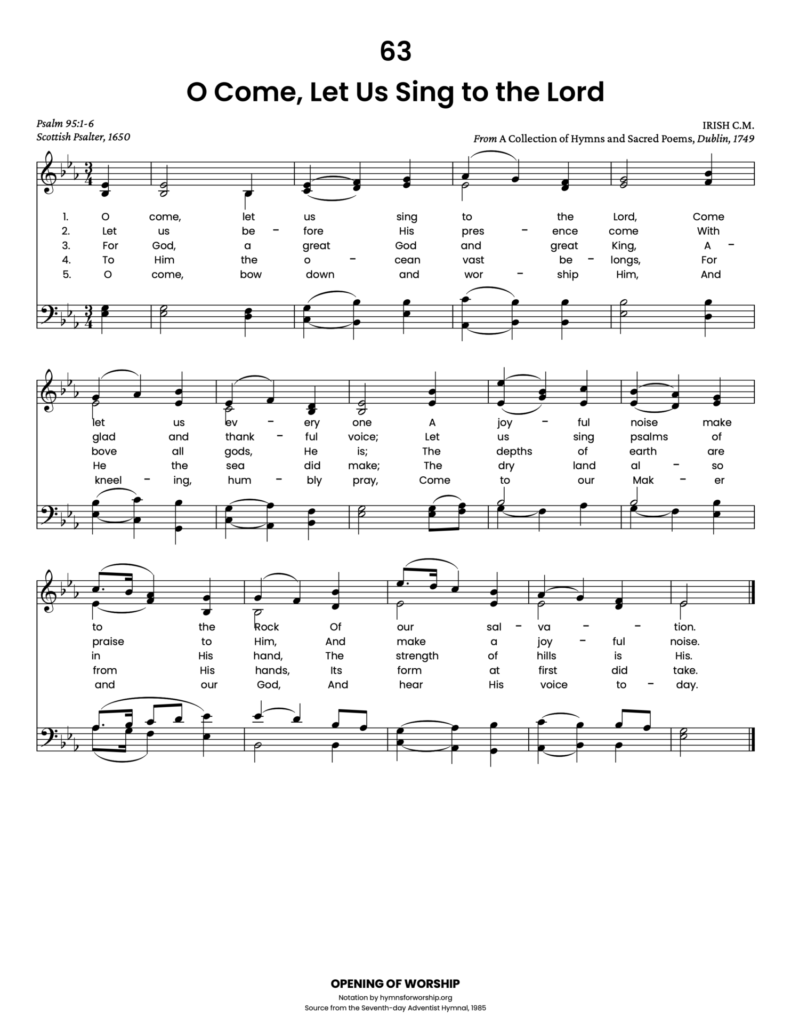
Get the hymn sheet in other keys here
For Worship Leaders
Make each hymn more meaningful with these helpful tools: Short, ready-to-use hymn introductions for church bulletins, multiple ways to introduce a hymn based on your worship theme and in-depth history and insights to enrich your song service.
Hymn Spotlight: O Come, Let Us Sing to the Lord
This stirring hymn is a metrical version of Psalm 95:1–7, calling worshipers to lift their voices in joyful praise. Rooted in the Scottish Psalter tradition, it reflects the long-standing practice of singing the Psalms in structured, poetic form (see also SDAH 16 and 62).
The tune IRISH has a fascinating history. First published unnamed in S. Powell’s Collection of Hymns and Sacred Poems(Dublin, 1749), it was later called IRISH TUNE by Caleb Ashworth around 1760. It even found its way into Jacobite Relics of Scotland (1819), where it was paired with the political song The Cameronian Cat. By 1793, it appeared in a Scottish hymnbook, marking its transition into church music.
Whether originally a folk tune or a hymn melody, IRISH has stood the test of time, becoming closely associated with Isaac Watts’ O God, Our Help in Ages Past in Ireland. Today, it continues to inspire believers to sing with joy and reverence before their Maker.
📖 Reference: Feel free to share but please cite hymnsforworship.org when reproducing.
Introductions for Sabbath School Song Service (based on specific lesson quarterlies):
This hymn is a metrical version (see SDAH 160 of the first seven verses of Psalm 95. For comments on the Scottish Psalter, see SDAH 16 and 62.
In S. Powell’s Collection of Hymns and Sacred Poems, Dublin, 1749, the tune IRISH was published with some other tunes at the end of the book and was unnamed. Caleb Ashworth named it IRISH TUNE in his Collection of Hymns and Sacred Poems, c. 1760.Curiously, in the book Jacobite Relics of Scotland, 1819, it is given as the melody for a little political song, “The Cameronian Cat.” It was not used as a hymn until it surfaced in a Scottish hymnbook in 1793. It was not clear whether IRISH began its life as a folk song or a hymn tune. In Ireland it has long been used with Watts’s “O God, Our Help in Ages Past.”
Stanza:
Psalm 95:1-6

Text
1
O come, let us sing to the Lord,
Come let us every one
A joyful noise make to the Rock
Of our salvation.
2
Let us before His presence come
With glad and thankful voice;
Let us sing psalms of praise to Him,
And make a joyful noise.
3
For God, a great God and great King,
Above all gods, He is;
The depths of earth are in His hand,
The strength of hills is His.
4
To Him the ocean vast belongs,
For He the sea did make;
The dry land also from His hands,
Its form at first did take.
5
O come, bow down and worship Him,
And kneeling, humbly pray,
Come to our Maker and our God,
And hear His voice today.

Hymn Info
Biblical Reference
Ps 95:1-6
Text Source
Scottish Psalter
Year Published
1650
Hymn Tune
IRISH
Metrical Number
C.M.
Tune Source
from A Collection of Hymns and Sacred Poems, Dublin / 1749
Theme
OPENING OF WORHIP