In the previous episode, we learned more about Annie Smith, a young woman who used her literary talents for God. She is one of the pioneers rarely mentioned, but she made a tremendous impact by being the copy editor of the Advent Review. This journal played a key role in nurturing believers in their newfound faith, as they navigated their way after the Great Disappointment in 1844. Light was being shed and poured upon them, and the publication was one of the main tools to promulgate these new and significant truths. Annie stood at the helm of this publishing work—quiet but consistent—a significant and indispensable part of the team.
In this episode, we will talk about one of the three hymns she wrote: “How Far From Home?”
In James Nix’s book, Early Advent Singing: A Collection of 52 Early Adventist Hymns with Illustrating Stories, he wrote, “Though not the first hymn writer among the early Sabbathkeepers, Annie Smith was one of the first, and certainly the most prolific.”
“How Far From Home” was certainly not Annie’s first hymn. But one thing to note about this hymn is that when it was submitted to the Advent Review, she added a note that it was to be sung to the tune of “’Tis Midnight Hour,” a well-known parlor song.
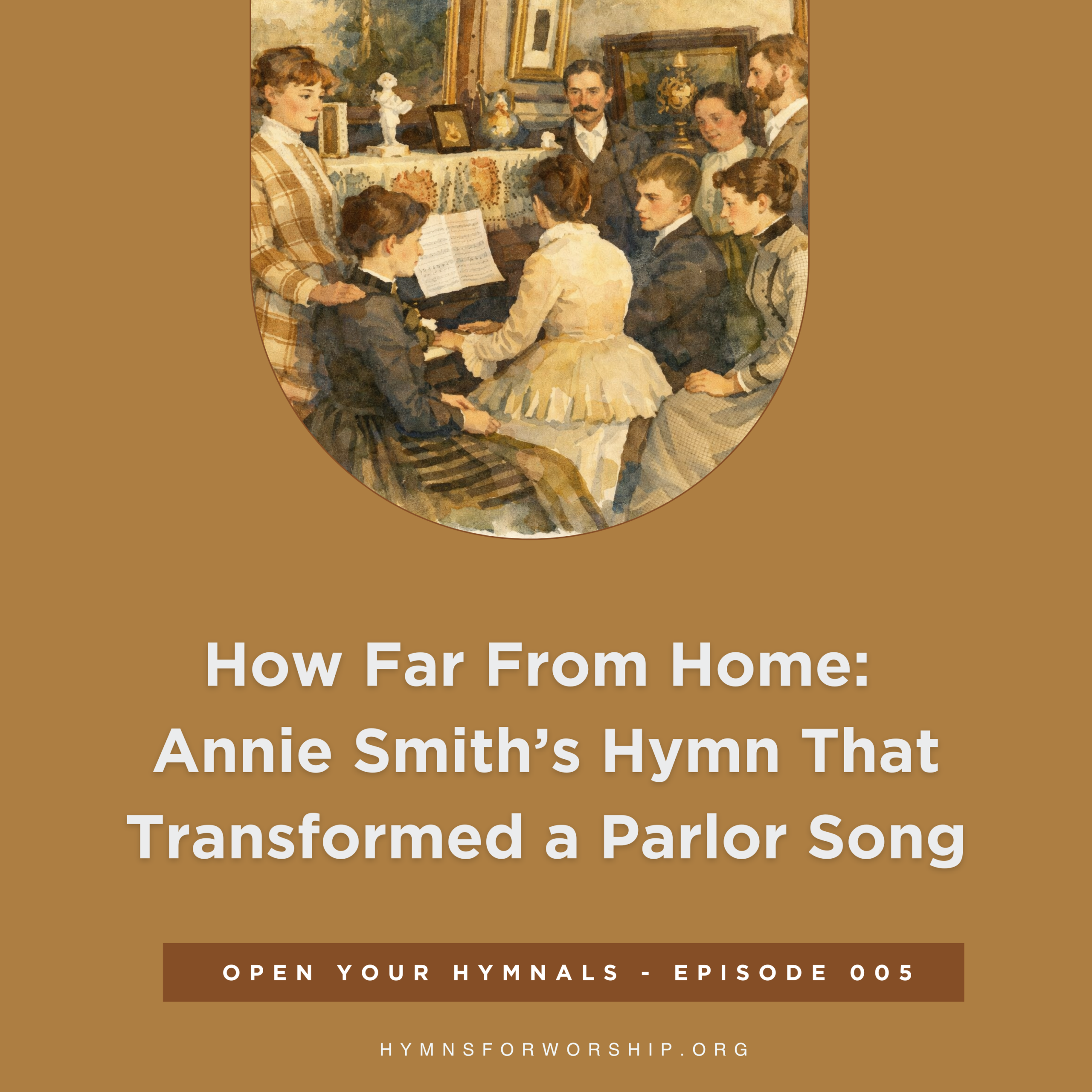
A parlor song is a type of popular song which, as the name suggests, is intended to be performed in the parlors of houses, usually by amateur singers and pianists.
Taking a closer look, the original song “’Tis Midnight Hour” is full of sentimentality. It’s basically a romantic midnight serenade—pure 1800s “soft-boy” poetry—with over-the-top feelings like tenderness, wistfulness, and yearning. The scenery is set at midnight, where everything is pictured glowing and romantic.
And so here, I see Annie Smith wanting to use the advantage of a popular melody and putting words to it that have more importance and depth.
Now just to give a general bird’s-eye view of the hymn before we look closer at the hymn text:
The premise of the whole hymn is Annie Smith asking the question: ”How far from home?” And each stanza features an answer to this question.
For stanza 1 she asks the watchman, stanza 2 she asks the warrior, stanza 3 she asks creation, but in stanza 4 she answers the question herself. This is a very deliberate structure using a writing technique called anaphora.
Anaphora is where you repeat the same word or phrase at the beginning of successive lines, sentences, or clauses to create emphasis and rhythm. Writers use it so the points they are making will stick. They also use it to build momentum, and to create expectation for the listener or reader.
So here Annie poses the question, big and bold in the opening line and of course in the title. Each stanza includes that line. And each stanza includes “I asked…” to give that feeling of familiarity. The variation comes in as each answer is different—but not so different.
Because again she uses anaphora by including the phrase “Then weep no more,” a part of the original song, by the way, mid-answer in each stanza. Most hymn writers use repetition by adding a refrain or a separate chorus in their hymn texts. But Annie—instead of doing a refrain—keeps this familiar line and turns it in a different direction every time.
- Stanza 1: Then weep no more—but speed thy flight
- Stanza 2: Then weep no more—but well endure
- Stanza 3: Then weep no more—with warning tones,
- Stanza 4: Then weep no more—since we shall meet
This is something that’s called incremental repetition, where the writer uses the same starting point, but then advances the meaning.
Now let’s take a closer look at each stanza and see how it also reflects biblical concepts.
Stanza 1
In the first stanza, she asks the watchman. The “watchman” isn’t just a random character she chose. A watchman represents a person who is spiritually aware, alert, and responsible. Prophets like Ezekiel and Isaiah frequently inquire of the watchman about important situations.
So this watchman initially answers (and I’m quoting from the hymn):
“the long, dark night is almost gone,
The morning soon will break.”
Whether Annie Smith literally asked one of the pioneers whom she considered a watchman and is quoting verbatim here, we wouldn’t know. But she writes that the watchman answers pertaining to time, indirectly quoting Romans 13:11–12 which says:
11 And that, knowing the time, that now it is high time to awake out of sleep: for now is our salvation nearer than when we believed.
12 The night is far spent, the day is at hand: let us therefore cast off the works of darkness, and let us put on the armour of light.
Also, the “morning” image fits the Second Coming hope: Jesus is the Light that ends the night (John 8:12), and Revelation pictures a world where there’s no more night (Revelation 22:5).
The watchman continues to answer in an encouraging tone:
“Then weep no more, but speed thy flight,
With Hope’s bright star, thy guiding ray,”
The line “then weep no more” can sound harsh if we read it like “stop crying.” But I don’t think that’s the spirit of it. It’s more like, “Don’t let sorrow make you stop walking.” In other words: grief can exist, but it doesn’t get to be your compass. And “Speed thy flight” is urgency—not frantic fear, but purposeful movement. And “Hope’s bright star” is that steady guiding idea: even when you can’t see the whole road, you walk by promise. That “star” image actually pairs beautifully with 2 Peter 1:19 where it says:
19 We have also a more sure word of prophecy; whereunto ye do well that ye take heed, as unto a light that shineth in a dark place, until the day dawn, and the day star arise in your hearts:
And finally the watchman concludes the stanza by saying:
“Till thou shalt reach the realms of light,
In everlasting days.”
The stanza started with a picture of a long dark night. But here, as the watchman gives his final line, he mentions “realms of light.” Two opposite metaphors talking about light. This transfer from darkness to light reminds me of Colossians 1:13 where it says:
13 Who hath delivered us from the power of darkness, and hath translated us into the kingdom of his dear Son:
And of course, Revelation 22:5, which describes this “realms of light” more succinctly:
5 And there shall be no night there; and they need no candle, neither light of the sun; for the Lord God giveth them light: and they shall reign for ever and ever.
Now musically speaking, pertaining to the hymn arrangement written by AJ Consolacion, the initial emotion that was captured was that day dawning. In fact, the tempo marking at the top of the page is written “dreamy.”
So imagine the stillness of the dark night right before the streams of sunlight hit the horizon—the day breaking quietly, still but consistent. The use of high registers, while the left hand gives a flowing arpeggio.
(Music insert)
Stanza 2
For the second stanza, Annie chooses the warrior on the field. While the watchman warns people of impending doom, the warrior is the person who, after hearing the warning, prepares himself to fight when the enemy arrives.
But who is this warrior?
I believe it is every one of us who claims to be Christians.
We are living in the middle of the Great Controversy. From the entrance of sin and the existence of human beings, life has been about engaging in this spiritual war.
Paul summarizes this in Ephesians 6:12 by saying:
12 For we wrestle not against flesh and blood, but against principalities, against powers, against the rulers of the darkness of this world, against spiritual wickedness in high places.
And so when this warrior is asked, “How far from home?” he answers:
“With courage, bold, the sword I’ll wield,
The battle is not long.”
Is this line encouraging us to be violent? I don’t think so. Since we’re talking about a spiritual war, then this sword is a symbol. As to what the sword symbolizes, we don’t have to go very far from the previous verse we read. In fact it’s just five verses away from Ephesians 6:12. Verse 17 says:
17 And take the helmet of salvation, and the sword of the Spirit, which is the word of God:
And so the warrior encourages us to read God’s Word and use that as we fight life’s daily conflicts.
And then the following line from the hymn—
“Then weep no more, but well endure
The conflict, till thy work is done;”
To endure means to keep going through something hard without giving up. And in this stanza it says to endure the conflict until your work is done.
James 1:12 encourages us when it comes to enduring difficulties. He says:
12 Blessed is the man that endureth temptation: for when he is tried, he shall receive the crown of life, which the Lord hath promised to them that love him.
Matthew writes in chapter 24 verse 13:
13 But he that shall endure unto the end, the same shall be saved.
I mean these guys, James and Matthew, know a lot about enduring to the end, and we can certainly take a page from their experience. And so the warrior quotes this and then concludes his answer with:
“For this we know, the prize is sure,
When victory is won.”
Confidence in Christ! The prize is sure; the victory is won! For the warrior fighting hard in the field, these are encouraging words.
1 Corinthians 9:24 talks about running to obtain the prize:
24 Know ye not that they which run in a race run all, but one receiveth the prize? So run, that ye may obtain.
Meaning just because victory is sure, it doesn’t mean we just rest easy, sit, relax, and wait for the prize. No. Paul says we still play our part by running in the race.
The sureness of the prize does not rely on how fast we ran or how hard we fought. The “sure” part rests on Christ:
“Thanks be to God, which giveth us the victory through our Lord Jesus Christ” (1 Corinthians 15:57).
So in the piano arrangement, the arranger builds on this idea by marking a change in tempo—a tempo movendo. The harmonies become more thick and lush, and things start to sound a bit faster or moving along. Instead of cascading arpeggios in the left hand, he uses a syncopated ostinato to signify that intensity is building. Here’s the snippet of the music I’m talking about.
(Music insert)
Stanza 3
For the third stanza, the reader might be expecting—okay, who is she going to ask this time? What character or kind of person is she going to ask? Personally for me, I was thinking she would ask a prophet or maybe a king. But this time, she addresses creation and what’s happening in the order of natural things. She may not be asking a prophet, but this stanza surely feels prophetic.
Basically, this stanza is saying that creation itself testifies that something is off—and Scripture agrees. Psalm 19 alludes to creation that can “speak” (Psalm 19:1–4). And Romans 8:22 says:
22 For we know that the whole creation groaneth and travaileth in pain together until now.
Personification is a writing technique where you give human qualities to something that isn’t human—like an object, an animal, a place, an idea, or nature—so it can feel or act like a person. Annie applies this technique by writing that this is the answer of nature:
“Time’s wasting sands are nearly run,
Eternity is nigh.”
This is giving me the “last days” vibe. And yes—Adventists are very familiar with this message of time. But we have to hold this message carefully. Because the healthy version of understanding this message is that time matters, choices matter, don’t sleepwalk through life. Speaking of sleepwalking, Romans 13:11 reminds us:
11 And that, knowing the time, that now it is high time to awake out of sleep: for now is our salvation nearer than when we believed.
James talks about the nearness of His coming as well in chapter 5 verse 8:
8 Be ye also patient; stablish your hearts: for the coming of the Lord draweth nigh.
This line is not trying to set dates, but rather, it’s trying to wake up sleepy hearts.
Back to the hymn:
“Then weep no more—with warning tones,
Portentous signs are thickening round,
The whole creation, waiting, groans,
To hear the trumpet sound.”
This is “signs of the times” language—referring to the whole chapter of Matthew 24 and Luke 21. Wars, disasters, distress, moral confusion, spiritual sleepiness—all of that. But notice: it’s not written to make us obsessed with the times; it’s written to make us awake. The signs are not to make us panic, but really, to warn us.
Luke 21:28 says:
28 And when these things begin to come to pass, then look up, and lift up your heads; for your redemption draweth nigh.
And then of course, the symbolism of the trumpet is included, in this stanza as well, and we have talked about in detail in episode 3 so make sure to refer back to that.
So this stanza is making us focus toward the literal, decisive return of Christ and the resurrection—glorious events that every Christian looks forward to at the end of time.
And so musically, you can hear excitement and urgency: 16th notes on the right hand, with the melody played by the left hand. Mid-stanza, the melody quickly shifts to the right hand played as chords. It shifts again to the left to restate the beginning of the stanza, and concludes again on the right hand with fuller four-note chords. Here’s how it sounds:
(Music insert)
Stanza 4
In the 4th stanza, Annie asks herself the question. That resonates a lot with me. We listen to sermons, we hear others expound on the Word of God, we may be blessed to be surrounded with family and friends who are talking about these things. We watch for the signs, we see the nearness of His return through the things happening around us. But here in the fourth stanza, Annie takes the time to ask herself: does she believe these things for herself?
As a Christian waiting for Christ’s soon return, do you believe these things for yourself? And I’ll ask myself too, “Do I believe these things for myself?” Or am I just caught up with the hype of it all?
After reflection, listen to how Annie answers the question:
“Not far from home! O blessed thought!
The traveler’s lonely heart to cheer;
Which oft a healing balm has brought,
And dried the mourner’s tear.”
Annie has had her share of a broken heart. Yet here, she alludes to the healing balm. In Psalm 147:3, we see God explicitly present Himself as the healer of broken hearts:
3 He healeth the broken in heart, and bindeth up their wounds.
This balm also refers to God being the source of comfort. 2 Corinthians 1:3–4 says:
3 Blessed be God, even the Father of our Lord Jesus Christ, the Father of mercies, and the God of all comfort;
4 Who comforteth us in all our tribulation, that we may be able to comfort them which are in any trouble, by the comfort wherewith we ourselves are comforted of God.
That’s a lot of comfort right there!
So the hymn continues:
Then weep no more, since we shall meet
Where weary footsteps never roam—
Our trials past, our joys complete,
Safe in our Father’s home.
“We shall meet” is reunion language. It’s we. Family. Friends. The church. The redeemed together.
And “where weary footsteps never roam”—no more limping along emotionally, spiritually, or physically.
This is the finish line: joy becomes complete.
And then she lands on the promise we’re all familiar with from John 14:
2 In my Father’s house are many mansions: if it were not so, I would have told you. I go to prepare a place for you.
3 And if I go and prepare a place for you, I will come again, and receive you unto myself; that where I am, there ye may be also.
The piano arrangement goes back to the “dreamy” style from the first stanza. The music is slower, signifying that trials have ended, and it invites the listener to set his/her hopes on that heavenly reunion in our Father’s home.
(Music insert)
Conclusion
There’s a 5-minute video produced by the Lineage ministry about Annie Smith, and I like how Adam Ramdin concluded the short life but huge impact of Annie’s life. He said: “Annie lived a life of sacrifice, dedication, and commitment. She gave up a prosperous career to work for the church in return for very little financial gain. It was the sacrifice of mainly young people like this in the early days of our church that caused it to grow so remarkably, and it will be a similar sacrifice by God’s people at the end of time that will bring this work to a close.”
And that’s the part I don’t want us to miss: Annie didn’t only serve the Adventist movement through editing and publishing. She also served it through hymns—words that could be sung by the whole church, remembered, carried, and passed on.
And what’s especially meaningful about “How Far From Home?” is that Annie took a melody that once carried a secular, sentimental parlor song, and she gave it a new direction. Same tune—new message. She gave that melody a lease on life by clothing it with Advent hope: urgency, endurance, warning, and finally, reunion at home with the Father.
So here’s my challenge, especially to the young: God has given you something—a voice, a mind, a craft, a skill. Are you using it to forward the cause? Does the message we speak of and dress for every Sabbath overflow into our work, our studies, our creativity, our decisions? Or are they two separate things? Annie’s life quietly asks us to bring it together—and to consecrate what we’re already good at.
You’ve been listening to Open Your Hymnals, helping you sing with purpose and understanding.