JESUS CHRIST >> Birth
SDAH 143
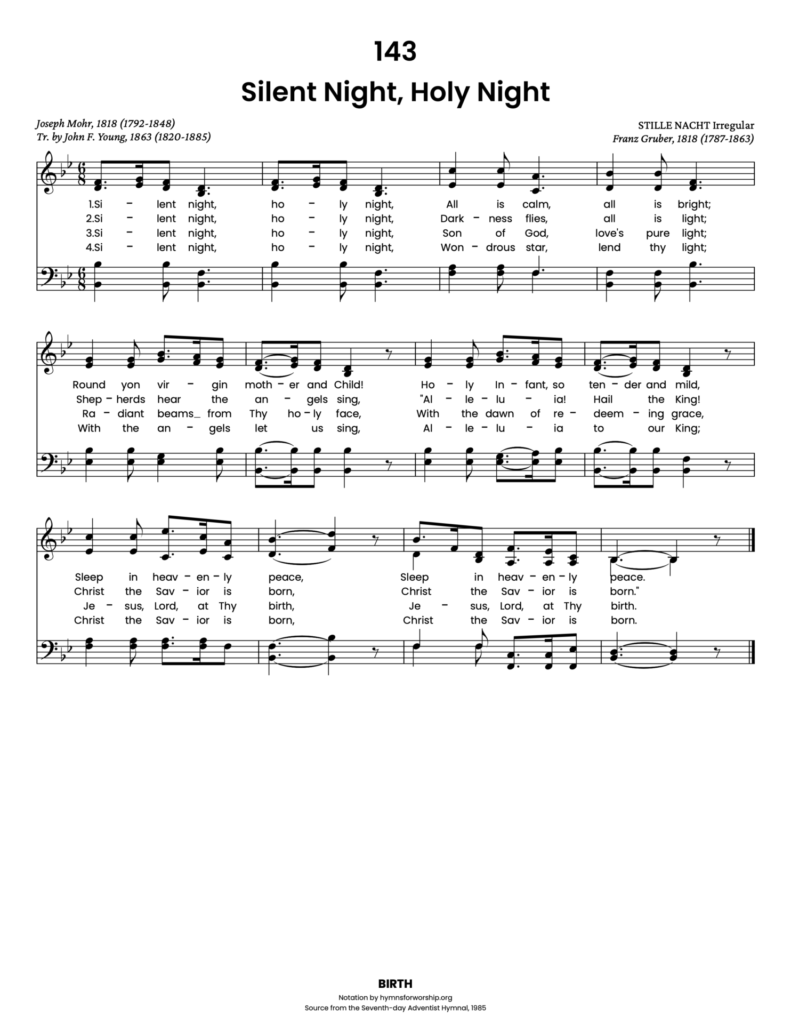
Silent night! holy night!
All is calm, all is bright
Round yon virgin mother and Child,
Holy Infant so tender and mild,
This hymn appears in:
Get the hymn sheet in other keys here
For Worship Leaders
Make each hymn more meaningful with these helpful tools: Short, ready-to-use hymn introductions for church bulletins, multiple ways to introduce a hymn based on your worship theme and in-depth history and insights to enrich your song service.
Hymn Spotlight: Silent Night, Holy Night
Born out of necessity when a church organ broke down, this timeless carol was first sung on Christmas Eve in 1818, accompanied only by guitar. The words were penned by a young priest, Joseph Mohr, and the melody quickly followed, composed by schoolmaster Franz Gruber.
Though simple, “Silent Night” captures the stillness and holiness of Christ’s birth like few others.
As we sing it today, may its gentle message calm our hearts and remind us of the peace Jesus brings.
📖 Reference: Feel free to share but please cite hymnsforworship.org when reproducing.
Introductions for Sabbath School Song Service (based on specific lesson quarterlies):
On December 24, 1818, in Oberndorf, a village near Salzburg, Austria, the organ at St. Nicolaus Church failed to function. Joseph Mohr, the assistant priest, decided to write a new hymn for the Christmas Eve service and to accompany it on his guitar. He wrote the words of this Christmas carol, in German, of course, in three stanzas of six lines each, and took it along to Franz Gruber, asking him to write a tune for it. Gruber was the schoolmaster at the neighboring village of Arnsdorf, and also the parish organist. Strangely enough, a few days prior to this, the two men had been discussing music and concluded that a perfect Christmas song had never been written. In the very short time available before the service the tune was composed. In the church that evening Mohr sang the tenor part and played the guitar accompaniment; Gruber sang the bass, and a choir of girls from the village repeated the last two lines of each stanza in four-part harmony. The carol was not published for 20 years, but it became known through the organ builder Karl Mauracher, from Zillertal, 80 miles distant. He came to repair the organ, heard the carol, secured a copy, and took it back with him and introduced it in his district. There it became very popular, and for a time was thought to be a folk song of the Austrian Tyrol. There have been many translations of the song; the one in SDAH was made in 1863 by John Freeman Young and published in his Great Hymns of the Church, 1887 (it had been published in 1871 with no credit for authorship given).
Joseph Mohr was born at Salzburg, Austria, on December 11, 1792. He was a boy chorister in the cathedral and later attended the university there. He was ordained a Roman Catholic priest in Salzburg in 1815, and served as assistant in several parishes in the Salzburg diocese (including Oberndorf), none of them more than 16 miles from Salzburg. In 1828 he was appointed vicar at Hintersee, southwest of Salzburg, and then in 1837 at Wagrein, 35 miles to the southeast of Salzburg. He died there on December 4, 1848.
The tune STILLE NACHT (Silent Night) receives its name from the words for which it was specifically composed by Franz Xavier Gruber, who was born on November 25, 1787, at the village of Unterweizberg in upper Austria. As a small boy he worked with his father, a weaver, at the loom, but showed talent as a musician, an occupation that his father felt offered no prospects of earning a living. However, in the evenings Franz studied secretly with the local schoolteacher and organist, who taught him to play the organ. When he was only 12 years old the sudden illness of his teacher opened the way for him to substitute at the organ, which pleased his father so much that he permitted his son to study organ at Burghausen, near Salzburg. He became a teacher at Arnsdorf in 1807, remaining there until 1829, and for a time in 1818 was organist at St. Nicolaus Church in nearby Oberndorf. In 1829 he was appointed headmaster at Berndorf, southwest of Vienna, and then in 1833 as organist and choirmaster at Hallein, near Salzburg. There he founded the Hallein Choral Society, and he died there on June 7,1863.
John Freeman Young was born on October 30, 1820, at Pittston, Maine, and trained in Wesleyan secondary school and college. He joined the Protestant Episcopal Church and trained for the ministry, being ordained in 1846. He served in Florida, Texas, Mississippi, and Louisiana, and then in 1860 moved to New York City as curate of Trinity Church. He was appointed bishop of Florida in 1867, holding that office until his sudden death from pneumonia on November 15, 1885, while on a visit to New York. His Great Hymns of the Church appeared posthumously in 1887.
Stanza:
1 – Luke 2:7
2 – Luke 2:13, 14
4 – Matthew 2:2
Luke 2:11

Text
1
Silent night! holy night! All is calm, all is bright
Round yon virgin mother and Child,
Holy Infant so tender and mild,
Sleep in heavenly peace, Sleep in heavenly peace.
2
Silent night! holy night! Darkness flies, all is light;
Shepherds hear the angels sing
Alleluia! hail the King!
Christ, the Savior is born, Christ, the Savior is born.
3
Silent night! holy night! Son of God, love’s pure light,
Radiant beams from Thy holy face,
with the dawn of redeeming grace,
Jesus, Lord, at Thy birth, Jesus, Lord, at Thy birth.
4
Silent night, holy night, Wondrous star lend thy light;
With the angels let us sing,
Alleluia to our King;
Christ the Savior is born, Christ the Savior is born.

Hymn Info
Biblical Reference
(a) Luke 2:7 (b) Luke 2:13,14 (c) Matt 2:2; Luke 2:11
Author
Joseph Mohr (172-1848)
Translator
John F. Young, 1863 (1820-1885)
Year Published
1818
Hymn Tune
STILLE NACHT
Metrical Number
Irregular
Composer
Franz Gruber (1787-1863)
Year Composed
1818
Theme
BIRTH OF JESUS CHRIST
Explore more hymns: