
JESUS CHRIST >> Birth
SDAH 122
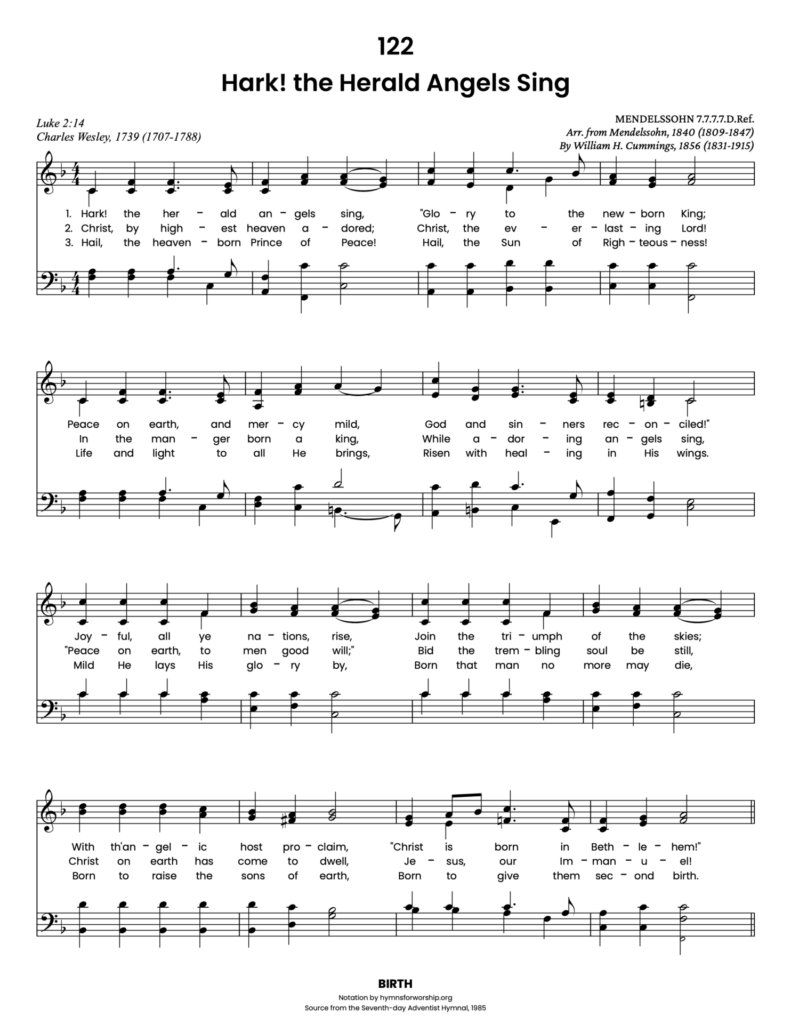
Hark! the herald angels sing,
“Glory to the new born King,
peace on earth, and mercy mild,
God and sinners reconciled!”
This hymn appears in:
Get the hymn sheet in other keys here
For Worship Leaders
Make each hymn more meaningful with these helpful tools: Short, ready-to-use hymn introductions for church bulletins, multiple ways to introduce a hymn based on your worship theme and in-depth history and insights to enrich your song service.
Hymn Spotlight: Hark! the Herald Angels Sing
Originally titled “Hymn for Christmas Day”, this joyful carol was penned by Charles Wesley in 1739. His first line, “Hark, how all the welkin rings,” was later changed to the now-beloved “Hark! the herald angels sing” by evangelist George Whitefield. In 1782, editors added the familiar refrain we sing today.
The triumphant tune we know so well wasn’t originally meant for church music! It comes from a piece by composer Felix Mendelssohn, written in 1840 to celebrate the invention of the printing press. William H. Cummings adapted it for Wesley’s words in 1856—despite Mendelssohn’s own belief that it wouldn’t suit sacred lyrics!
As we sing, may we echo the angels’ message of peace and glory, rejoicing in the birth of our Savior with hearts and voices lifted high.
📖 Reference: Feel free to share but please cite hymnsforworship.org when reproducing.
Introductions for Sabbath School Song Service (based on specific lesson quarterlies):
This hymn by Charles Wesley (1707-1788; see Biographies) appeared first in John and Charles Wesley’s Hymns and Sacred Poems, 1739, under the title “Hymn for Christmas Day.” There are 10 stanzas of four lines each, beginning:
Hark, how all the welkin rings
Glory to the King of kings.
In 1753 this was changed to the present wording by George Whitefield; since then, other minor alterations have been made, including, in 1782, the repetition of the first two lines as a refrain.
The tune MENDELSSOHN is part of the second movement of Festgesang an die Kunstler (Festival Song for the Artists), composed by Jakob Ludwig Felix Mendelssohn-Bartholdy (1809-1847; see Biographies), for the Gutenberg Festival in Leipzig in 1840 to commemorate the 400th (approximately) anniversary of the invention of printing. It was arranged as a hymn tune in 1856 by William Hayman Cummings to Flt Wesley’s words and named in honor of the original composer. Mendelssohn himself prophesied— falsely, as it turned out—that while singers and hearers might like the tune, it would never be appropriate for sacred words.
William Cummings was born on August 22, 183 1, in Sidbury, a village near the Devon coastal town of Sidmouth. As a boy he was a chorister at St. Paul’s Cathedral in London and later in the Temple Church. In 1 847 he was appointed organist at Waltham Abbey, and in that year he sang in the performance of Mendelssohn’s Elijah, conducted by the composer. He was noted as a successful tenor soloist and from 1879 to 1896 was professor of singing at the Royal Academy of Music. He conducted the Sacred Harmonic Society and in 1 896 was chosen to succeed Joseph Barnby as principal of the Guildhall School of Music, retaining that position until retirement in 1911. The University of Dublin accorded him an honorary D.Mus. degree in 1900. He composed one cantata, but was recognized as an authority on the life and works of Henry Purcell (see SDAH 607). Cummings died at Dulwich, south London, in June, 1915.
Stanza:
1 – Luke 2:13 – 15
2 – Isaiah 9:6
Luke 2:12, 14
Matthew 1:23
3 – Malachi 4:2
Philippians 2:7
John 3:7

Text
1
Hark! the herald angels sing,
“Glory to the new born King,
Peace on earth, and mercy mild,
God and sinners reconciled!”
Joyful, all ye nations rise,
Join the triumph of the skies;
With th’ angelic host proclaim,
“Christ is born in Bethlehem!”
Hark! the herald angels sing,
“Glory to the new born King!”
2
Christ, by highest heaven adored;
Christ, the everlasting Lord;
In the manger born a King,
While adoring angels sing,
“Peace on earth, to men goodwill;”
Bid the trembling soul be still,
Christ on earth has come to dwell,
Jesus, our Immanuel!
Hark! the herald angels sing,
“Glory to the new born King!”
3
Hail the heaven-born Prince of Peace!
Hail the Sun of Righteousness!
Life and light to all He brings,
Risen with healing in His wings.
Mild He lays His glory by,
Born that men no more may die,
Born to raise the sons of earth,
Born to give them second birth.
Hark! the herald angels sing,
“Glory to the new born King!”

Hymn Info
Biblical Reference
(a) Luke 2:13-15 (b Isa 9:6; Luke 2:12, 14; Matt 1:23 (c) Mal 4:2; Phil 2:7; John 3:7
Author
Charles Wesley (1707-1788)
Year Published
1788
Theme
BIRTH OF JESUS
Hymn Tune
MENDELSSOHN
Metrical Number
7.7.7.7.D.Ref.
Arranger / Harmonized / Paraphrased
Arr. from Mendelssohn, 1840 (1809-1847) by William H. Cummings, 1856 (1831-1915)
Watch
Recommended Reading
Charles was the other Wesley. Alongside his brother John who was considered the main guy behind the founding of Methodism, it was Charles’ hymns that pushed through the envelope of being “just another religion.” His lasting and well-known hymns have captivated Christians all around the world. Through his poetic lines, we are able to sing many hymns with such deep theology.
It was said that he wrote 8,989 hymns. That’s 10 lines of poetry every single day for 50 years. And we are privileged to have sung some of those hymns. Tell me, don’t these hymns ring a bell for you?
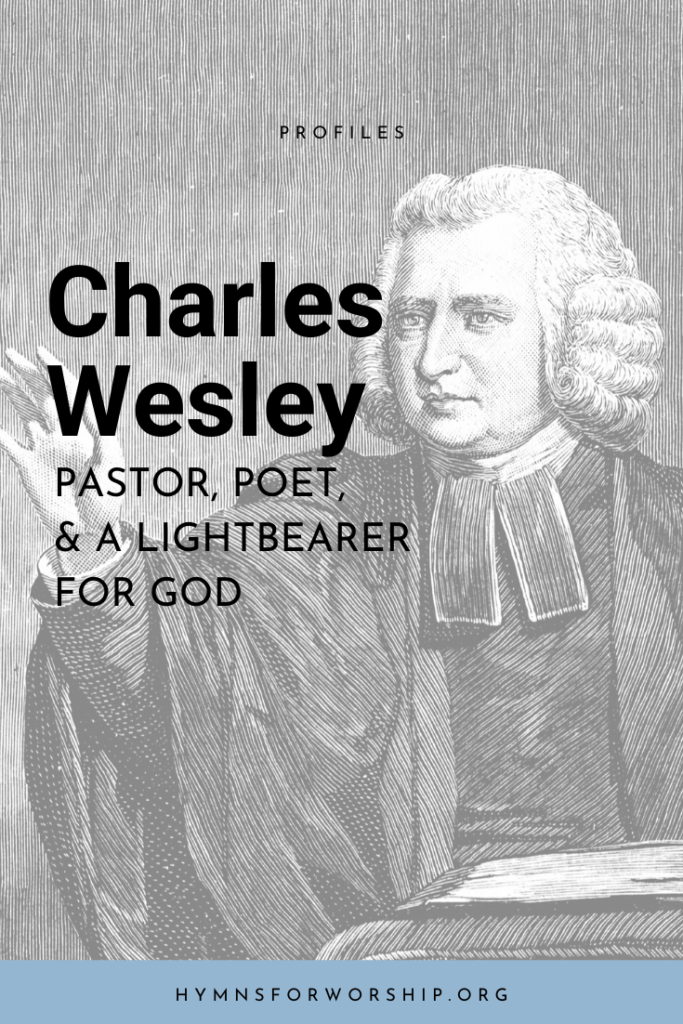
Charles was the other Wesley. Alongside his brother John who was considered the main guy behind the founding of Methodism, it was Charles’ hymns that pushed through the envelope of being “just another religion.” His lasting and well-known hymns have captivated Christians all around the world. Through his poetic lines, we are able to sing many hymns with such deep theology.
It was said that he wrote 8,989 hymns. That’s 10 lines of poetry every single day for 50 years. And we are privileged to have sung some of those hymns. Tell me, don’t these hymns ring a bell for you?
Explore more hymns: