GOD THE FATHER >> Faithfulness of God
SDAH 104
My Shepherd will supply my need,
Jehovah is His name.
In pastures fresh He makes me feed
Beside the living stream.
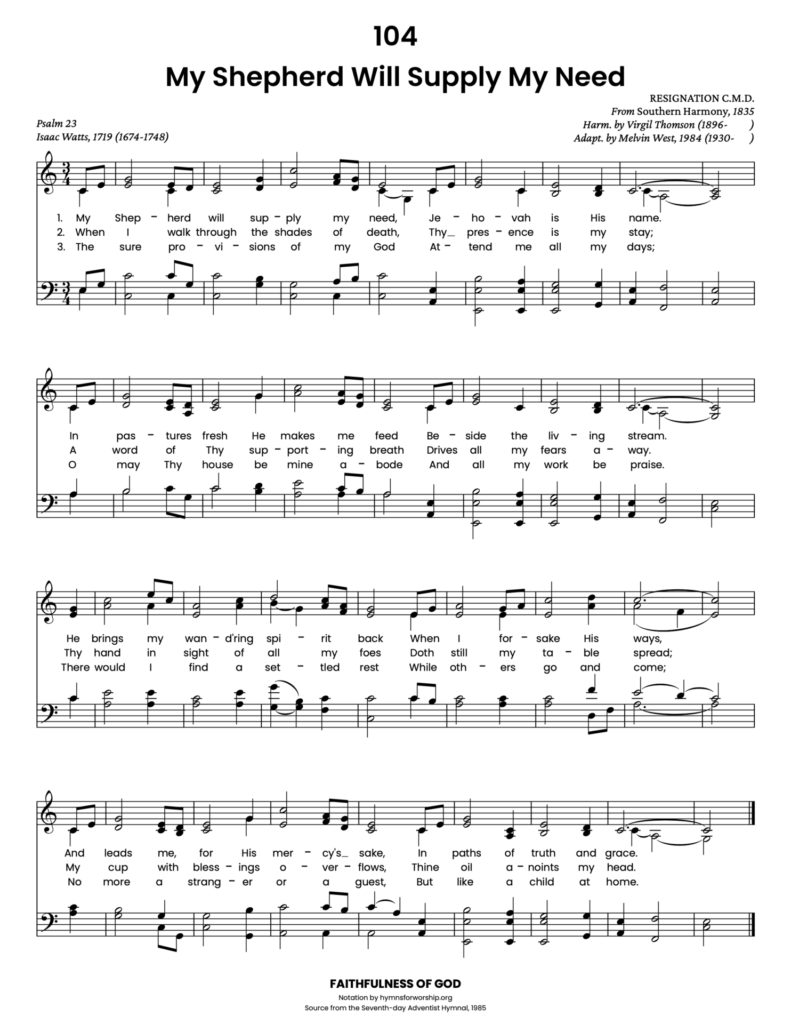
Get the hymn sheet in other keys here
For Worship Leaders
Make each hymn more meaningful with these helpful tools: Short, ready-to-use hymn introductions for church bulletins, multiple ways to introduce a hymn based on your worship theme and in-depth history and insights to enrich your song service.
Hymn Spotlight: My Shepherd Will Supply My Need
Isaac Watts (1674–1748) penned this poetic paraphrase of Psalm 23 in The Psalms of David, Imitated in the Language of the New Testament (1719). It is one of three versions he created, all titled “God Our Shepherd.” The version we sing today is from his six-stanza common meter version, skillfully merged into three flowing stanzas of eight lines each. Watts’s imagery of green pastures and divine guidance continues to offer assurance and comfort to hearts across generations.
The tune RESIGNATION is an early American melody, deeply rooted in Southern shaped-note tradition. It was included in Southern Harmony (1854) by William Walker, and its simple pentatonic structure gives it a gentle, folk-like quality. Melvin West’s choral arrangement and Virgil Thomson’s anthem have also helped bring new depth to this beloved pairing of tune and text.
As we sing, may our hearts rest in the peaceful promise that our Shepherd leads us and supplies all our need.
📖 Reference: Feel free to share but please cite hymnsforworship.org when reproducing.
Introductions for Sabbath School Song Service (based on specific lesson quarterlies):
We tend to place God as our last resort when finding an answers in our life. But actually He is the ultimate and only solution to everything we ask for. (Lesson 7, 1st Quarter 2021 -Monday, Propaganda, 2/08/2021)
When God calls us as He called Abraham, He bids us go to the place He wants us to go and do what He wants us to do with the assurance that He will be with us to supply us all our needs. (Lesson 4, 2nd Quarter 2021 – Wednesday, Covenant Stages, 4/21/2021)
This is a paraphrase of Psalm 23 by Isaac Watts (1674-1748; see Biographies). It was first published in his The Psalms of David, Imitated in the Language of the New Testament, and Applied to the Christian State and Worship, 1719. He made three paraphrases of this psalm and headed all of them “God Our Shepherd.” The first was in eight stanzas of long meter, this one in six stanzas of common meter, and the third in six stanzas of short meter. The SDAH hymn simply combines each pair of stanzas, making the hymn one of three stanzas of eight lines each, the original wording being followed exactly.
RESIGNATION is one of those early American tunes that appeared in dozens of shaped-note, oblong books, mostly in the South (see comments on BEACH SPRING, SDAH 363). It is in the pentatonic scale, that is, it can be played entirely by using only the black notes on the piano. This means that there are no half-step intervals in the melody, only whole steps. William Walker included it in the 1854 edition of his Southern Harmony, 1835, but no composer is given. The earliest combination of this text and tune seems to have been in John W. Steffy’s The Valley Ilarmonist, Winchester, Virginia, 1836. Melvin harmonic West’s progressions (1930- , that sec have Biographies) bccomc dear adaptation to all who preserves have sungthe or heard the choral anthem on this text and tune by the eminent American composer Virgil Thompson.
Born November 25, 1896, in Kansas City, Missouri, Thompson was educated in public schools and enlisted in the Army, becoming a second lieutenant in the U.S. Military Aviation Corps during World War L After the war he attended Harvard University, graduating in 1922. While there he was awarded the Payne Fellowship, which sent him to Paris in 1921 to study with Nadia Boulanger. For a time he was assistant instructor of music at Harvard, and assistant to Archibald T. Davison, famed conductor of the Harvard Glee Club. In 1922 he was appointed organist-choirmaster at King’s Chapel, Boston, where he also began to write essays and criticisms of the musical scene. Further study at Julliard School of Music, New York, and at Ecole Normale de Musique, Paris, helped to mature his style as a composer of music that is regarded as almost classic in American musical theater. In 1940 he became music critic for the New York Herald Tribune, where his witty, succinct, and penetrating reviews of musical events secured for him a great reputation. His experience as a church musician is reflected in the hymnlike melodies that surface in many of his works. Thomson is known for two operas, Four Saints in Three Acts and The Mother of Us All; a ballet, Filling Station; and chamber, choral, orchestral, band, organ, and vocal works.
Southern Harmony was a collection of hymns made by William Walker (1809-1875), born in South Carolina, the son of a Welsh immigrant. He became a singing teacher and collected folk hymns and tunes from the southern Appalachian region, many of which were of British origin. He was assisted in his collection by his brother-in-law, Benjamin Franklin White (1800-1879), but Walker’s name was the only one on the title page. White subsequently published his own book, The Sacred Harp, in 1844, which in part duplicated much of the material in Southern Harmony. These two books were the most successful of all the tune books published in this era. Southern Harmony also had SDAH 162, WONDROUS LOVE, and SDAH 620, PROMISED LAND.
Stanza: All
Psalm 23:1-6

Text
1
My Shepherd will supply my need,
Jehovah is His name.
In pastures fresh He makes me feed
Beside the living stream.
He brings my wand’ring spirit back
When I forsake His ways,
And leads, me for His mercy’s sake,
In paths of truth and grace.
2
When I walk through the shades of death,
Thy presence is my stay;
A word of Thy supporting breath
Drives all my fears away.
Thy hand in sight of all my foes
Doth still my table spread;
My cup with blessings overflows,
Thine oil anoints my head.
3
The sure provisions of my God
Attend me all my days;
O may Thy house be mine abode
And all my work be praise.
There would I find a settled rest
While others go and come;
No more a stranger or a guest,
But like a child at home.

Hymn Info
Biblical Reference
Ps 23:1-6
Author
Isaac Watts (1674-1748)
Year Published
1719
Copyright
Music copyright 1949 by H.W. Gray, a division of Belwin-Mills Publishing Corp. Used by permission.
Hymn Tune
RESIGNATION
Metrical Number
C.M.D.
Arranger
Harmonized by Virgil Thompson (1896-); Adapted by Melvin West (1930-)
Tune Source
Southern Harmony, 1835
Theme
FAITHFULNESS OF GOD
Explore more hymns: