GOD THE FATHER >> Majesty & Power of God
SDAH 83
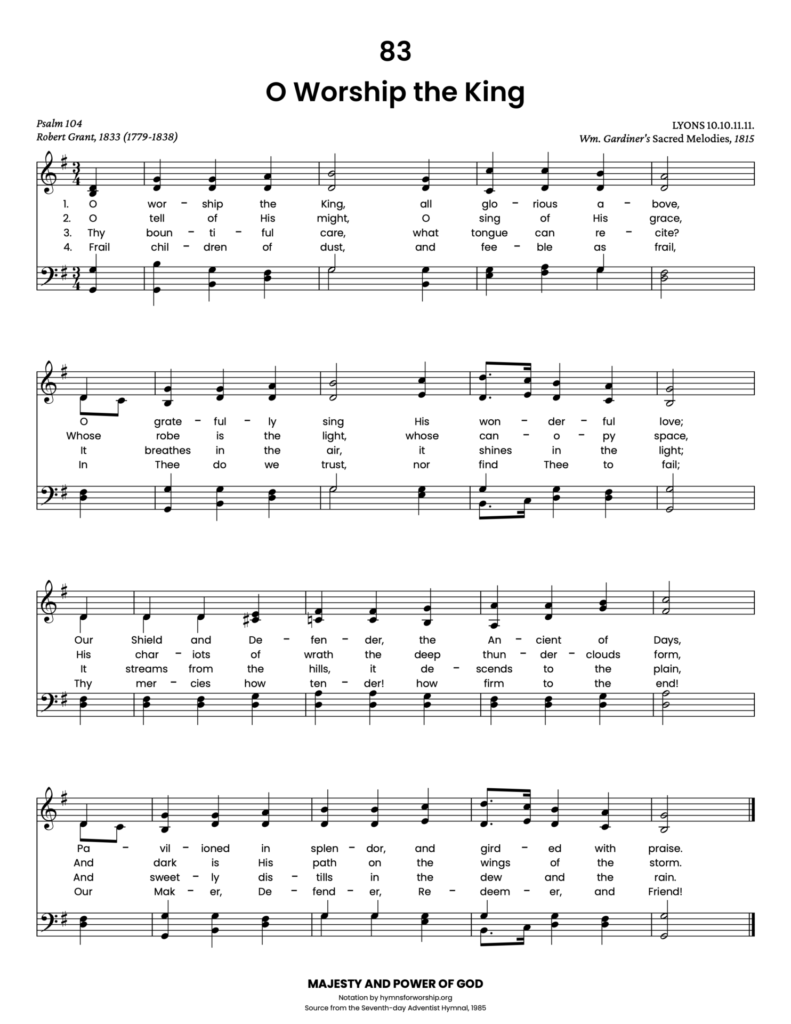
O worship the King, all glorious above,
O gratefully sing His wonderful love;
Our Shield and Defender, the Ancient of Days,
Pavilioned in splendor, and girded with praise.
This hymn appears in:
Get the hymn sheet in other keys here
For Worship Leaders
Make each hymn more meaningful with these helpful tools: Short, ready-to-use hymn introductions for church bulletins, multiple ways to introduce a hymn based on your worship theme and in-depth history and insights to enrich your song service.
Hymn Spotlight: O Worship the King
Robert Grant (1779–1838) penned this majestic hymn after being inspired by William Kethe’s metrical Psalm 104. While not a strict paraphrase, Grant’s text closely follows the psalm’s themes of God’s glory and goodness. First published in Christian Psalmody (1833), it has remained one of the church’s great hymns of praise. Grant, a British lawyer and politician, served as governor of Bombay and was knighted for his contributions.
The tune LYONS is attributed to Johann Michael Haydn (1737–1806), younger brother of the famed composer Franz Joseph Haydn. With its triumphant melody and stirring harmonies, this tune lifts the text in joyful adoration. As we sing, may our hearts be filled with awe and reverence for our mighty Creator and King.
📖 Reference: Feel free to share but please cite hymnsforworship.org when reproducing.
Introductions for Sabbath School Song Service (based on specific lesson quarterlies):
Robert Grant was impressed to write this hymn based on Psalm 104 after reading William Kethe’s (see SDAH 16) quaint rendering of this psalm. It is not strictly a paraphrase, bu several verses are followed quite closely. The hymn first appeared in 1833 in Edward Bickersteth’s Christian Psalmody and posthumously in Grant’s Sacred Poems, 1839. It was originally entitled “Glory and Goodness of God” and had three stanzas, each of eight lines.
Robert Grant was born in Bengal, India, in 1779 and went to England for his education. He graduated from Magdalen College, Cambridge, with a B.S. in 1801 and an M.A. in 1804. He studied law and was called to the bar in 1807. Becoming a member of Parliament in 1818, he was made a privy counselor in 1831 and judge advocate-general in 1832. In 1834 he was knighted and appointed governor of Bombay. He died at Dalpoorie in western India on July 9, 1838.
LYONS was probably composed in 1770 by Johann Michael Haydn, younger brother of the more famous Franz Joseph (see SDAH 96). He was born in Rohrau, Austria, near Vienna, on September 14, 1737. He was a chorister and deputy organist at St. Stephen’s Cathedral in Vienna from 1745 to 1755. In 1757 he was appointed kapellmeister to Count Firmian, the bishop at Grosswardein; five years later the archbishop of Salzburg appointed him musical director and concertmaster. He served as organist at the churches of Holy Trinity and St. Peter. Despite tempting offers from Vienna, Haydn remained in Salzburg. He composed a great deal of music, including about 300 pieces for the church, all of which were initialed O.a.m.D.Gl., “Omnia ad moharem Del Gloriam” (All for the Greater Glory of God). SDAH 599, GREENLAND, is one of his compositions. He died at Salzburg on August 10, 1806.
The arrangement was made by William Gardiner (1770-1835; see SDAH 177) and appeared in his Sacred Melodies II, 1815. Gardiner also arranged the tune GARDINER, which is used for SDAH 177, 355, and 376.
Stanza:
1 – Psalm 59:9, 11
Daniel 7:9
2 – Psalm 104:1-3
3 – Psalm 104:10
4 – Psalm 103:14

Text
1
O worship the King, all glorious above,
O gratefully sing His wonderful love;
Our Shield and Defender, the Ancient of Days,
Pavilioned in splendor, and girded with praise.
2
O tell of His might, O sing of His grace,
Whose robe is the light, whose canopy space,
His chariots of wrath the deep thunderclouds form,
And dark is His path on the wings of the storm.
3
Thy bountiful care, what tongue can recite?
It breathes in the air, it shines in the light;
It streams from the hills, it descends to the plain,
And sweetly distills in the dew and the rain.
4
Frail children of dust, and feeble as frail,
In Thee do we trust, nor find Thee to fail;
Thy mercies how tender, how firm to the end!
Our Maker, Defender, Redeemer, and Friend.

Hymn Info
Biblical Reference
Ps 104 (a) Ps 59:9, 11; Dan 7:9 (b) Ps 104:1-3 (c) Ps 104:10 (d) Ps 103:14
Author
Robert Grant (1779-1838)
Year Published
1833
Hymn Tune
LYONS
Metrical Number
10.10.11.11.
Tune Source
Wm. Gardiner’s Sacred Melodies, 1815
Theme
MAJESTY & POWER OF GOD
Watch
Explore more hymns: