GOD THE FATHER >> Majesty & Power of God
SDAH 85
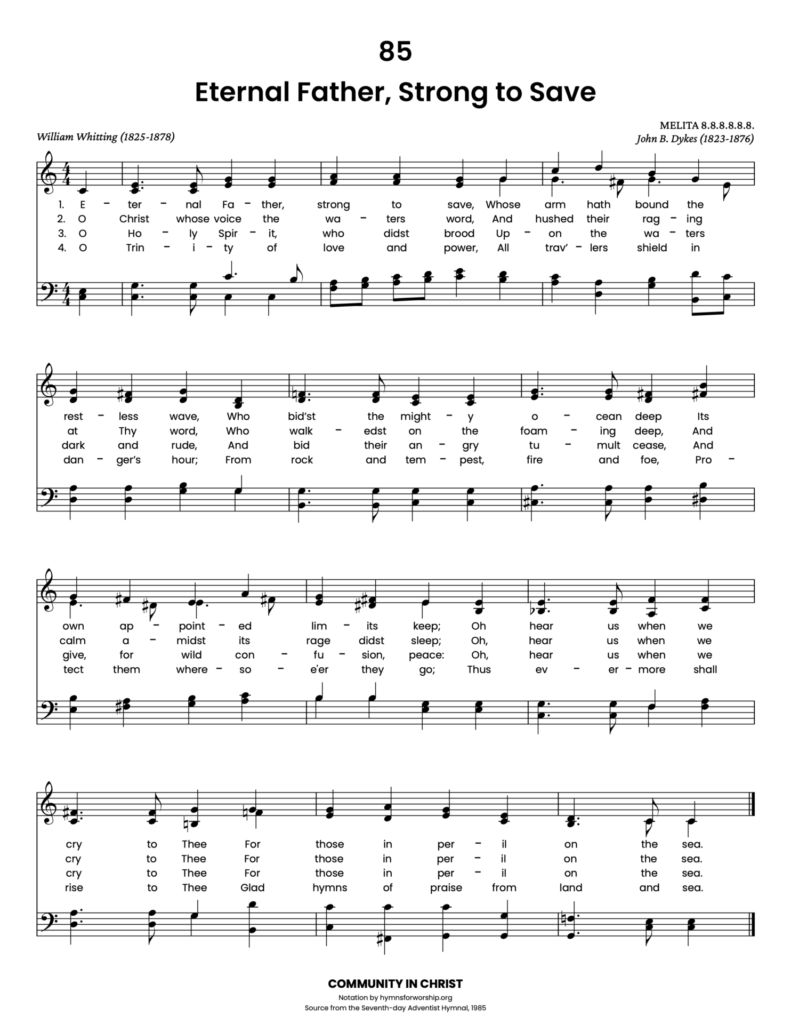
Eternal Father, strong to save,
Whose arm doth bind the restless wave,
Who bidd’st the mighty ocean deep
Its own appointed limits keep;
Get the hymn sheet in other keys here
For Worship Leaders
Make each hymn more meaningful with these helpful tools: Short, ready-to-use hymn introductions for church bulletins, multiple ways to introduce a hymn based on your worship theme and in-depth history and insights to enrich your song service.
Known as the Navy Hymn, this beloved hymn was first published in Hymns Ancient and Modern (1861) with the caption: “For those at sea. These see the works of the Lord, and His wonders in the deep” (Ps. 107:24). William Whiting (1825–1878), a poet and choirmaster, wrote the text, likely inspired by the nearby English naval bases of Southampton and Portsmouth. The hymn has been sung at countless maritime services and naval ceremonies, including those of the U.S. Naval Academy.
John B. Dykes (1823–1876) composed the tune MELITA, named after the island where Paul was shipwrecked (Acts 27–28). The pairing of text and tune has remained unchanged, its solemn and stirring melody reinforcing the hymn’s prayer for divine protection over those who travel the seas.
As we sing, may we be reminded of God’s sovereign care over all who journey through life’s uncertainties.
📖 Reference: Feel free to share but please cite hymnsforworship.org when reproducing.
Introductions for Sabbath School Song Service (based on specific lesson quarterlies):
The author and the composer of this hymn lived almost contemporaneously, and both died at age 53. First published in the original edition of Hymns Ancient and Modern, 1861, it bore the caption: “For those at sea. These see the works of the Lord, and His wonders in the deep” (Ps. 107:24). It was altered several times, once by the author, but except for a couple of small changes (“Our brethren” in stanza 4 becomes “All trav’lers”), SDAH uses the original version as found in the Episcopal Hymnal 1940. It has come to be known as the Navy Hymn and is sung regularly at the U.S. Naval Academy, Annapolis, Maryland.
William Whiting was born November 1, 1825; his father was a grocer in Kensington, London. At age 16 William entered the Winchester Training Institute; the very next year his musical ability got him the job of master of the Winchester College Chorister’s School, a 16-boy choir whose tradition went all the way back to 1382. Besides singing in the chapel, the boys waited tables for the college boys in the dining hall, wearing uniforms with swallowtail coats. Whiting stayed on as leader of this group for 35 years until his death, June 3, 1878.
Two collections of his poetry were published, but he is remembered solely for this hymn, which has found its way into countless hymnals. It is not so strange that a prayer for safety on the sea should come from an inland boys’ school. Winchester is only 12 miles from England’s second greatest port, Southampton, and 22 miles away is the great naval base at Portsmouth. Bailey, in The Gospel in Hymns, says: “I have crossed the Atlantic 49 times, and to the best of my recollection this hymn was sung at morning prayer every Sunday we were at sea under the British flag.”
MELITA is the Roman version of Malta, the island where Paul was shipwrecked while traveling as a prisoner to Rome (read the story in Acts 27 and 28). This tune was written by John B. Dykes (1823–1876; see Biographies) especially for Whiting’s words and was published with them. It has been one of those happy marriages of text and tune that is universally considered permanent. Dykes’s style, which greatly influenced later hymn tune composers, is characterized by interesting melodic parts for alto, tenor, and bass; and the use of chromaticism, considered by some to be too romantic but by others to be expressive and beautiful.
Stanza:
1 – 1 Timothy 1:17
Job 38:11
Psalm 107:28
2 – Matthew 14:25
Mark 4:38, 39
3 – Genesis 1:2
4 – Psalm 137:31

Text
1
Eternal Father, strong to save,
Whose arm hath bind the restless wave,
Who bid’st the mighty ocean deep
Its own appointed limits keep;
O hear us when we cry to Thee
For those in peril on the sea.
2
O Christ, whose voice the waters heard,
And hushed their raging at Thy words
Who walkedst on the foaming deep,
And calm amidst its rage didst sleep;
O hear us when we cry to Thee
For those in peril on the sea.
3
O Holy Spirit, who didst brood
Upon the waters dark and rude,
And bid their angry tumult cease,
And give, for wild confusion, peace;
O hear us when we cry to Thee
For those in peril on the sea.
4
O Trinity of love and power,
All Trav’lers shield in danger’s hour;
From rock and tempest, fire and foe,
Protect them wheresoe’er they go;
Thus evermore shall rise to Thee
Glad hymns of praise from land and sea.

Hymn Info
Biblical Reference
(a) 1 Tim 1:17; Job 38:11; Ps 107:28 (b) Matt 14:25, Mark 4:38, 39 (c) Gen 1:2 (d) Ps 137:31
Author
William Whitting (1825-1878)
Hymn Tune
MELITA
Metrical Number
8.8.8.8.8.8.
Composer
John B. Dykes (1823-1876)
Theme
MAJESTY & POWER OF GOD
Explore more hymns: