GOD THE FATHER >> Majesty & Power of God
SDAH 82
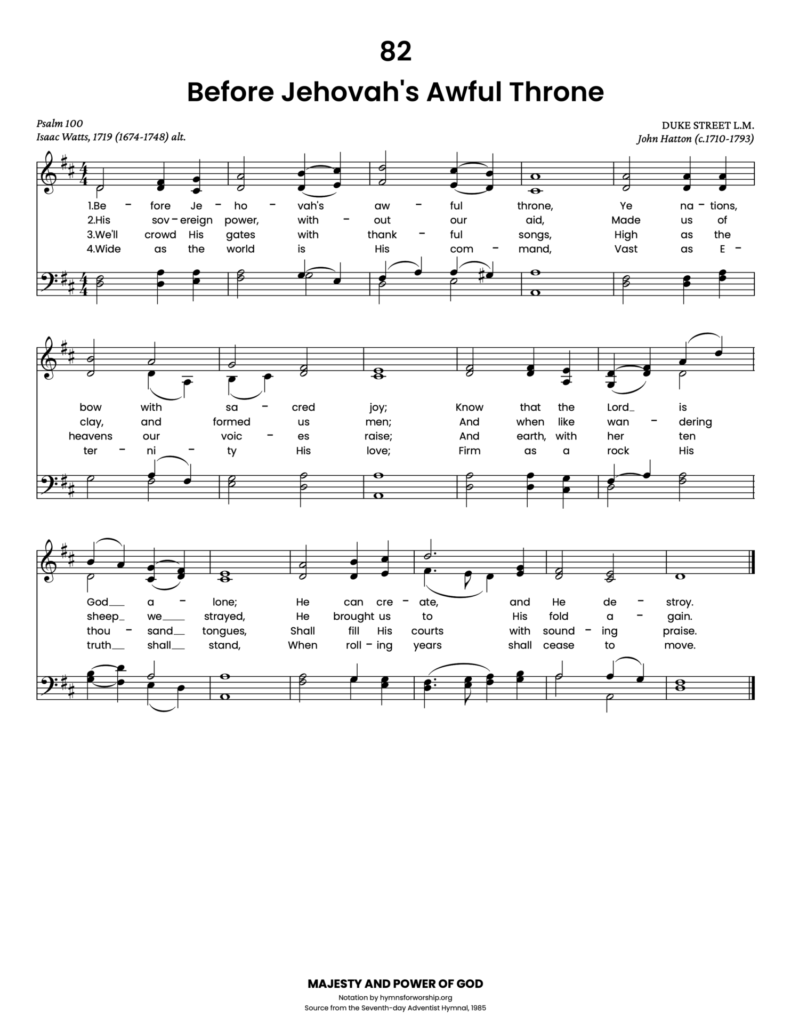
Before Jehovah’s awful throne,
Ye nations, bow with sacred joy;
Know that the Lord is God alone;
He can create, and He destroy.
This hymn appears in:
Get the hymn sheet in other keys here
For Worship Leaders
Make each hymn more meaningful with these helpful tools: Short, ready-to-use hymn introductions for church bulletins, multiple ways to introduce a hymn based on your worship theme and in-depth history and insights to enrich your song service.
Hymn Spotlight: Before Jehovah’s Awful Throne
Isaac Watts (1674–1748) revolutionized hymnody by paraphrasing psalms in a way that made them more meaningful for Christian worship. This hymn is his version of Psalm 100, emphasizing joyful praise before God’s throne. John Wesley made slight modifications to the text, including omitting a patriotic stanza and refining certain lines for clarity and devotion.
The tune DUKE STREET is attributed to John Hatton (c. 1710–1793), though little is known about him beyond his residence in Windle, England. This majestic melody, with its bold, stepwise motion, has become a favorite setting for hymns of praise. As we sing, may we lift our voices with joy, joining in the timeless call to worship the Lord with gladness.
📖 Reference: Feel free to share but please cite hymnsforworship.org when reproducing.
Introductions for Sabbath School Song Service (based on specific lesson quarterlies):
Isaac Watts (1674–1748) broke away from the metrical versions of the psalms. These adhered very strictly to the wording of the Old Testament and, consequently, in many cases produced awkward, clumsy lines. Watts made free paraphrases, skillfully using the main thought of the psalm and omitting references that were not germane in Christian times. This hymn is his paraphrase of Psalm 100; it could be compared profitably with William Kethe’s metrical version of the same psalm (see SDAH 16).
John Wesley, who objected to other writers tinkering with his hymns and those of his brother Charles, wisely omitted the initial patriotic stanza and changed the first two lines of the second stanza (first in SDAH) from:
Nations attend before His throne,
With solemn fear, with sacred joy.
DUKE STREET is listed as anonymous in Henry Boyd’s Select Collection of Psalm and Hymn Tunes, 1793, where it bears the name ADDISON’S 19TH PSALM. But in William Dixon’s Euphonia, c. 1805, it is called DUKE STREETand credited to John Hatton. The name is a street where the composer’s home was located.
Little is known about John Hatton. Born about 1710 at Warrington, Lancashire, he lived at St. Helen’s in the township of Windle, England, on the street after which he named the tune. Some think he was killed in a stagecoach accident; the Presbyterian Church of St. Helen’s records the preaching of his funeral sermon on December 13, 1793. If he wrote other music, it has not survived, but this one, which marches vigorously up and down the scale, is in nearly every hymnal and often is set to several texts. SDAH uses it again for No. 227, “Jesus Shall Reign,” in which Melvin West (see Biographies) has arranged it for unison voices.
Stanza:
Psalm 100:1-5

Text
1
Before Jehovah’s awful throne,
Ye nations, bow with sacred joy;
Know that the Lord is God alone;
He can create, and He destroy.
2
His sovereign power, without our aid,
Made us of clay, and formed us men;
and when like wandering sheep we strayed,
He brought us to His fold again.
3
We’ll crowd His gates with thankful songs,
High as the heavens our voices raise;
And earth, with her ten thousand tongues,
Shall fill His courts with sounding praise.
4
Wide as the world is His command,
Vast as Eternity His love;
Firm as a rock His truth shall stand,
When rolling years shall cease to move.

Hymn Info
Biblical Reference
Ps 100:1-5
Author
Isaac Watts (1674-1748)
Year Published
1719
Hymn Tune
DUKE STREET
Metrical Number
L.M.
Composer
John Hatton (c. 1710-1793)
Alternate Harmony
SDAH 227
Theme
MAJESTY & POWER OF GOD
Explore more hymns: