GOD THE FATHER >> POWER OF GOD IN NATURE
SDAH 95
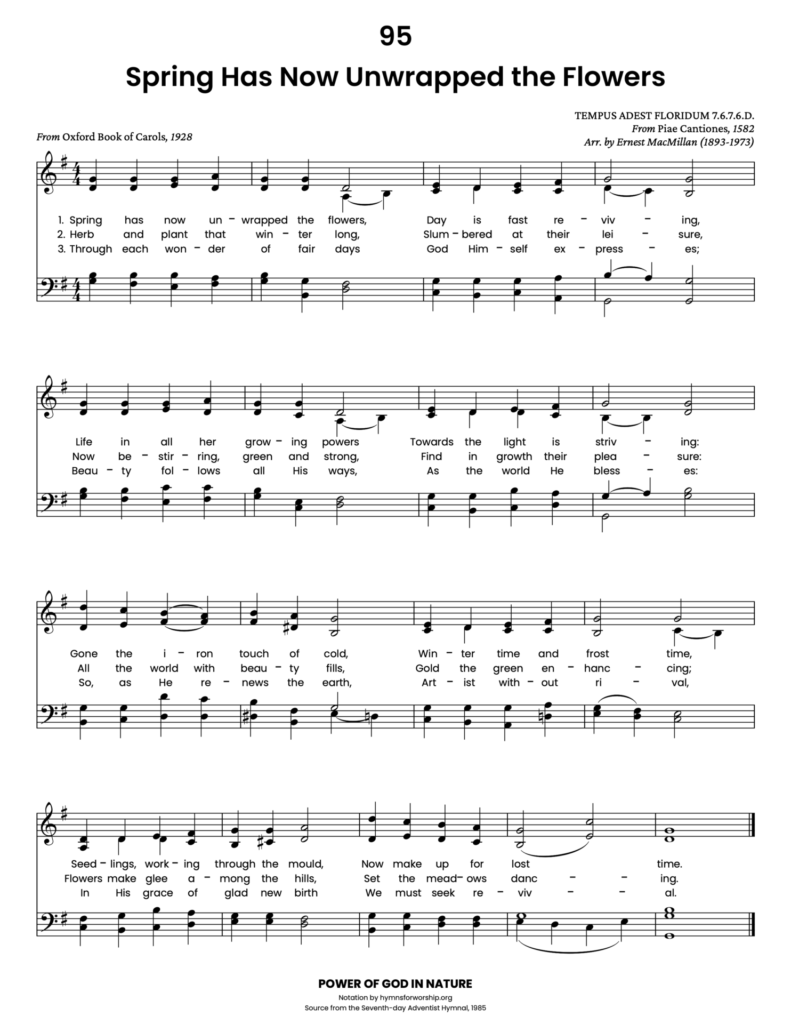
Spring has now unwrapped the flowers,
Day is fast reviving,
Life in all her growing powers
Towards the light is striving:
Get the hymn sheet in other keys here
For Worship Leaders
Make each hymn more meaningful with these helpful tools: Short, ready-to-use hymn introductions for church bulletins, multiple ways to introduce a hymn based on your worship theme and in-depth history and insights to enrich your song service.
Hymn Spotlight: Spring Has Now Unwrapped the Flowers
This joyful spring carol originated in the Piae Cantiones, a collection of sacred songs published in Finland in 1582. Though the texts were in Latin, the book was Protestant in origin. The carol’s original title, Tempus adest floridum (The time of flowers is here), celebrates the renewal of life in nature. John M. Neale later adapted the tune for Good King Wenceslas, but the version found in SDAH follows a freer translation by Ralph Vaughan Williams, Percy Dearmer, and Martin Shaw from The Oxford Book of Carols (1928).
The arrangement by Sir Ernest MacMillan (1893–1973), one of Canada’s most distinguished musicians, preserves the tune’s lively charm. MacMillan, knighted for his contributions to music, conducted the Toronto Symphony and Mendelssohn Choir and remained a champion of musical excellence.
As we sing, may this hymn remind us of God’s renewing power in creation and in our lives.
📖 Reference: Feel free to share but please cite hymnsforworship.org when reproducing.
Introductions for Sabbath School Song Service (based on specific lesson quarterlies):
This delightful carol for spring first appeared in Piae Cantiones (Sacred Songs), printed by Theodoric Petri in Nyland, Finland, 1582. Even though the texts of this collection were in Latin, it was a Protestant publication, with this full title: Sacred Songs of Church and Cloister of the clergy of past ages, in common use in the Renowned Realm of Sweden; newly and accurately revised and corrected by the labour of the same most reverend and honorable member of the Church of God, and of the School of Åbo in Finland, Theodoric Petri of Nyland, now committed to print, 1582.
Around 1850, G. J. R. Gordon, Her Majesty’s envoy and minister at Stockholm, brought back a copy to England and gave it to the translator, John M. Neale, who wrote words for several of the carols. For this tune he wrote “Good King Wenceslas.” While working on the Oxford Book of Carols, 1928, Ralph Vaughan Williams, Percy Dearmer, and Martin Shawelected to use their own free translation of the spring carol from Piae Cantiones, beginning “Tempus adest floridum”(The time of flowers is here). This is the version SDAH uses, omitting stanzas 4 and 5.
The Methodist Hymnal, 1964, is one of the very few present-day books to use this spring carol. SDAH uses the same arrangement by Ernest MacMillan, considered Canada’s most noted musician. Born August 18, 1893, in Mimico, Ontario, into the home of a Presbyterian minister and hymn book editor, Ernest grew up in an atmosphere of church music. At age 10, he played the organ at Massey Hall, Toronto, and at 13 won the Bronze Medal for harmony at University of Edinburgh, Scotland. At age 18, he won the highest mark of all candidates for the Fellow of the Royal College of Organists and graduated B. Mus. from Oxford University.
While attending the Bayreuth Wagner Festival in 1914, MacMillan was interned and spent World War I as a prisoner. Making the most of his time, he composed Ode for Chorus and Orchestra, which won for him the D. Mus. from Oxford in 1918. Back in Canada, he had a most distinguished career as a teacher, administrator, church musician, organ recitalist, and conductor. He was conductor of the Toronto Symphony, 1931–1956, and of the Toronto Mendelssohn Choir, 1942–1957. King George VI knighted him in 1935 for his services to the cause of music in Canada, the first person in the Commonwealth outside of the United Kingdom to receive such an honor. He was a humble man, but one who always insisted on the highest standards of excellence. He died in Toronto on May 6, 1973.
Stanza:
2 – Psalm 104:30

Text
1
Spring has now unwrapped the flowers,
Day is fast reviving,
Life in all her growing powers
Towards the light is striving:
Gone the iron touch of cold,
Winter time and frost time,
Seedlings, working through the mould,
Now make up for lost time.
2
Herb and plant that winter long,
Slumbered at their leisure,
Now be stirring, green and strong,
Find in growth their pleasure:
All the world with beauty fills,
Gold the green enhancing;
Flowers make glee among the hills,
Set the meadows dancing.
3
Through each wonder of fair days
God Himself expresses;
Beauty follows all His ways,
As the world He blesses:
So, as He renews the earth,
Artist without rival,
In His grace of glad new birth
We must seek revival.

Hymn Info
Biblical Reference
(b) Ps 104:30
Text Source
from Oxford Book of Carols
Year Published
1928
Copyright
Words from the Oxford Book of Carols by permission of Oxford University Press. Music used by persmission of Ernest MacMillan.
Hymn Tune
TEMPUS ADEST FLORIDUM
Metrical Number
7.6.7.6.D.
Arranger
Ernest MacMillan
Tune Source
from Piae Cantiones, 1582
Theme
POWER OF GOD IN NATURE
Explore more hymns: