GOD THE FATHER >> POWER OF GOD IN NATURE
SDAH 94
Nature with open volume stands,
To spread its Maker’s praise abroad;
And every labor of His hands
Shows something worthy of our God.
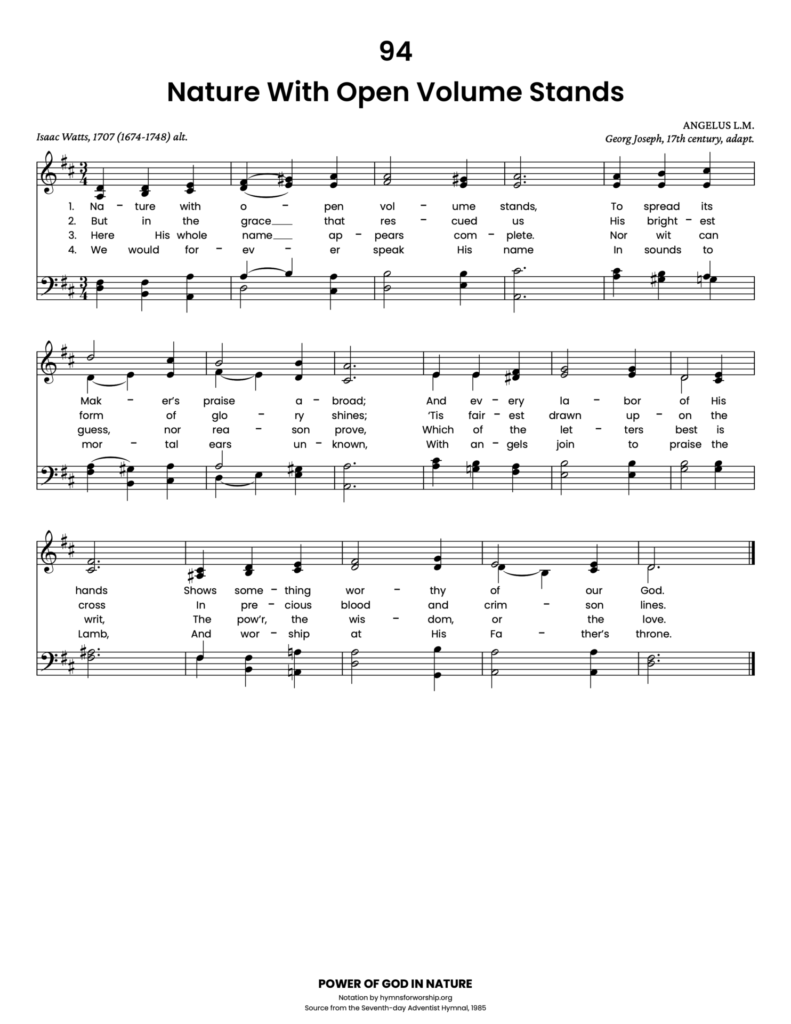
Get the hymn sheet in other keys here
For Worship Leaders
Make each hymn more meaningful with these helpful tools: Short, ready-to-use hymn introductions for church bulletins, multiple ways to introduce a hymn based on your worship theme and in-depth history and insights to enrich your song service.
Hymn Spotlight: Nature With Open Volume Stands
Isaac Watts (1674–1748) wrote this hymn in Hymns and Spiritual Songs (1707), originally titled “Christ Crucified, the Wisdom and Power of God.” While the first stanza marvels at God’s power in nature, the heart of the hymn focuses on Christ’s sacrifice as the ultimate display of His wisdom and love. Inspired by 1 Corinthians 1:23–24, Watts declares that God’s brightest glory is revealed at the cross. Some consider this hymn second only to When I Survey the Wondrous Cross among Watts’s most profound works.
The tune ANGELUS was composed by seventeenth-century musician Georg Joseph, appearing in Heilige Seelenlust (1657). Named in honor of his collaborator Johann Scheffler—who became known as Angelus Silesius—the melody originally resembled an Italian solo song. It has since been adapted into a deeply reflective hymn tune.
As we sing, may we stand in awe of both the beauty of creation and the greater wonder of redemption.
📖 Reference: Feel free to share but please cite hymnsforworship.org when reproducing.
Introductions for Sabbath School Song Service (based on specific lesson quarterlies):
This hymn by Isaac Watts (1674–1748; see Biographies) appears in his Hymns and Spiritual Songs, 1707, under the title “Christ Crucified, the Wisdom and Power of God.” Originally, there were six stanzas. Watts’s title indicates that this hymn should be included in the SDAH section on Christ’s sufferings and death, for the first stanza is introductory only, speaking of one aspect of God’s power and glory. But as stanza 2 states, God’s brightest glory was shown in His sacrifice for humanity. The words were inspired by the apostle Paul: “But we preach Christ crucified … Christ the power of God, and the wisdom of God” (1 Cor. 1:23, 24).
Not willing for “God the Savior” to love and die, most hymnal editors changed it to “Christ the Savior.” There are a number of minor alterations in the four stanzas in SDAH, two of them to change the sexually exclusive words “her” and “man” to “its” and “us.” The first word of the fourth stanza has been changed from “I” to the collective “we.” Some feel this atonement hymn ranks right up there next to “When I Survey the Wondrous Cross” as one of Watts’s finest works. Strangely, it appears in very few hymnals. The Dictionary of American Hymnology lists it in a Baptist book, Hymns and Spiritual Songs, 1766, by Samuel Hall, Newport, Rhode Island. It was included in Congregational Praise, 1951, and Lutheran Book of Worship, 1978.
Not much is known of Georg Joseph, composer of the tune ANGELUS. He was a musician employed in the seventeenth century by the prince-bishop of Breslau, Germany. Collaborating with Lutheran poet and physician Johann Scheffler (1624–1677), he published five books of hymns from 1657 to 1668. The volume containing this tune (and 184 more of his) was Heilige Seelenlust (Holy Desire for Souls), 1657. The original tune was a soprano solo styled after Italian secular music. Undergoing some changes from the original, the SDAH form of the tune is from Cantica Spiritualia, Munich, 1847, with further rhythmic changes from the version printed in the 1875 revised edition of Hymns Ancient and Modern. Joseph named this tune ANGELUS to commemorate his collaborator, Scheffler, who, though brought up a Lutheran, converted to the Roman Catholic faith in 1653 and took the name Angelus Silesius when he became a priest.
Stanza:
1 – Psalm 145:10
2 – Galatians 6:14
3 – 1 Corinthians 1:24
4 – Revelation 5:12

Text
1
Nature with open volume stands,
To spread its Maker’s praise abroad;
And every labor of His hands
Shows something worthy of our God.
2
But in the grace that rescued us
His brightest form of glory shines;
‘Tis fairest drawn upon the cross
In precious blood and crimson lines.
3
Here His whole name appears complete.
Nor wit can guess, nor reason prove,
Which of the letters best is writ,
The pow’r, the wisdom, or the love.
4
We would forever speak His name
In sounds to mortal ears unknown,
With angels join to praise the Lamb,
And worship at His Father’s throne.

Hymn Info
Biblical Reference
(a) Ps 145:10 (b) Gal 6:14 (c) 1 Cor 1:24 (d) Rev 5:12
Author
Isaac Watts (1674-1748)
Year Published
1707
Hymn Tune
ANGELUS
Metrical Number
L.M.
Composer
Georg Joseph, 17th century, adapt.
Theme
POWER OF GOD IN NATURE
Explore more hymns: