GOD THE FATHER >> Love of God
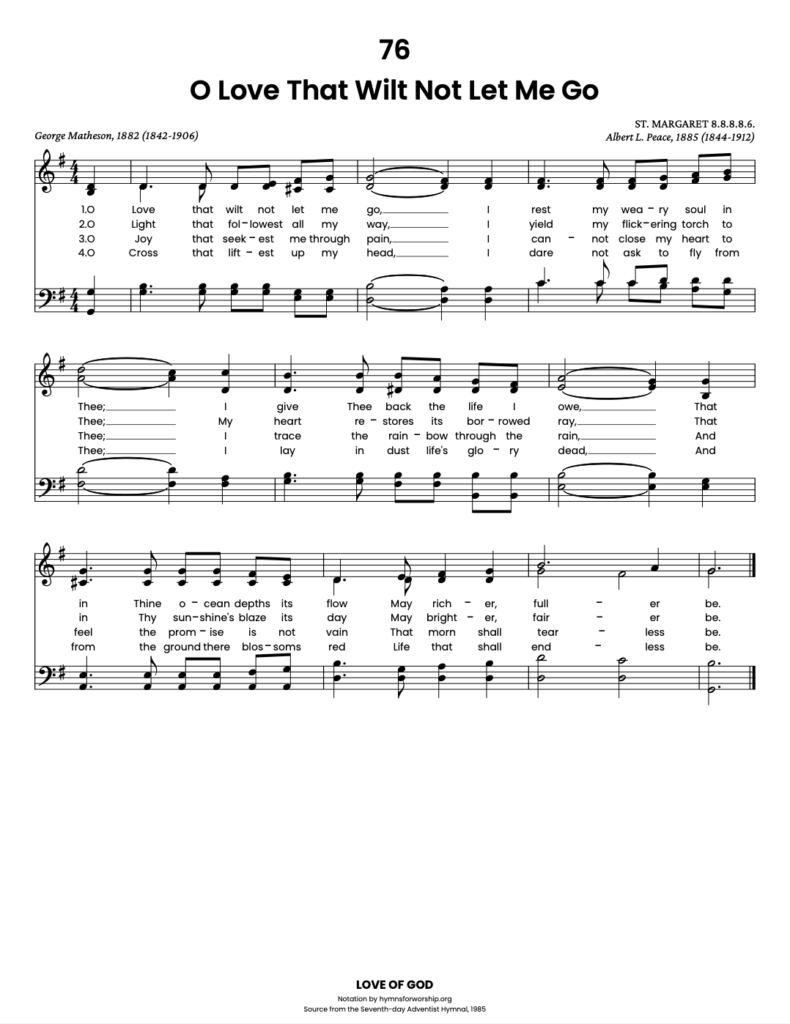
SDAH 76
O Love that wilt not let me go,
I rest my weary soul in thee;
I give thee back the life I owe,
that in thine ocean depths
This hymn appears in:
Get the hymn sheet in other keys here
For Worship Leaders
Make each hymn more meaningful with these helpful tools: Short, ready-to-use hymn introductions for church bulletins, multiple ways to introduce a hymn based on your worship theme and in-depth history and insights to enrich your song service.
Hymn Spotlight: O Love That Wilt Not Let Me Go
George Matheson (1842–1906) wrote this hymn in a moment of deep personal anguish, describing it as “the fruit of pain.” Despite nearly total blindness from a young age, he excelled in his studies and became a respected Scottish minister. On June 6, 1882, in the manse at Innellan, he penned these words in just minutes, feeling as though they were dictated to him. Using powerful metaphors—Love, Light, Joy, and the Cross—he expresses the unyielding presence of God, even in suffering.
Albert Lister Peace composed the tune ST. MARGARET just as quickly, inspired while reading the lyrics on the Isle of Arran. Named after a Scottish queen devoted to the church, the melody beautifully carries Matheson’s words, making this hymn a true Scottish treasure.
As we sing, may we rest in the unwavering love of God, which holds us fast through every trial.
📖 Reference: Feel free to share but please cite hymnsforworship.org when reproducing.
Introductions for Sabbath School Song Service (based on specific lesson quarterlies):
Have you been in a situation where from a human standpoint all seemed lost? If so, may this hymn reminds us that God’s love will keep us through. “O Love that will not let me go, I rest my weary soul in Thee. (Lesson 7, 1st Quarter 2021 -Monday, Propaganda, 2/08/2021)
George Matheson began to lose his sight before he was a year old; at 17 he was almost completely blind. A brilliant student in spite of this handicap, he gained his B.A. at the University of Glasgow in 1861, his M.A. in 1862, and a B.D. in 1866. He was ordained in 1868 and appointed as parish minister in Innellan, Argyll, on the Firth of Clyde. In the manse there on June 6, 1882, he was, he says, “Suffering from extreme mental distress and the hymn was the fruit of pain.” This pain was not caused by a broken engagement, as that had happened about 20 years earlier, but it might have been a bereavement or his concern over the inroads that Darwinism was making in the church.
This hymn was written very quickly in the space of minutes only, as though it was dictated by an inward voice, and not revised or retouched afterwards. The one exception that was later suggester and agreed upon was in the third stanza where “I climb” now reads “I trace. In spite of the author’s statement that it was written in 1882, it appeared in the Church of Scotland magazine Life and Work in January 1882, so June 1881 may be the correct date. The words, as in most of Matheson’s poems, are not easy to understand on the first reading, but become clearer after much thought and meditation. The structure of this hymn is very apparent, however, as the poet uses metaphors for a God who will not leave His child forsaken: first Love, then Light, then Joy, then the Cross.
George Matheson was born in Glasgow in March 27, 1842. He ministered at Innellan from 1868 to 1886, when he was transferred to St. Bernard’s, Edinburgh. He served there until he resigned, because of ill health, in 1899. He was honored with a D.D. from Edinburgh University in 1879 and with a L.L.D. from Aberdeen University in 1902. He died at North Berwick, Lothian, Scotland, on August 28, 1906. He also wrote SDAH 568, “Make Me a Captive Lord.”
ST. MARGARET was likewise composed very rapidly; its composer, Albert Lister Peace, said that “the ink of the first note was hardly dry when I had finished the tune.” He was requested to supply a tune for Matheson’s words in the uncommon meter 8.8.8.8.6. (there are no others in SDAH!); in accordance with his usual practice, he carried with him the words of the hymn, ready to jot down the melody as inspiration came to him. He was sitting on the sand on the isle of Arran reading the words when this melody came into his mind. The name of the tune commemorates a queen of Scotland who was a benefactress to the church, thus making this hymn a truly Scottish one.
Peace was born in Huddersfield, Yorkshire, on January 26, 1844. When only 9 years old, he was organist at the Parish Church at Holmfirth, five miles south of his birthplace. He studied at the University of Oxford, gaining a B.Mus. degree in 1870 and D.Mus. Im 1875. After filling several minor posts as organist until 1879, he was appointed organist at Glasgow Cathedral, where he remained until 1897. Then he was called to be organist at St. George’s Hall in Liverpool. He wrote much church and organ music and edited two hymnals. He died in Blundellsans, near Liverpool, on March 14, 1912. In his time he was recognized as one of Britain’s greatest organists.
Stanza:
1 – 1 John 4:8
2 – 1 John 1:5
3 – Psalm 43:4
4 – Luke 14:27

Text
1
O Love that wilt not let me go,
I rest my weary soul in Thee;
I give Thee back the life I owe,
That in Thine ocean depths its flow
May richer, fuller be.
2
O Light that followest all my way,
I yield my flickering torch to Thee;
My heart restores its borrowed ray,
That in Thy sunshine’s blaze its day
May brighter, fairer be.
3
O Joy that seekest me through pain,
I cannot close my heart to Thee;
I trace the rainbow thru the rain,
And feel the promise is not vain,
That morn shall tearless be.
4
O Cross that liftest up my head,
I dare not ask to fly from Thee;
I lay in dust life’s glory dead,
And from the ground there blossoms red
Life that shall endless be.

Hymn Info
Biblical Reference
(a) 1 John 4:8 (b) 1 John1:5 (c) Ps 43:4 (d) Luke 14:27
Author
George Matheson (1842-1906)
Hymn Tune
ST. MARGARET
Metrical Number
8.8.8.8.6.
Composer
Albert L. Peace (1844-1912)
Year Composed
1885
Theme
LOVE OF GOD
Watch
Explore more hymns: