WORSHIP >> Morning WORSHIP
SDAH 39
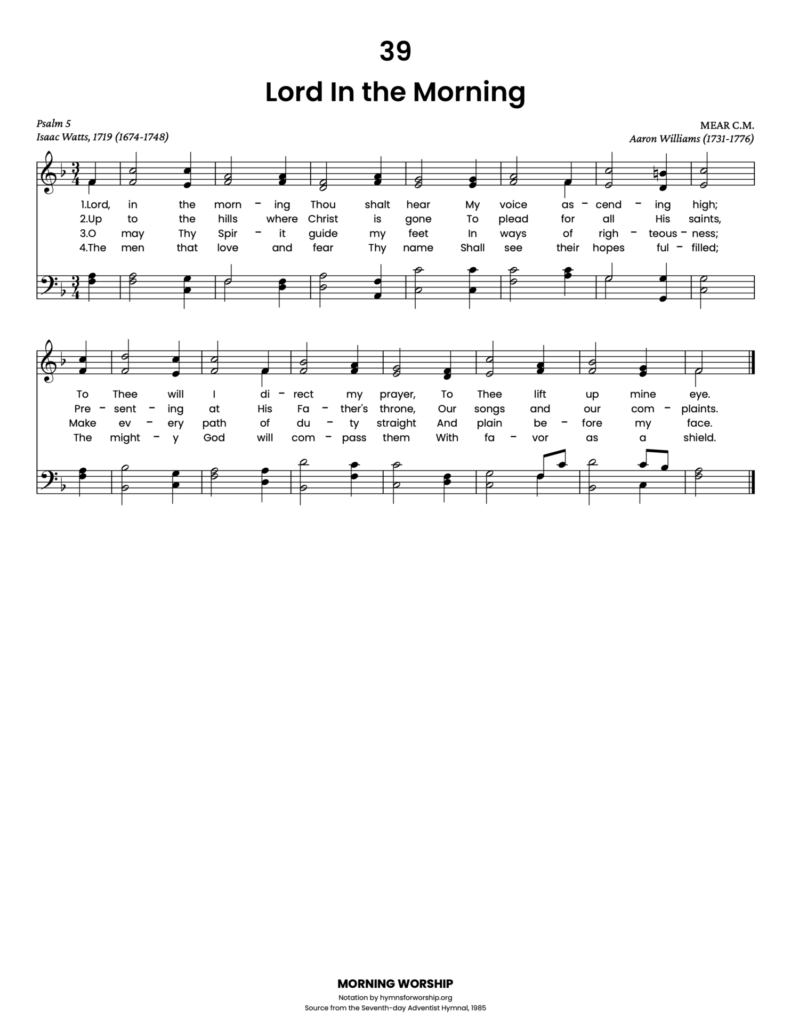
Lord, in the morning Thou shalt hear
My voice ascending high;
To Thee will I direct my prayer,
To Thee lift up mine eye.
This hymn appears in:
Get the hymn sheet in other keys here
For Worship Leaders
Make each hymn more meaningful with these helpful tools: Short, ready-to-use hymn introductions for church bulletins, multiple ways to introduce a hymn based on your worship theme and in-depth history and insights to enrich your song service.
Hymn Spotlight: Lord, In the Morning
This paraphrase of Psalm 5 by Isaac Watts (1674–1748) appeared in The Psalms of David Imitated (1719) with the title “For Lord’s Day Morning.” Watts emphasized prayer and worship as the first act of the day, reflecting the psalmist’s devotion.
The tune MEAR, likely by Aaron Williams (1731–1776), was widely used in early American hymn collections. Its gentle yet firm melody echoes the soul’s quiet confidence in God’s guidance.
May this hymn remind us to seek God’s presence at the start of each day!
📖 Reference: Feel free to share but please cite hymnsforworship.org when reproducing.
Introductions for Sabbath School Song Service (based on specific lesson quarterlies):
SDAH 039 Lord in the Morning
A prayerful hymn about directing one’s voice to God, seeking the Spirit’s guidance in righteous living, and walking in His ways. (Choose This Day; Lesson 13, 2025 4th Quarter)
Is a hymn of dedication, asking for God’s guidance and strength as the day begins. It expresses a desire for God’s presence throughout the day, seeking
His help to live a life of faith and obedience. (Understanding Sacrifice; Lesson 6, 2025 2nd Quarter)
This paraphrase of Psalm 5 by Isaac Watts (1674-1748; see Biographies) appeared in his Psalm of David, 1719. There are eight stanzas in the original hymn. Watts added the following note after his hymn: “This psalm begins with the mention of morning prayer, and proceeds to the worship of God in His temple, which inclined me to entitle it “For Lord’s Day Morning.”
Regarding SDAH stanzas 2 and 3, Watts commented, “Where any just occasion is given to make mention of Christ and the Holy Spirit, I refuse it not; and I am persuaded David would not have refused it, had he lived under the gospel, nor St. Paul, had he written a Psalm-Book.” This illustrates the principle Watts had in mind in the full title he gave his book, The Psalms of David Imitated in the Language of the New Testament, and Adapted to the Christian State and Worship.
Comparison of the hymn with the psalm will show that stanza 1 and 2 in the SDAH correspond with the first three verses of the psalm, stanza 3 with verse 8, and stanza 4 with verses 11 and 12.
The tune MEAR is probably by the music engraver Aaron Williams (1731-1776), of Welsh descent, a member of the Scots Church in London, and editor of Williams’ Psalmody, 1770. MEAR appears in an early New England collection of hymn tunes appended to a copy of an edition of an edition of Tate and Brady’s New Version, published in Boston in 1757. It is certainly a shortened version of the tune HOLBORN, which first appeared in 1763 in Williams’ The Universal Psalmist. Another Watts-Wiliams’ combination is SDAH (372), “How Beauteous Are Their Feet.” to the tune ST. THOMAS.
Stanza:
1 – 4 – Psalm 5:1-12

Text
1
Lord, in the morning Thou shalt hear
My voice ascending high;
To Thee will I direct my prayer,
To Thee lift up mine eye.
2
Up to the hills where Christ is gone
To plead for all His saints,
Presenting at His Father’s throne
Our songs and our complaints.
3
O may Thy Spirit guide my feet
In ways of righteousness;
Make every path of duty straight
And plain before my face.
4
The men that love and fear Thy name
Shall see their hopes fulfilled;
The mighty God will compass them
With favor as a shield.

Hymn Info
Author
Isaac Watts (1674-1748)
Year Published
1719
Hymn Tune
MEAR
Metrical Number
C.M.
Composer
Aaron Williams (1731-1776)
Theme
MORNING WORSHIP
Explore more hymns: