WORSHIP >> Adoration & Praise
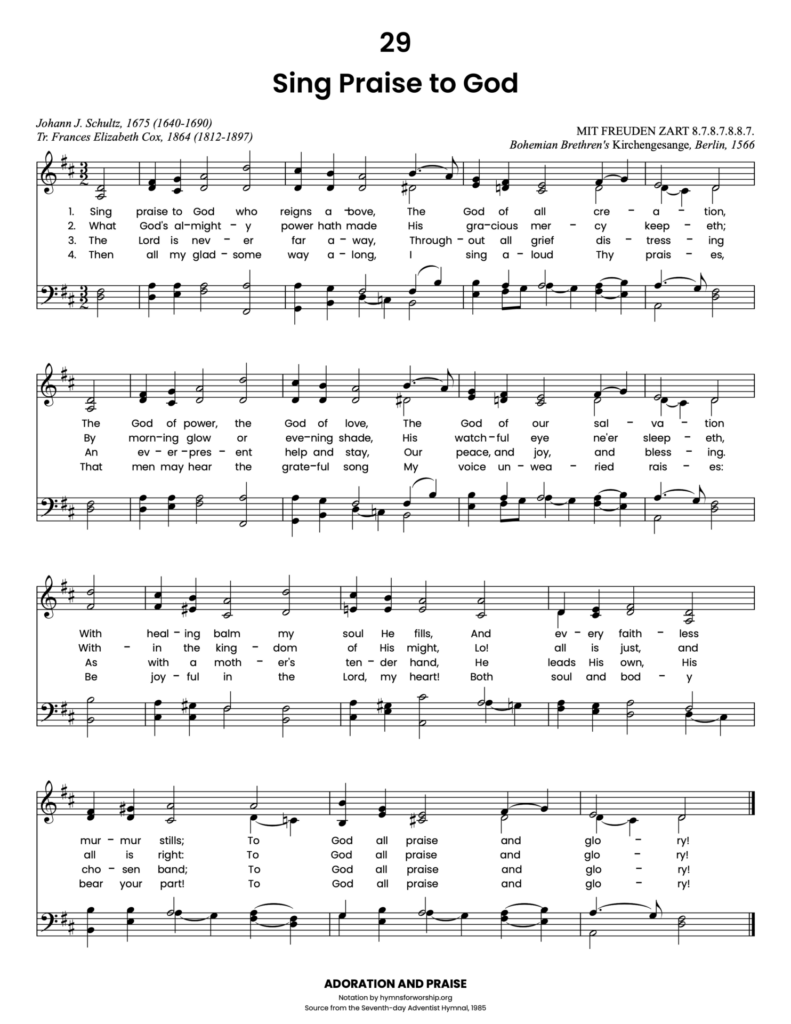
SDAH 29
Sing praise to God who reigns above,
the God of all creation,
the God of power, the God of love,
the God of our salvation.
Get the hymn sheet in other keys here
For Worship Leaders
Make each hymn more meaningful with these helpful tools: Short, ready-to-use hymn introductions for church bulletins, multiple ways to introduce a hymn based on your worship theme and in-depth history and insights to enrich your song service.
Hymn Spotlight: Sing Praise to God
A hymn of thanksgiving, Sing Praise to God is based on Deuteronomy 32:3—“Because I will publish the name of the Lord: ascribe ye greatness unto our God.” Originally written in 1675 by Johann Jacob Schütz, it was later translated into English by Frances Elizabeth Cox in 1864, becoming a treasured part of Lutheran hymnody.
Schütz (1640–1690) was a lawyer and devout theologian in Frankfurt, Germany. Influenced by Philipp Spener, he later became part of the Separatist movement, seeking a deeper spiritual life beyond traditional Lutheranism.
The tune, MIT FREUDEN ZART (With Tender Joy), is linked to the Bohemian Brethren, followers of John Huss who fled persecution in the 16th century. The melody, believed to date back to the Middle Ages, carries the spirit of joy and resilience, making it a fitting setting for this hymn of praise and trust in God.
As we sing today, may our voices proclaim God’s greatness, lifting joyful thanksgiving for His faithfulness!
📖 Reference: Feel free to share but please cite hymnsforworship.org when reproducing.
Introductions for Sabbath School Song Service (based on specific lesson quarterlies):
SDAH 029 Sing Praise to God
God as the all-powerful, loving Creator who reveals His character through His works and constant care for His people. It reflects the call to know Him andtrust in His just and merciful nature. (To Know God; Lesson 2, 20206 2nd Quarter)
Who reigns above, praises God as the all-powerful Creator of all things and also acknowledges His tender care and presence with His people, reflecting both His greatness and nearness. (To Know God; lesson 2, 2026 2nd Quarter)
This hymn of nine stanzas was in Schutz’s Christliches Gedenkbüchlein (Christian Commemorative Booklet), published in 1675 at Frankfurt am Main, Germany. It was headed “Hymn of Thanksgiving” and was based on Deuteronomy 32:3, “Because I will publish the name of the Lord: ascribe ye greatness unto our God.”
Frances Cox translated eight of the stanzas into English, and it was printed in her Hymns From the German, 1864. Ever since then it has been a treasured part of the Lutheran song tradition.
Johann Jacob Schutz was born September 7, 1640, at Frankfurt am Main, Germany. He studied law and practiced all of his life in his hometown. He was highly respected as a counselor, and for His deep sense of piety. Influenced by Philipp Spener and Johann Petersen, he left the Lutherans and became a Separatist. In 1683 he joined with others in the Frankfurt Company, which purchased land in Germantown, Pennsylvania, from William Penn. He died at Frankfurt on May 22, 1690.
Frances Elizabeth Cox was born on May 10, 1812, at Oxford, England. She wrote a few poems for magazines before she achieved fame as a translator. Barron C.C.J. Bunsen, ambassador from Germany 1841 to 1854, had compiled an important book of German hymns in 1833 and suggested that she make some of them available in English. She did so, translating and publishing 46 of them in Sacred Hymns From the German, 1841. Later she revised 27 of them and added 29 new ones in Hymns From the German, 1864. She died at Iffley, Oxford, in September 1897.MIT FREUDEN ZART (With Tender, or Fond, Joy), gets its name from the original German text associated with this tune, the translation of which is, “With high delight let us unite.” It is also known as BOHEMIAN BRETHREN, after the followers of John Huss, who fled persecution in Bohemia (Czechoslovakia) and found refuge on the estate of Count Zinzendorf (see SDAH 177) in Saxony, Germany. The hymnbooks of the brethren made free use of adopted folk songs, and this could be from such a source. It is believed that the tune originated in the Middle Ages, and many different versions have found their way into hymnbooks. It is closely related to LASST UNS ERFREUEN (see SDAH 2, 91, 228). It resembles the tune for Psalm 138 in the Genevan Psalter and is similar to a popular French song, Une pastorelle gentille,” printed about 1529. The Bohemian Brethren included it in their Kirkengesaänge (Church Hymns), 1566, and Ralph Vaughan William (see Biographies) introduced it to English congregations in the English Hymnal, 1906.
Stanza:
1 – Psalm 148:5
2 – Psalm 121:4
3 – Psalm 46:1
Isaiah 66:13

Text
1
Sing praise to God who reigns above,
the God of all creation,
the God of power, the God of love,
the God of our salvation.
With healing balm my soul He fills,
and every faithless murmur stills;
To God all praise and glory!
2
What God’s almighty power hath made
His gracious mercy keepeth;
By morning glow or evening shade,
His watchful eye ne’er sleepeth,
Within the kingdom of his might,
Lo! all is just, and all is right:
To God all praise and glory!
3
The Lord is never far away,
throughout all grief distressing,
an ever present help and stay,
our peace and joy and blessing.
As with a mother’s tender hand,
He leads His own, His chosen band:
To God all praise and glory!
4
Then all my gladsome way along,
I sing aloud thy praises,
that men may hear the grateful song
my voice unwearied raises:
Be joyful in the Lord, my heart!
both soul and body bear your part!
To God all praise and glory.

Hymn Info
Author
Johann J. Schutz (1640-1690)
Translator
Frances Elizabeth Cox (1812-1897)
Year Published
1864
Hymn Tune
MIT FREUDEN ZART
Metrical Number
8.7.8.7.8.8.7.
Tune Source
Bohemian Brethren’s Kirchengesange, Berlin
Year Composed
1566
Theme
ADORATION AND PRAISE
Explore more hymns: