WORSHIP >> Adoration & Praise
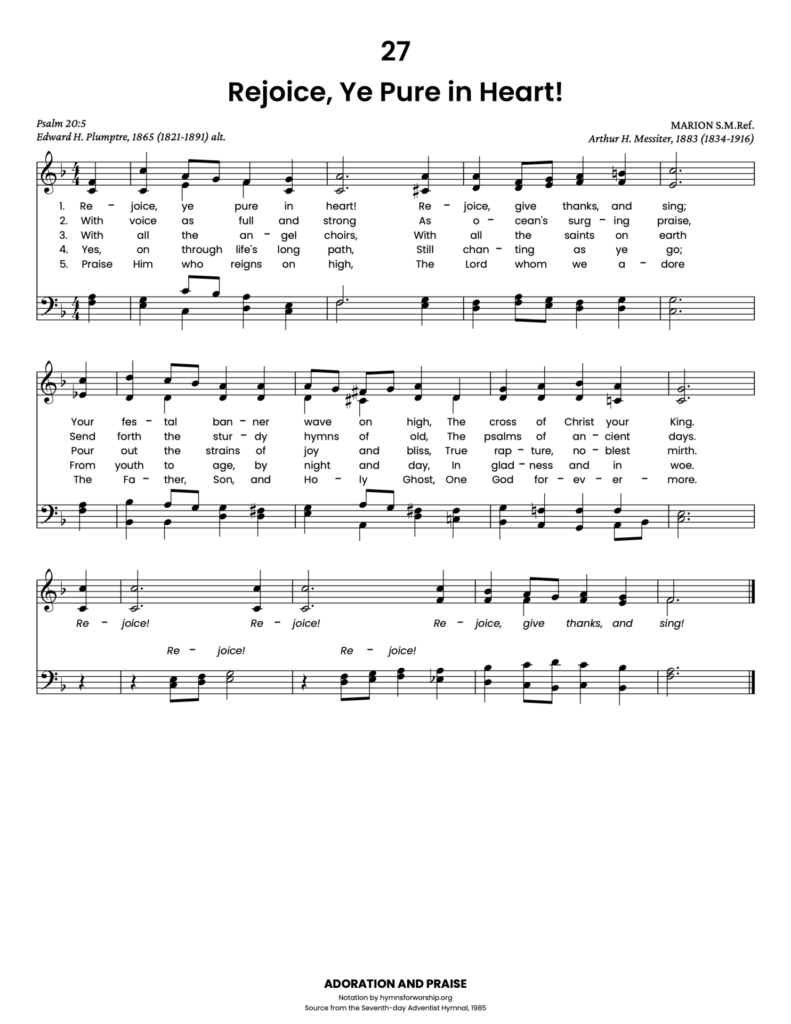
SDAH 27
Rejoice ye pure in heart!
Rejoice, give thanks, and sing;
Your festal banner wave on high,
The cross of Christ your King.
This hymn appears in:
Get the hymn sheet in other keys here
For Worship Leaders
Make each hymn more meaningful with these helpful tools: Short, ready-to-use hymn introductions for church bulletins, multiple ways to introduce a hymn based on your worship theme and in-depth history and insights to enrich your song service.
Hymn Spotlight: Rejoice, Ye Pure in Heart
A triumphant hymn of joyful procession, Rejoice, Ye Pure in Heart was written by Edward Hayes Plumptre in 1865 for a choir festival at Peterborough Cathedral. Inspired by Psalm 20:5—*”We will rejoice in thy salvation, and in the name of our God will set up our banners”—*the hymn originally had 11 stanzas to accommodate the long cathedral processional, symbolizing the Christian’s journey toward the New Jerusalem.
Plumptre (1821–1891) was a noted Anglican theologian, preacher, and hymn writer, known for his profound scholarship and poetic hymns. His words reflect Philippians 4:4, calling believers of all ages to “Rejoice in the Lord always!”
The tune, MARION, was composed in 1883 by Arthur Henry Messiter and named after his mother. It is unusual for its shifting key changes, adding musical energy and forward movement, perfect for a hymn of joyful celebration.
As we sing today, may our voices ring with gladness, lifting banners of praise as we continue our journey of faith!
📖 Reference: Feel free to share but please cite hymnsforworship.org when reproducing.
Introductions for Sabbath School Song Service (based on specific lesson quarterlies):
SDAH 027 Rejoice Ye Pure In Heart
The hymn inspires a sense of unity and devotion among believers as they exalt God’s name together. (The Two Witnesses; Lesson 6, 2024 2nd Quarter)
Celebrates the joy of worshiping God as a community and emphasizes the importance of praising Him together as the “assembly of the upright.” (Worship That Never Ends; Lesson 12, 2024 1st Quarter)
The captive is set free! The slave to sin and death is rescued and given the very life of God. What theme of rejoicing and thanksgiving at every step and circumstance of life all the way to our heavenly home. (Jesus Wins, Satan Loses; Lesson 1, 2023 2nd Quarter)
Though tempted in all points as we are, Jesus was undefiled, sinless, pure and holy. His righteousness and obedience was perfect, though He condescended to take on sinful human flesh in this world. He is our example, and gives us His strength to follow Him. (Jesus, The Faithful Priest; Lesson 6, 2022 1st Quarter)
Christ is our King, and because He is our King, God the Father becomes our King and Father, and the Holy Spirit our Comforter. What greater gift could ever be given to us? What greater reason is there to rejoice? (The Promised Son; Lesson 3, 2022 1st Quarter)
These words were written by Edward Hayes Plumptre in 1865 especially for the choir festival in Peterborough Cathedral. They were first sung there to a tune by William Henry Monk (see SDAH 50). The theme was taken from Psalm 20:5: “We will rejoice in thy salvation, and in the name of our God will set up our banners,” and amplified to suit the special occasion. The length of time occupied in a choir festival procession in a large cathedral necessitates a long hymn. Consequently, there were originally 11 stanzas. The complete text of the hymn shows that the author has used the processional as a type of the Christian pilgrim’s spiritual march to the New Jerusalem, singing all the way. Other scriptures referred to are: “Rejoice in the Lord alway: and again I say, Rejoice” (Phil. 4:4); “Both young men . . . ; old men” (Ps. 148:12).
Plumptre was born in Bloomsbury, London, on August 6, 1821, and educated at King’s College, London, and University College, Oxford. He gained his B.A. in 1844, was ordained to the ministry in the Anglican Church in 1846, and received his M.A. in 1847. He was then appointed as chaplain at King’s College. During his occupancy there, which lasted until 1868, he was first professor of pastoral theology and then of New Testament exegesis. He was also prebendary at St. Paul’s Cathedral, and special lecturer at Oxford on several occasions. In 1869 he was appointed as rector of Pluckley, a small town in Kent. In 1873 he was vicar of Bickley, a village also in Kent, and then in 1881 was appointed dean of Wells Cathedral in Somerset. He was a noted theologian and preacher, and wrote copiously on history, the classics, divinity, and biography. He wrote several volumes of verse and hymns–many for special occasions, and some translated from Latin. The University of Glasgow honored him with a D.D. degree in 1875. He died at Wells on February 1, 1891. He also wrote SDAH 351, “Thy Hand, O God Has Guided.”The tune MARION was composed in 1883 by Arthur Henry Messiter and named for his mother, Marrion. It is unusual in that it undergoes several changes of key in such a short hymn: F major, D minor, C major, B-flat major, D major, and back to F major again. Messiter was born in Frome, Somerset, on April 1, 1834, and from ages 17 to 21 was apprenticed to a musician. Then he studied piano and voice privately and became a piano teacher. He emigrated to the United States in his late 20s and was a choir member of the Trinity Episcopal Church in New York City. Next, he was organist at St. Mark’s, Philadelphia, and professor of music at the Female College in Poultney, Vermont. Returning to Philadelphia, he was the organist at three churches successively. In 1866 he was appointed choir leader and organist at Trinity Episcopal Church in New York City and retired in 1897. He wrote several anthems, edited a psalter, and after retirement in 1906, wrote The History of the Choir and Music of Trinity Church. He died in New York City on July 2, 1916.
Stanza:
1 – Psalm 20:5
2 – Psalm 148:12

Text
1
Rejoice ye pure in heart!
Rejoice, give thanks, and sing;
Your festal banner wave on high,
The cross of Christ your King.
Refrain
Rejoice, rejoice, rejoice, rejoice
Rejoice, Give thanks and sing.
2
With voice as full and strong
As ocean’s surging praise,
Send forth the sturdy hymns of old,
The psalms of ancient days.
3
With all the angel choirs,
With all the saints of earth,
Pour out the strains of joy and bliss,
True rapture, noblest mirth.
4
Yes, on through life’s long path,
Still chanting as ye go;
From youth to age, by night and day,
In gladness and in woe.
5
Praise Him who reigns on high,
The Lord whom we adore,
The Father, Son and Holy Ghost,
One God forever more.

Hymn Info
Author
Edward H. Plumptre (1821-1891)
Year Published
1865
Hymn Tune
MARION
Metrical Number
S.M. Ref.
Composer
Arthur H. Messiter (1834-1916)
Year Composed
1833
Theme
ADORATION & PRAISE
Explore more hymns: