WORSHIP >> Adoration & Praise
SDAH 8
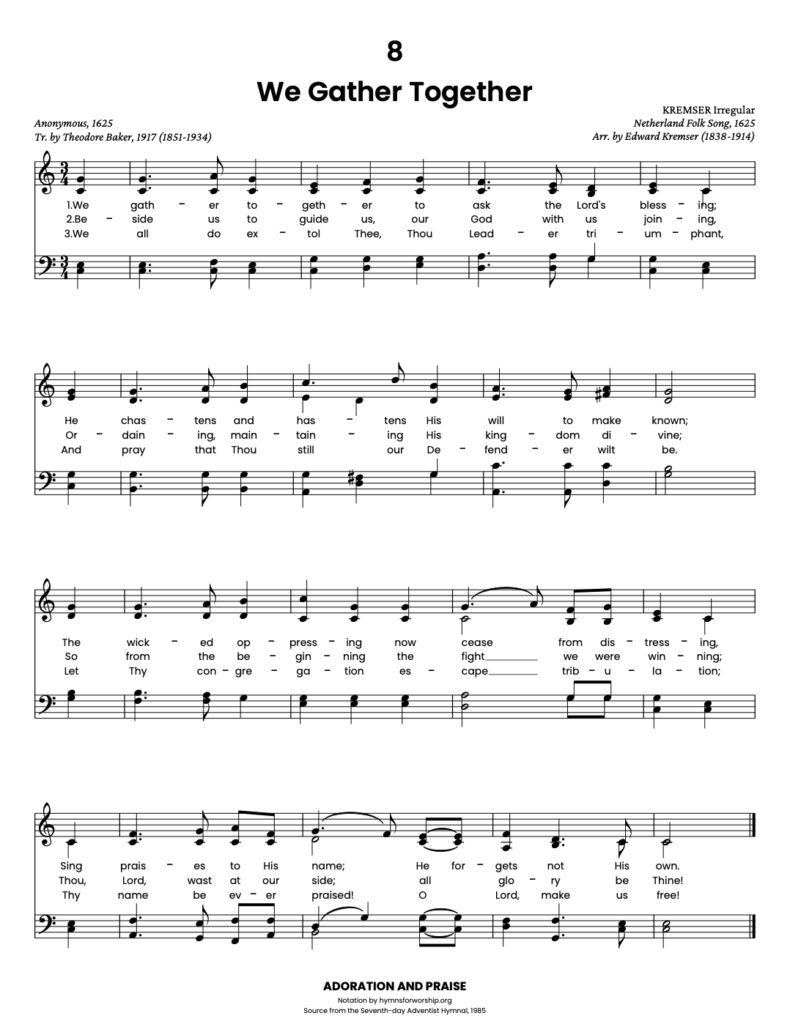
We gather together to ask the Lord’s blessing;
He chastens and hastens His will to make known.
The wicked oppressing now cease from distressing.
Sing praises to His Name; He forgets not His own.
This hymn appears in:
Get the hymn sheet in other keys here
For Worship Leaders
Make each hymn more meaningful with these helpful tools: Short, ready-to-use hymn introductions for church bulletins, multiple ways to introduce a hymn based on your worship theme and in-depth history and insights to enrich your song service.
Hymn Spotlight: We Gather Together
A hymn of thanksgiving and trust in God’s providence, We Gather Together has its roots in the struggles of the Protestant Netherlands against Catholic Spanish rule in the late 16th century. Written around 1625, it was originally a celebration of the Dutch victory over Spanish forces and the newfound freedom to worship. The hymn reflects the faith of a people who endured hardship but found strength in God’s guidance, echoing Hebrews 13:6—“The Lord is my helper, and I will not fear what man shall do unto me.”
The English translation we sing today was done by Theodore Baker (1851–1934), a respected music scholar and editor. His work preserved the hymn’s spirit of gratitude and reliance on God, making it a cherished song in Thanksgiving celebrations and worship services around the world.
The tune, KREMSER, is named after Eduard Kremser (1838–1914), who rediscovered and arranged this melody in 1877. Originally a Dutch folk tune, it was set to these lyrics in 1626 by Adrian Valerius, ensuring its legacy as a hymn of faith and national resilience.
As we sing today, may our voices join in heartfelt gratitude for God’s faithfulness, just as believers through the centuries have sung: “Sing praises to His name; He forgets not His own!”
📖 Reference: Feel free to share but please cite hymnsforworship.org when reproducing.
Introductions for Sabbath School Song Service (based on specific lesson quarterlies):
SDAH 008 We Gather Together
Emphasizes the unity and fellowship of believers as they come together to
praise God, acknowledging His sovereignty and faithfulness. (Inside Out; Lesson 6, 2024 3rd Quarter)
This Anonymous old Dutch song is reminiscent of the struggles between the Protestant Netherlands and the Catholic Spanish oppressors at the time of the supremacy of Philip II of Europe. At the time of that king’s death in 1598, the United Provinces of the Northern section of the Netherlands continued their struggle for independence and gained a truce for 11 years. Although this truce did not recognize their independence and an attempt at reconquest was renewed, the Dutch republic became a sovereign state at that time under Maurice of Nassau.
Religious warfare and divine guidance and deliverance are noted through all these stanzas, which enlarge upon Hebrew 13:6, “The Lord is my helper, and I will not fear what man shall do unto me.” The lines were first written about 1625 and published in 1626 to celebrate the liberation of the Netherlands from Spain. The English translation by Baker was printed first in Coenraad V. Bos’s Dutch Folk-songs, 1917.
Theodore Baker was born June 3, 1851, in New York. As a young man he was trained for a career in business. At age 23 he decided to switched to music, and went to Leipzig, Germany, for study with Oscar Paul. His doctoral thesis was the first serious study of the music of American Indians. In 1890 he returned to the United Stated to become musical editor and translator for the publishing house of G. Schirmer. He edited and published the monumental Baker’s Biographical Dictionary of Music and Musicians, which, under editorship of Nicolas Slonimsky, is now in its seventh edition. Baker’s Dictionary of Musical Terms went through more than 25 printing and sold more than 1 million copies. In 1926 he retired, and lived in Dresden, Germany, until his death in October 13, 1934. His other translation in SDAH is No. 131, “Lo, How a Rose E’er Blooming.”
The tune KREMSER is named after Eduard Kremser, a Biennese director of a male-voice singing society. He rediscovered the tune, originally a Dutch folk song appropriated by Adrian Valerius in his collection of Dutch songs published in Haarlem in 1626. Kremser used it in a collection of works he arranged for male chorus and orchestra, the Sech Altneiderlandische Volkslieder, 1877, all of which were from Valerius’ book, made 250 years earlier. Kremser was born April 10, 1838, and died November 26, 1914, in Vienna. He composed operatas, cantatas, and orchestral and piano music.
Stanza
1 – Hebrews 13:6

Text
1
We gather together to ask the Lord’s blessing;
He chastens and hastens His will to make known.
The wicked oppressing now cease from distressing.
Sing praises to His Name; He forgets not His own.
2
Beside us to guide us, our God with us joining,
Ordaining, maintaining His kingdom divine;
So from the beginning the fight we were winning;
Thou, Lord, wast at our side, all glory be Thine!
3
We all do extol Thee, Thou leader triumphant,
And pray that Thou still our defender wilt be.
Let Thy congregation escape tribulation;
Thy name be ever praised! O Lord, make us free!

Hymn Info
Author
Anonymous
Translator
Theodore Baker, 1917 (1851-1934)
Year Published
1625
Hymn Tune
KREMSER
Metrical Number
Irregular
Arranger
Edward Kremser (1838-1914)
Tune Source
Netherland Folk Song
Year Composed
1625
Theme
ADORATION & PRAISE
Explore more hymns: