Chapters
02:23 Losing a leg
04:25 Leaving Adventism
06:48 Coming back to hope
10:46 A man of the page
13:47 Creativity thru invention
15:51 Signs of weakness
17:21 Established but mistaken
21:18 Closing chapter
24:39 Lessons from Uriah Smith’s life
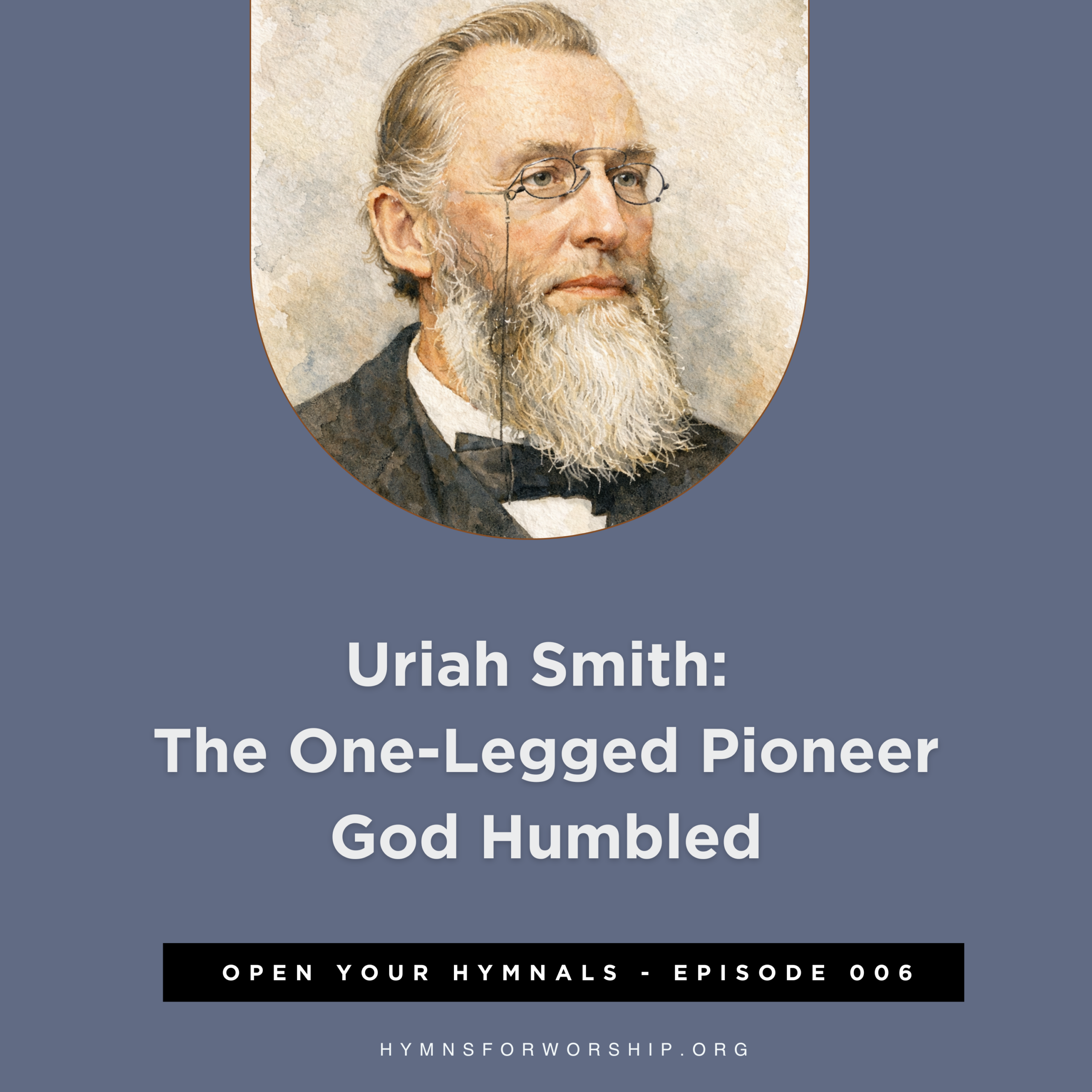
This month, I am going to do a two-part journey into the life and legacy of Uriah Smith.
In this episode, we won’t focus on one of his hymns just yet. We’ll focus on the man himself—his life, his losses, his gifts, his failures, and the strange, steady way God used him. And then in the following episode, we can turn to the hymn and hear his words with new understanding.
Uriah Smith is often remembered as an editor, a theologian, a pioneer, a man connected with prophecy and doctrine. And all of that is true. But sometimes when names become large in denominational memory, they also become kind of flat. We remember what they produced, but not what they endured. We remember what they taught, but not what they wrestled through to become the kind of people they were.
And Uriah Smith was not simply a name on a title page. He was a person. A boy. A brother. A gifted mind in a frail body. A worker with real disappointments, real limitations, real blind spots, and real usefulness in the cause of God.
And perhaps that is why his life still inspires. Because his story is not mainly the story of a man with no obstacles. Instead, it is the story of a man who would not let his obstacles decide the measure of his usefulness.
Losing a leg
When Uriah Smith was still a boy, his life was marked by pain in a way most of us can scarcely imagine.
He was born in 1832 in New Hampshire. His family were among those swept up in the Millerite expectation of Christ’s soon return. But before he would become known for editing, writing, or prophecy, he was simply a child whose body had already been touched by suffering. At about the same age that he passed through the disappointment of 1844, his infected left leg had to be amputated above the knee. Later sources remember that in later life he would invent an artificial leg with flexible knee and ankle joints, but as a boy there was nothing noble or romantic about what he first endured. It was loss, pain, and permanent limitation.
For a child in the mid-nineteenth century, to lose a leg was no small inconvenience. It was not merely a challenge to overcome in inspirational language. It could alter how others viewed you, what work you might do, where you might go, what future seemed possible. It could easily become the fact around which the rest of your life was arranged.
And yet, in Uriah Smith’s case, it did not become his whole story.
Sure… it does not mean it did not matter. Because it mattered greatly. It surely shaped his daily life, his movement, his endurance, his self-consciousness, his sense of dependence. But it did not imprison his usefulness, and it did not become his master.
Around that same period came another kind of wound—less visible, but in some ways just as deep.
Leaving Adventism
Uriah was twelve years old when the Great Disappointment swept through the Millerite movement in 1844. His family had believed. They had hoped. They had expected Christ to come. And then He did not come as they had understood. For many Millerites, that disappointment was not merely theological confusion. It was emotional shock, public humiliation, spiritual disorientation. It was the collapse of expectation.
So again, notice how those two things meet in the young life of Uriah: bodily loss and spiritual disappointment.
A withered leg.
A shaken faith.
A future suddenly less clear than before.
And so it is no surprise that for a time, Uriah drifted.
Along with his older sister Annie, he left the Adventists for a season and pursued education.
You know, as big of a pioneer was as Uriah Smith, he was not born with a pioneer mindset. His faith got cold, he pulled away and was discouraged too about why Jesus did not come when all the Scriptures pointed to Him coming on that fateful day. Uriah was a person, and like many people, disappointment left its mark.
You know sometimes we tell the stories of early Advent believers as if they were made of stronger material than ordinary Christians today. But they were not. They were people with nerves, egos, disappointments, ambitions, griefs, and susceptibilities. They needed to be converted, and in some cases reconverted, just as surely as we do.
And so after drifting from the Advent hope, Uriah Smith pursued education at Phillips Exeter Academy, where he received a strong classical training. This meant studying Latin, Greek, literature, rhetoric, history, disciplined writing to mention a few. ****He appears to have hoped for further study at Harvard and was also positioned for a teaching career, but those plans were interrupted.
And that brings us to one of the great turning points in Uriah Smith’s life.
Coming back to hope
In 1852, he attended a Sabbatarian Adventist gathering in Washington, New Hampshire, where he heard James and Ellen White. By this point he was not a deeply engaged young believer hungering for revival. Historical accounts suggest he had given little attention to religion by then. But something began to thaw in him. He listened. He reconsidered. He re-examined. Later, reflecting on that period, he described himself as deciding to cast his lot with “the remnant, who keep the commandments of God, and the faith of Jesus.” Late in 1852, he became a Sabbath-keeping Adventist.
I really find that deeply moving.
Because not every return to God comes in this blaze of an experience, you know?
Sometimes it just comes through rethinking, or conviction settling quietly back into the heart.
Sometimes it’s through hearing truth explained with enough clarity that the fog begins to lift.
And maybe someone listening today knows exactly what that feels like.
You know that feeling of not being openly rebellious. Not dramatic atheism.
But just adrift. Just weary. Just having a so-so conviction.
Uriah Smith’s return to Adventism reminds us that beginning again is possible.
Not because we are naturally stable, but because God is patient.
And once Uriah began again, he did not return halfway.
Discover Uriah Smith’s hymn, ‘O Brother, Be Faithful.’
Early the next year, in 1853, he joined James and Ellen White in Rochester, New York, in the publishing work. He had been well educated, like his sister Annie. His first major published contribution was a 35,000-word poem, The Warning Voice of Time and Prophecy. In other words, he could have pursued a more respectable, more secure path because he had ability. He had education. He had prospects. But he chose instead to attach himself to a small, struggling movement whose publishing work demanded more sacrifice than comfort.
You know, sometimes we imagine that to serve God is merely to offer Him what no one else wanted. But in Uriah Smith’s case, what he offered was not leftover ability. It was real ability. I mean he had a trained mind. Literary talent. Artistic skill. Mechanical ingenuity. Teaching capacity.
This part of Uriah’s story makes me reflect on something I have seen in ministry life. Sometimes people enter mission work not from a deep sense of consecration, but because they feel there is nowhere else to go. The demands of ordinary work feel too much. The world feels too toxic for them. They do not believe they are capable of building a life elsewhere at the moment, so ministry becomes the softer landing. I say that carefully, because I know people come with wounds and exhaustion. But still, God’s work should never be treated as a fallback for those who have given up on growing. Uriah Smith did not come because he was unable to do anything else. He joined the ministry because he believed his abilities belonged to God. And that is a very different spirit.
I mean, what are our abilities for?
For reputation?
For financial stability alone?
For self-expression?
For comfort?
Clearly for Uriah Smith, his abilities were instruments in the hand of God.
A man of the page
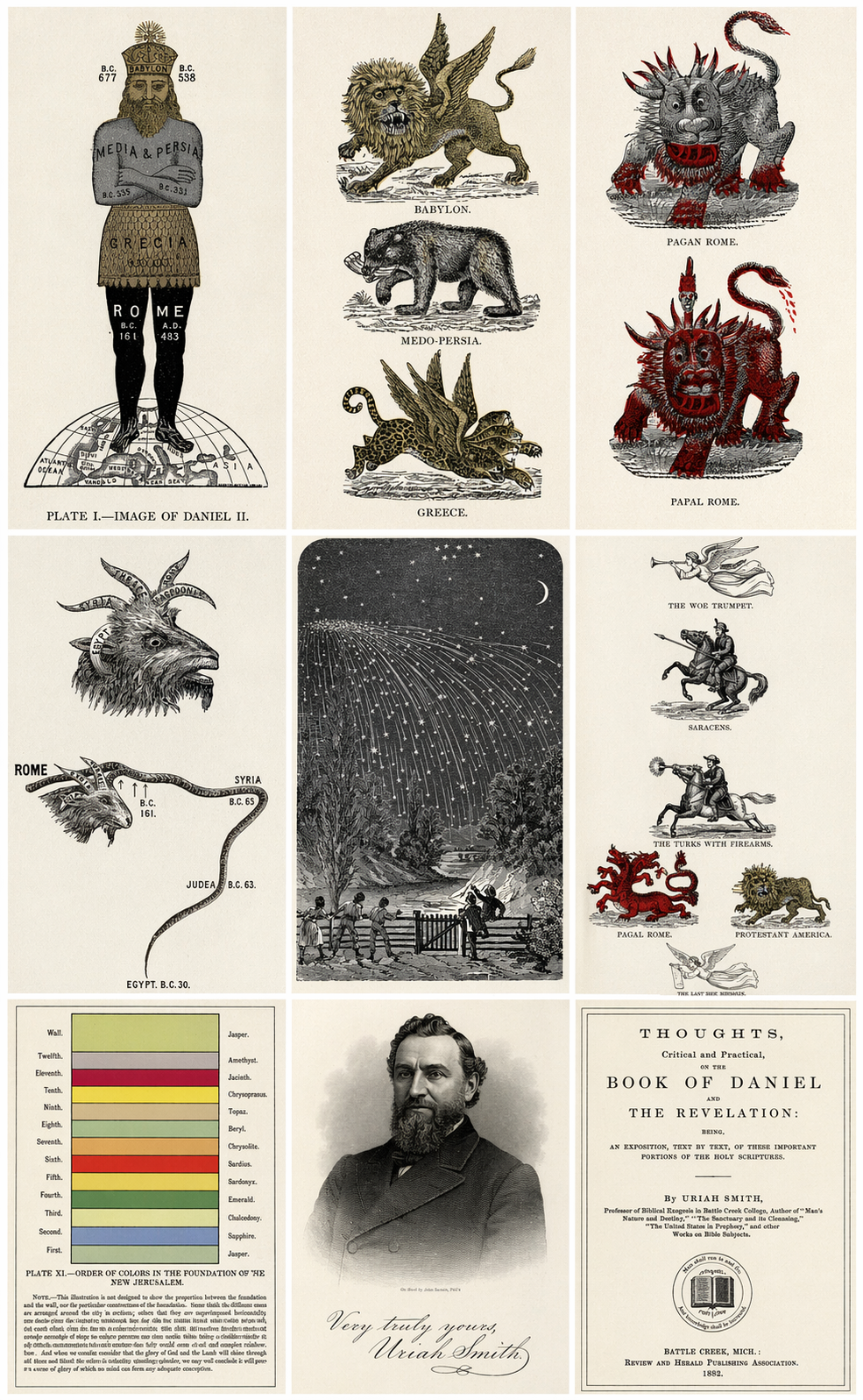
In 1855, when the Review moved to Battle Creek, Uriah Smith became editor at the age of 23. And for much of the next fifty years, he served either as editor or on the editorial staff of the Review and Herald. He also became the first secretary of the General Conference when it organized in 1863, and taught Bible for a number of years at Battle Creek College. In other words, he held many responsible positions in the work.
Now to modern ears, the position of an editor can sound administrative, you know, almost dull and boring. But in early Adventism, it was anything but small work.
The Review was one of the chief ways a scattered people were held together. It carried doctrine, correction, encouragement, reports, warnings, and identity. One historian describes the Advent Review and Sabbath Herald as the journal that bound together the scattered and often isolated adherents of the young movement. Another White Estate summary notes that Uriah Smith effectively became a kind of pastor to isolated believers through the printed page.
And so we see that Uriah Smith was not chiefly a man of the stage. He was a man of the page. And through that page, he anchored the people to the present truth.
Through editorials, articles, arguments, and exposition, he helped shape how early Seventh-day Adventists understood themselves. He wrote books and tracts— more than twenty over the course of his life— and the best known of them was Thoughts on Daniel and Revelation.
He also helped articulate Adventist belief in 1872 through the anonymous tract A Declaration of the Fundamental Principles Taught and Practiced by Seventh-day Adventists. It was not intended as a binding creed above Scripture; rather, it was meant to summarize what Adventists held, help answer public misunderstanding, and guard against confusion from those claiming the Adventist name while undermining its shared convictions.
In other words, Uriah was helping a young movement explain itself. He was helping put language around their convictions. He was helping ordinary believers to say, “Yeah, this is what we understand the Bible to teach. This is why we exist as Seventh-day Adventists. This is what ties us together as believers.” Meaning he helped form the identity of the early Adventists through his writings.
Creativity thru invention
But of course, Uriah Smith was not only a writer.
He was also an artist, engraver, inventor, poet, hymn writer, teacher, and administrator. The White Estate describes him exactly in those terms. He produced some of the first illustrations connected with early Adventist publishing, and later in life he accumulated patents, including one for an improved artificial leg.
Uriah Smith had been one-legged since he was a boy. He could have just accepted that fate. But making his own artificial leg and securing patents for it tells you something about the kind of man he was.
And there is a profound lesson in that.
And that is: to take one’s suffering and make it a place of service. Which is to say, in effect: this pain will not only diminish me; by God’s grace, it may deepen me, sharpen me, even teach me how to help.
Many people are living with limitations of one sort or another— physical weakness, chronic discouragement, family burdens, financial constraints, late starts, educational gaps, disappointments they never expected. And one of the quiet lies we easily believe is that usefulness belongs mostly to the unencumbered.
But the life of Uriah Smith says otherwise.
The question is not whether you have limits.
The question is whether your limits will become an excuse for barrenness, or an arena in which grace can still work.
Now, to speak honestly of Uriah Smith, we must also speak of his weaknesses. Because it is also in the weaknesses that we learn deep lessons of humility and grace.
Signs of weakness
By the 1880s, Uriah was no young convert and no untested worker. He was established. Respected. Influential. His voice carried weight. And that is often precisely when spiritual danger grows subtler. Not in the excitement of beginning, but in the authority of having long been right, long been needed, long been heard.
First, Uriah’s connection to Battle Creek College became one of the first places where a deeper weakness in his character began to show. During the school troubles of 1882, he sided with the party that was critical of Goodloe Bell, one of the college’s key early teachers. Ellen White believed Bell had been mistreated, and she told Uriah plainly that he was “on the wrong side,” involved with people whom God was not leading. What made the matter worse was that when Ellen White wrote to correct him, Uriah hesitated to regard that counsel as a true testimony because, in his mind, it had not come from a specific new vision about the college conflict. So the problem was not only that he misread the situation. It was that he found it difficult to receive prophetic counsel when it crossed his own settled judgment.
Established but mistaken
And then something similar happened a few years later. At the 1888 General Conference session in Minneapolis, Uriah Smith, along with General Conference president G. I. Butler, strongly opposed certain presentations by E. J. Waggoner and A. T. Jones. The dispute centered in part on the law in Galatians and broader questions related to righteousness by faith and the place of Christ in the message. The discussion, according to the Adventist Encyclopedia, degenerated into a bitter and intractable feud.
Now, many listeners will know 1888 as a defining and painful chapter in Adventist history. Others may know very little about it. But for our purposes here, 1888 was a defining moment in Adventist history because it was not just a debate over fine points of doctrine. What happened in Minneapolis opened up a deeper struggle over righteousness by faith, the place of Christ in the message, and whether the church would recognize light when it came in a form some of its leaders did not expect. That is why 1888 is remembered not simply as a conference, but as a spiritual turning point—one that revealed both the church’s need for a clearer grasp of the gospel and the danger of resisting truth when pride and habit get in the way.
And so, what was Uriah Smith’s problem in 1888? It was not that he suddenly denied the faith. It was that he was so committed to protecting established Adventist teaching that he had difficulty hearing what Jones and Waggoner were trying to emphasize — that a sinner is made right with God, not by law-keeping, but by the righteousness of Christ received through faith. Smith feared that if Adventists changed how they explained certain passages, especially in Galatians, it would weaken the Sabbath and undermine confidence in the whole message. Ellen White strongly supported this emphasis and later said the message was meant to bring “more prominently before the world the uplifted Saviour.” For Uriah Smith tho, the deeper issue was spiritual: he struggled to let fresh light correct positions he had defended for years.
Ellen White strongly reproved Uriah during and after that period. One later historical summary notes that his temporary rejection of the prophetic voice was harmful both to his own Christian experience and to others influenced by him. But the story did not simply end there. In Arthur White’s account, a significant moment of repentance came in 1891, when Uriah spoke with Ellen White and said, with emotion, “If the Lord will forgive me for the sorrow and burdens I have brought upon you, I tell you this will be the last. I will stay up your hands. The testimonies of God shall hold this place in my experience.”
That is one of the most important parts of his story.
Not that he was right all along.
Not that his influence exempted him from danger.
But that he could still be humbled.
There is hope in that.
Hope for older workers.
Hope for experienced leaders.
Hope for those who have done much good and yet have also done real harm.
Hope for anyone who has ever mistaken long familiarity with truth for present tenderness of heart.
Repentance is not only for beginners.
Sometimes the people who have served longest need it most deeply.
Closing chapter
Uriah Smith remained an important laborer in the cause, and by the end of his life he was still at work, still writing, still bearing burdens, still tied to the publishing mission that had defined so much of his adult life.
Then came the closing chapter.
In late 1902, the Review and Herald publishing house in Battle Creek burned. The fire was a devastating blow, and the loss far exceeded what insurance covered. Battle Creek itself was already a place of growing strain and transition, and the destruction of the publishing house marked the end of an era. A later Adventist Review account notes that in those early years, the publishing work was deeply woven into the life of the Advent movement. Through its workers and its printed pages, believers were taught, encouraged, and held together across great distances.
So this was no minor institutional setback. It was a calamity.
And yet during that difficult season, Uriah wrote words of courage. The White Estate preserves a message he prepared for the coming 1903 General Conference session: “I am with you in the endeavor to send forth in this generation this gospel of the kingdom, for a witness to all nations. And when this is completed, it will be the signal for the coronation of our coming King.” The session itself would open later that month, on March 27, in Oakland, California. But Uriah would not live to attend it.
On March 6, 1903, as he was walking to the Review office, he stopped at the home of H. W. Kellogg and spoke about the address he had written for the coming General Conference. According to the Review and Herald obituary, he also remarked that he felt “as though he was a young man.” He then continued on his way, but when he was within sight of the institution where he had labored for so many years, he was stricken with apoplexy, collapsed, was taken home, and died about two hours later without recovering consciousness. In the language of the period, “apoplexy” referred to what we would now ordinarily describe as a stroke.
Just picture this.
An old pioneer.
Still walking toward the work.
Still carrying words for the church.
Still facing the office to which he had given so much of his life.
He did not die in retirement from usefulness.
He died on the way.
And perhaps that is one reason his life leaves such an impression. Not because every position he held was perfect. Not because every judgment he made was flawless. But because the broad outline of his life shows a man who refused to surrender to either limitation or disappointment.
He lost a leg.
He lost heart for a season.
He later lost his way again in controversy.
But again and again, there is this pattern of return, labor, repentance, and perseverance.
Lessons from Uriah Smith’s life
Today, we live in a time that is often obsessed with ideal conditions. The right season. The right body. The right circumstances. The right energy. The right mental state. The right tools. The right freedom from inconvenience. And then—perhaps—we will be useful.
But Uriah Smith’s life points us in another direction.
He reminds us that God is not waiting for perfect conditions before He can use a person. He can work through limitation, through disappointment, through weakness, and even through a life marked by deep struggle. A lost leg did not make Uriah useless. A season of spiritual drift did not put him beyond recovery. And even his failure in the years surrounding 1888 did not have to be the end of his story.
Because perhaps one of the most important things about Uriah Smith is not only that he labored long, but that he was willing, in the end, to be humbled.
And maybe that is part of what faithfulness really is.
Not perfection.
Not never being wrong.
Not never needing correction.
But being willing to return.
Willing to repent.
Willing to keep placing one’s powers, one’s work, and even one’s pride into the hands of God.
That is why the words of 1 Corinthians 15:58 feel so fitting here:
“Therefore, my beloved brethren, be ye stedfast, unmoveable, always abounding in the work of the Lord, forasmuch as ye know that your labour is not in vain in the Lord.”
Uriah Smith was not a marble statue from Adventist history. He was a man who suffered, returned, labored, stumbled, repented, and kept going.
And perhaps that is why his life still speaks.
Because by the grace of God, that can be our story too.
In the next episode, we’ll turn from the man to one of the hymns he wrote, and listen more closely to the faith, longing, and theology that flowed from his pen.
Thank you for listening to Open Your Hymnals.
Explore more hymns: