James White, as the head editor of the Advent Review and Sabbath Herald, led a team of talented youngsters in Rochester, New York. At the age of 32, James, alongside his wife Ellen, aged 26, oversaw a young group of printers, writers, and copywriters, all of whom were under 25 years old.
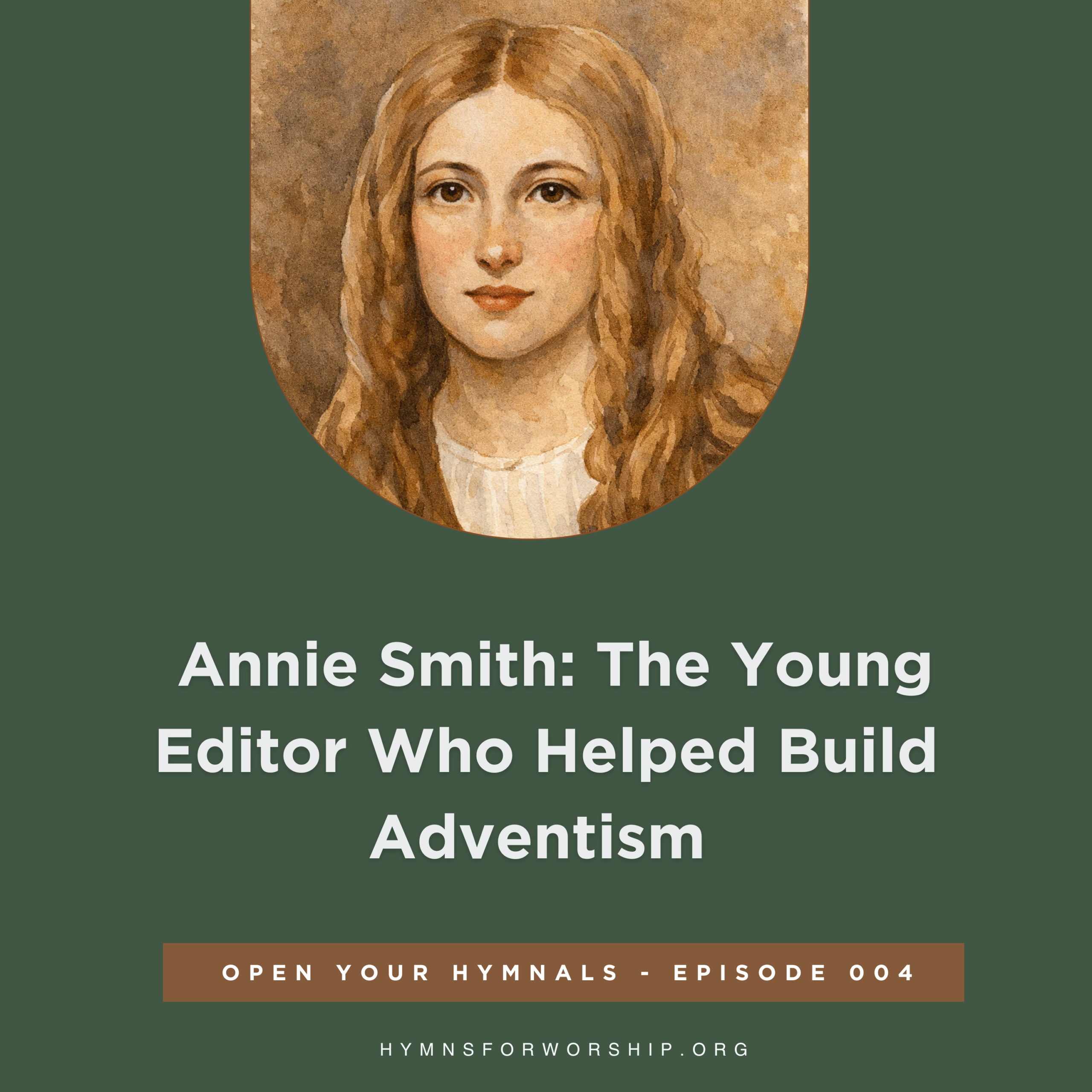
Among them, Annie Smith emerged as a standout leader, entrusted with significant responsibilities in James White’s absence.
Annie coordinated editorial production and ensured the smooth operation of the publication when he was away on trips and other appointments.
Her contributions were essential to the publication’s success. Annie Smith’s skill and steady dedication earned the team’s trust, and she was given a major responsibility—one that confirmed her as a key part of the work.
And so in this episode, we’re embarking on a journey to uncover the remarkable life of Annie Smith, the talented author behind our hymn study for this month. Annie’s pen has graced the pages of the previous 1941 edition of the Church Hymnal with ten beautiful hymns, three of which found their place in the 1985 SDA Hymnal.
Join us as we delve into one of her most beloved hymns in Part 2 of this podcast. But first, let’s shine a spotlight on Annie herself and the pivotal role she played in the early days of the Adventist movement.
Annie’s Beginnings as a Millerite
We mainly gather information about Annie from a brief biography tucked within a collection of poems authored by her mother, Rebekah Smith, which was published in 1871. According to this account, Annie entered the world on March 16, 1828, in West Wilton, New Hampshire.
She was the cherished daughter of Samuel and Rebekah Smith, growing up alongside her more famous brother, Uriah, who was four years younger.
At the age of ten, Annie found solace in her faith, becoming a member of the Baptist Church. However, in 1844, Annie, who was about 15 at that time, left the Baptist community to join the Millerites, anticipating the return of Jesus on October 22, 1844.
Despite her hopeful expectations of witnessing angels descending from the heavens, the day passed like any other ordinary New England day, without any sign of Jesus. Disheartened and disappointed, Annie lost her faith and gave up hope in His soon return. She then redirected her energy towards pursuing her worldly dreams of studying and teaching, much to her mother’s growing concern.
Check out one of Annie Smith’s hymn set to the tune of DUANE STREET
Building Dreams in Art and Literature
For the next six years, Annie had a busy routine. She taught in seven different schools and also made time to learn new things. One place she spent time at was the Charlestown Female Seminary in Massachusetts.
The Charlestown Female Seminary had a significant place in the history of women’s education in the United States. Established in 1833, it was one of the pioneering institutions dedicated to providing higher education for women. During this time, opportunities for girls to receive formal education beyond basic literacy were limited. The seminary played a crucial role in expanding educational opportunities for young women by offering a curriculum that included subjects such as English, philosophy, languages, music, and art. They even had free talks about anatomy, physiology, and chemistry!
While the primary aim of the institution was to equip young women with the knowledge and skills necessary for their roles as wives and mothers, it also encouraged intellectual curiosity and personal growth.
This institution’s commitment to promoting female education contributed to the broader movement for women’s rights and equality in nineteenth-century America.
And so Annie found herself in this environment. According to her mother’s account, the school year was divided into three parts – a twelve-week session in the fall, and then longer terms in the winter and spring.
During Annie’s last term at the seminary in 1850, she took an art course. But one day, while she was drawing a picture of Boston, her eyes got really tired, and she could hardly see for eight whole months! This was a big setback for Annie because she had to turn down a job she really wanted at a school in Hancock, New Hampshire.
To cheer herself up, she started writing for a fancy magazine called The Ladies’ Wreath. Her mom said she even wrote four poems that got published in just two years!
Now “The Ladies’ Wreath” was a literary magazine published in New York during the 19th century. It was known for featuring poetry, short stories, essays, and other literary works aimed at a female audience. The magazine often covered topics such as literature, fashion, homemaking, and social issues relevant to women of the time. It provided a platform for aspiring writers, including women, to showcase their talents and connect with readers.
Actually it was the 19th century version of “Vogue,” “Cosmopolitan,” “Elle,” you get the idea.
And so to put it in terms that resonate with the modern mindset, imagine Annie Smith as a sophisticated woman immersed in the world of art and literature, attending a prestigious school and contributing to a highly regarded magazine of her era.
On top of that, she had an almost irresistible career opportunity on the table. She had been offered a job teaching at the prestigious Mount Vernon Academy for $1000 a year in addition to full room and board.
Surely life was going well for her, filled with opportunities for intellectual and creative growth.
A Strange Dream
As Annie delved deeper into her studies of literature and art, her mother grew increasingly worried about her daughter’s focus on secular success.
Seeking guidance, Mrs. Smith confided her concerns to Joseph Bates, a former sea captain turned Adventist preacher, who happened to visit their home in West Wilton. Recognizing an opportunity, Bates suggested that Mrs. Smith invite Annie to his upcoming meetings in Boston
Her mother wrote to Annie asking her to attend the meetings. But she wasn’t ****really interested, yet out of a sense of duty and obligation, she agreed to go.
The night before the first gathering, Bates had a vivid dream. In it, the meeting room was filled to capacity, except for one empty seat by the door. As the service commenced, a young lady entered and took the last available chair just as Bates was about to preach.
That same night, Annie also had a similar dream. The following evening, she set out for the meeting but got lost along the way. Miraculously, she arrived at the exact moment described in her dream, stepping into the room as Joseph Bates began his sermon on the Adventist perspective of the Hebrew sanctuary.
After the meeting, Bates approached Annie, feeling a strange sense of familiarity. He remarked, “I believe this is Sister Smith’s daughter, of West Wilton. I never saw you before, but your countenance looks familiar. I dreamed of seeing you last night.” Annie was stunned, sharing her own dream with Bates and she felt deeply moved by this unexpected turn of events.
Annie was deeply affected by her experience at Joseph Bates’s meetings. And it reshaped her faith and reconversion back to Adventism.
It was a small yet an amazing opportunity but was it the path God wanted her to take?
Answering God’s Call
Well, a month later, she took a bold step and sent a poem titled “Fear Not, Little Flock” to the Advent Review, along with a heartfelt letter expressing her hesitation.
In the letter, she admitted, and I’m rephrasing because it was written in Victorian style of English, basically she wrote: “I send these lines with some hesitation, because until recently this topic (which was the sanctuary and prophecies) was far from my mind. I feel like a newcomer to this cause, unworthy to address something so weighty. Still, since I wrote these words for others and want to offer them sincerely, I’m sending them to you.”
I honestly believe Annie was feeling the Holy Spirit tugging at her heart to use her talents for God’s work instead. And her way of answering is by contributing a poem.
Well, James White, the editor of the Advent Review, was greatly impressed by Annie’s poem. Being familiar with her talents, likely through her mother, he wasted no time in reaching out to her. He promptly wrote to Annie, inviting her to Saratoga Springs, New York, to join him as a copy editor.
Initially hesitant due to her eye troubles, Annie expressed her concerns to James. However, he insisted that she come regardless. Upon her arrival, something remarkable happened – after receiving anointing and prayer, Annie’s eyesight was miraculously restored.
Ellen White, James’s wife, took notice of Annie’s arrival and shared the news with a friend in a letter. She mentioned, “Annie Smith is with us. She is just the help we need, and takes right hold with James and helps him much. We can leave her now to get off the papers and can go out more among the flock.”
Ellen’s words reflected that Annie’s presence among them was truly significant and valuable.
Heartbreaks and Promises
After living with the Whites in Saratoga Springs for just a few months, Annie found herself relocating with them to Rochester. It was around this time, shortly before the move, that Annie celebrated her 24th birthday.
Life in Rochester proved to be challenging for the small group of workers. Ellen White herself recalled the tough times they faced, even resorting to eating turnips to replace potatoes.
In spite of the hardships, Annie loved doing the work at the publication. She turned down invitations to teach in an academy saying that she is making a better influence by being a copy editor.
But you know who else Annie loved? Well…It was the handsome young preacher, John Nevins Andrews. J.N. Andrews lived in Rochester during the time Annie was there.
They were about the same age, and both were bright and intellectually ambitious. There are indications that Annie had high hopes for her future with J.N. Andrews, and he seemed to return her feeling. But he later disappointed her, turning his affections to Angeline Steven, a girl from his hometown of Paris, Maine.
Annie’s love story and heartbreak are hinted at in a letter Ellen White wrote to J.N. Andrews shortly after Annie passed away. In the letter she wrote:
“I saw that you could do no better than to marry Angeline; that after you had gone thus far it would be wronging Angeline to have it stop here. The best course you can now take is to move on, get married, and do what you can in the cause of God. Annie’s disappointment cost her her life.”
Basically, Ellen White appears to be saying: “Don’t do the same thing to Angeline that you did to Annie. Now that you’ve raised her expectations, go ahead and marry her.” Ellen White’s comments are linked with certain passages in Annie’s own poetry.
That published poem actually talked about how some friendships may look bright and promising -— especially when life is going well. But when things get hard, you realize that the friendship was just for convenience. I mean, talk about subtweeting in print.
Annie’s heartbreaking experience was no secret, and so when she wrote this, several SDA historians have deduced that Annie is actually confirming she was jilted by John.
Dying Young
Unbeknown to her, there were more crosses she needed to bear. Not only was she thwarted in love, but death itself was stalking her. She had been with the Advent Review for barely a year when she was called home for the death of her father, Samuel Smith. When she returned to the office in Rochester late in December, 1852, she found that James White’s brother Nathaniel and his sister Anna had arrived, both suffering from tuberculosis.
Now, tuberculosis, or commonly known as consumption or the White Plague, was a widespread and deadly disease in the 19th century. By the dawn of this century, tuberculosis had killed one in seven of all people that had ever lived. It was a leading cause of death during that time period and affected people of all ages and social classes. It was highly contagious, spreading easily through respiratory droplets when infected individuals coughed, sneezed, or even spoke. This ease of transmission contributed to its widespread prevalence and high mortality rates.
And it was just a matter of time before Annie would contract the same disease from Anna and Nathaniel since they were living and working together in the same house.
Anna White soon took over the editorship of the newly launched Youth’s Instructor, a publication aimed at young readers. Annie Smith worked closely with Anna and Nathaniel, even contributing her poems as well.
But Nathaniel lived only until May of 1853.
In November of 1854, Annie returned to her home in West Wilton, suffering from the first stages of tuberculosis herself. She had just arrived when word came that Anna White had died of the disease. The poem she wrote for Anna became a hymn which would be sung at her own funeral.
Annie had one last wish before she died. She wanted to finish her long poem called “Home Here and Home in Heaven” and publish her book of poetry. Her brother Uriah came home in May and helped her with her poetry. He even drew a picture of her favorite flower, a peony, for the book cover.
Annie told her mom that she believed something would change once her book was done. She thought she might get better or die. Sadly, she passed away less than ten days after finishing her work.
Here’s an excerpt from Rebekah Smith’s biography detailing the moments right before Annie’s death:
“On Wednesday, the 25th, she felt cold like death. In the afternoon, she started to feel less pain and discomfort. When talking about taking care of her in the evening, she said, “I won’t need anyone to stay up with me; you can rest on the sofa.”…Around three o’clock, she asked her brother to wet her head with water and said she was feeling sleepy. She was indeed drifting into her final sleep. Her brother wet her head, and shortly after, he said to me, “I think Annie might be dying.” I tried speaking to her, but she didn’t respond. She took a few breaths and then passed away, seemingly as peacefully as someone falling asleep naturally. Her suffering was over. She was gone. It was 4 o’clock in the morning, July 26, 1855.”
Annie’s story is brief, but it’s not small. In just a few years, she shows us what it looks like when God redirects a gifted, ambitious young person—not by erasing her talents, but by reclaiming them. She could have chased a polished life in art and education, but instead she poured her words into the work that helped shape a movement. And even in heartbreak and sickness, she kept writing—leaving behind faith on paper when her own body was failing. The takeaway for me is simple: God doesn’t only use the strong and the long-lived. He also uses the surrendered. Annie didn’t get a long life, but she gave what she had, and it speaks volumes, even to this day.
Annie wrote several hymns for the Seventh-day Adventist Church — three of which are still in the current SDA Hymnal. And so in the following episode, we will talk about one of these 3 hymns and how this hymn reflected the Advent movement from a young person’s point of view.
You’ve been listening to Open Your Hymnals, helping you sing with purpose and understanding.
Explore more hymns: