CHRISTIAN LIFE >> Guidance
SDAH 538
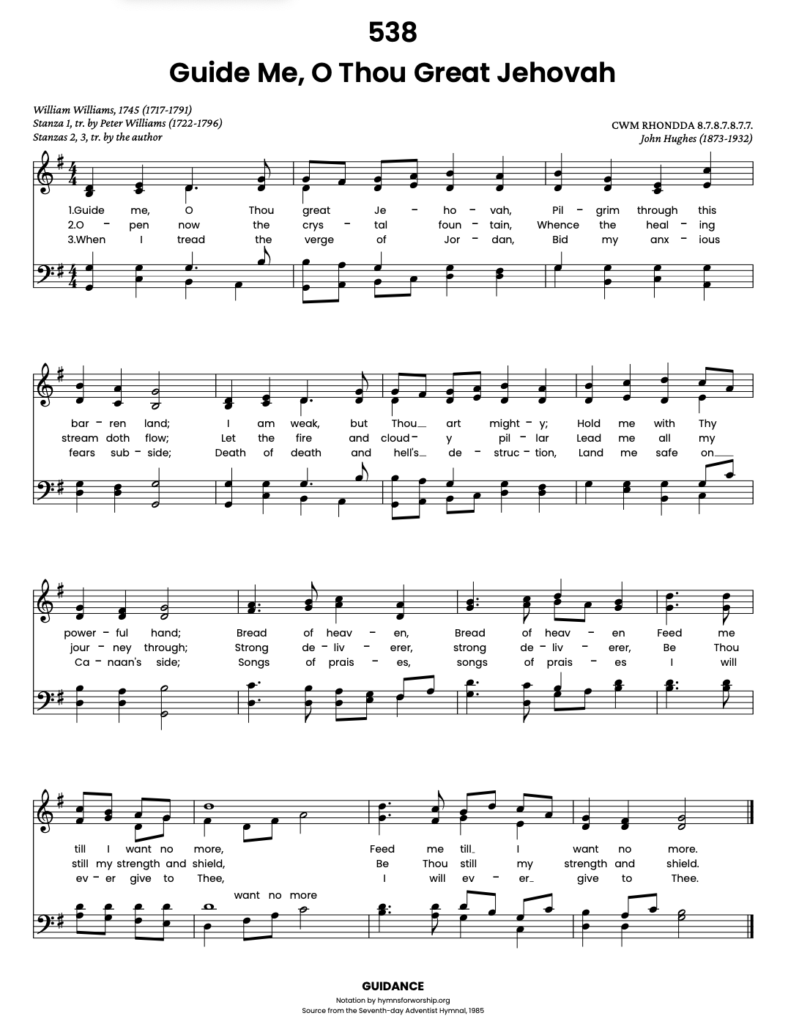
Guide me, O thou great Jehovah,
pilgrim through this barren land.
I am weak, but thou art mighty;
hold me with thy powerful hand.
For Worship Leaders
Make each hymn more meaningful with these helpful tools: Short, ready-to-use hymn introductions for church bulletins, multiple ways to introduce a hymn based on your worship theme and in-depth history and insights to enrich your song service.
📖 Reference: Feel free to share but please cite hymnsforworship.org when reproducing.
Introductions for Sabbath School Song Service (based on specific lesson quarterlies):
William Williams was concerned over the obvious lack of good hymns W in Welsh. This constituted a continual challenge to produce better ones, which this enthusiastic Welshman did to such effect that he became known as the “Welsh Watts” and the “sweet singer of Wales.” He wrote this hymn in Welsh, and it appeared in his Alleluia in 1745 under the title “Strength to Pass Through the Wilderness.” It was translated into English by Williams’ friend Peter Williams and was printed in his Hymns an Various Subjects, 1771, using stanzas 1, 3, and 5 of the original hymn. William Williams being bilingual, then made his own translation; this appeared first in leaflet form and then in 1772 in Collection of Hymns Sung in the Countess of Huntingdon’s Chapels. The SDAH hymn consists of Peter’s stanza 1 and William’s stanzas 2 and 3.
The hymn likens the Christian life to the march of the Israelites through the wilderness of Sinai to the Promised Land of Canaan, led by a powerful God who provided their sustenance.
William Williams was born on February 11, 1717, at Cefn-y-Coed, northeast of Llandovery, in what was then the county of Carmarthen. The son of a wealthy farmer, he intended to study medicine at the Llwynllwyd Academy in Carmarthen. But he forsook this aim after coming under the influence of Howell Harris, one of George Whitefield’s preachers, at one of his open-air meetings. William dedicated himself to the ministry and was ordained deacon in the Established Church in 1740. He served as curate in the small villages of Llanwrtyd and Abergwesyn, near Llandovery. How- ever, his evangelistic views prevented him from further progress in that church. He joined the Calvinistic Methodists and became an itinerant preacher, traveling extensively in his native Wales and covering about 3,000 miles a year. Harris encouraged him to write hymns, and his first book Alleluia was so successful that he continued until he had written more than 800 hymns in Welsh and more than 100 in English. He also wrote two long poems, some tracts, and many elegies. After more than 45 years of preaching, he died at Pantycelyn, near Llandovery, on January 11, 1791.
Peter Williams was born on January 7, 1722, at Llansadurnin, a small town near the inlet into Carmarthen Bay. He was educated at the Grammar School in Carmarthen and while there was converted by George Whitefield. He trained for the ministry and was ordained in 1744, serving first as curate at Eglwys Cymmyn, where he founded a school. However, being too vehement in his preaching to suit the staid established church, in 1746 he left became an itinerant preacher, fervent and eloquent, but because of a charge of the Church of England and joined the Welsh Calvinistic Methodists. He heresy, he was expelled from the Methodists. So he built a chapel of his own in Carmarthen and continued preaching there until his death on August 8, 1790, at Llandyfeilog, Wales. From 1767 to 1770 he published a family edition of the Welsh Bible with a commentary, and with a concordance in 1773. He also published a Welsh hymnbook in 1759 and his Hymns on
Various Subjects in 1771.
For a discussion of the tune CWM RHONDDA and John Hughes (1873-1932) see SDAH 201.
📖 Reference: Companion to the Seventh-day Adventist Hymnal by Wayne Hooper and Edward E. White. Review and Herald Publishing Association, 1988.
Stanza:
1 – Nehemiah 9:19, 20
2 – Psalm 18:2
Nehemiah 9:19, 20
3 – Jeremiah 12:5

Text
1
Guide me, O Thou great Jehovah,
Pilgrim through this barren land.
I am weak, but Thou art mighty;
Hold me with Thy powerful hand.
Bread of heaven, bread of heaven,
feed me till I want no more;
feed me till I want no more.
2
Open now the crystal fountain,
Whence the healing stream doth flow;
Let the fire and cloudy pillar
Lead me all my journey through.
Strong deliverer, strong deliverer,
Be Thou still my strength and shield;
Be Thou still my strength and shield.
3
When I tread the verge of Jordan,
Bid my anxious fears subside;
Death of death and hell’s destruction,
Land me safe on Canaan’s side.
Songs of praises, songs of praises,
I will ever give to Thee;
I will ever give to Thee.

Hymn Info
Biblical Reference
(a) Neh 9:19, 20 (b) Ps 18:2; Neh 9:19, 20 (c) Jer 12:5
Author
William Williams (1717-1791)
Translator
Stanza 1 by Peter Williams (1722-1796)
Stanza 2, 3 by the author
Year Published
1745
Hymn Tune
CWM RHONDDA
Metrical Number
8.7.8.7.8.7.7.
Composer
John Hughes (1873-1932)
Alternate Tune and Key
Alt tune BRYN CALFARIA, SDAH 165
Alt key SDAH 201
Explore more hymns: