
JESUS CHRIST >> SECOND ADVENT
SDAH 211
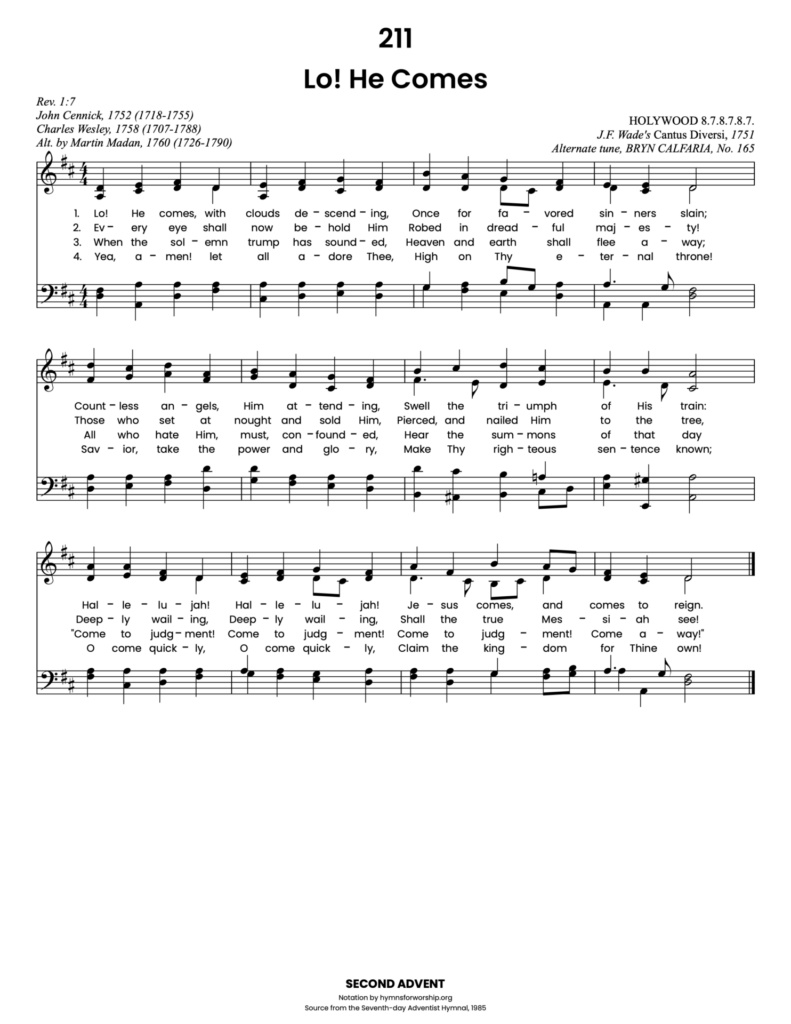
Lo! He comes, with clouds descending,
Once for favored sinners slain;
Countless angels, Him attending,
Swell the triumph of His train:
Get the hymn sheet in other keys here
For Worship Leaders
Make each hymn more meaningful with these helpful tools: Short, ready-to-use hymn introductions for church bulletins, multiple ways to introduce a hymn based on your worship theme and in-depth history and insights to enrich your song service.
Hymn Spotlight: Lo! He Comes
Rooted in early Methodist hymnody and adapted by Charles Wesley, this stirring Advent hymn proclaims the majesty of Christ’s return. With vivid imagery of trumpet sounds and mourning nations, it echoes Revelation 1:7—“Behold, He cometh with clouds.” The tune HOLYWOOD, related to ADESTE FIDELES, brings solemn grandeur to the hymn’s triumphant theme. Let this hymn awaken our hearts to prepare for that glorious day when “every eye shall see Him.”
📖 Reference: Feel free to share but please cite hymnsforworship.org when reproducing.
Introductions for Sabbath School Song Service (based on specific lesson quarterlies):
The Son of man regains what Adam lost. It also suggests that He shares common ground with humanity. The title Son of man points to His bond with humankind. From the broad context of the Scriptures, we can infer that the Son of man not only represents His people in the heavenly tribunal, but He also can identify with them because He partakes of their human nature (Heb. 2:14, Heb. 4:15). We also should note that the Son of man of Daniel 7 must be identified with the Prince of the Host (Dan. 8:11), the “man clothed in linen” (Dan. 10:5), and Michael (Dan. 10:13, Dan. 12:1). To conclude, the Son of man of Daniel 7 is clearly the Messiah Jesus Christ, who comes to the presence of God the Father as a representative of the saints (1 John 2:1) on the antitypical day of atonement. (Lesson 8, 1st Quarter 2020 – Wednesday, The Coming of the Son of Man, 2/19/2020)
In 1750 John Cennick wrote a hymn beginning “Lo! He cometh, countless trumpets blow His bloody sign!” which was first published in his Collection of Sacred Hymns, 1752. It was in six stanzas and was used as a basis for the present hymn, most of which was written by Charles Wesley (1707-1788; see Biographies), and published in four stanzas in his Hymns of Intercession for All Mankind, 1758. Martin Madan used both Cennick’s and Wesley’s hymn and with some alterations produced a hymn of six stanzas that appeared in his Collection of Psalms and Hymns, 1760. Wesley’s first two stanzas are only slightly changed, but his third stanza is completely omitted.
SDAH’s third stanza has been altered again from Madan’s version, which had as its first line, “Ev’ry Island, sea, and mountain,” and as its fourth, “Hear the trump proclaim the day.”
John Cennick was born in Reading, Berkshire, England, on December 12, 1718. Of Quaker descent, he was brought up in the Church of England. He was a land surveyor, but after becoming acquainted with the Wesley brothers in 1739 he was appointed as a teacher in a school for the children of mine workers in Kingwood, Bristol, in 1740. He became a lay preacher but dissociated with Wesley very soon on doctrinal issues and joined George Whitefield until 1745. Then he joined the Moravian Church and was ordained as a deacon, working in Germany and in Northern Ireland. He published four volumes of hymns and two volumes of sermons. He died in London on July 4, 1755.
Martin Madan was born in 1726 at Hertingfordbury, near Hertford, in the county of the same name, in England. He trained for legal profession but underwent a through conversion and change of aim after hearing John Wesley preach on the text “Prepare to meet thy God.” He was ordained and became a popular preacher, and founded and became chaplain of the Lock Hospital, Hyde Park Corner, London. However, he gave up preaching after the publication of his book, which advocated polygamy. He published A Commentary on the Articles of the Church of England, other theological articles, and his Collection of Psalms and Hymns, which, although unsystematic, had a great influence on the hymnody of the Anglican Church. He died at Epsom Surrey, on May 2, 1790.
HOLYWOOD occurs in a compilation dated 1751, entitled Cantus Diversi (various songs), by John Francis Wade (c. 1711-1786; see SDAH 132). The tune ADESTE FIDELES, SDA 132, was also in this collection.
📖 Reference: Companion to the Seventh-day Adventist Hymnal by Wayne Hooper and Edward E. White. Review and Herald Publishing Association, 1988.
Stanza:
1 – Revelation 1:7
Matthew 16:27
2 – Revelation 1:7
3 – 1 Thessalonians 4:16
Revelation 20:11
4 – Revelation 22:12

Text
1
Lo! He comes, with clouds descending,
Once for favored sinners slain;
Countless angels, Him attending,
Swell the triumph of His train:
Hallelujah! Hallelujah!
Jesus comes, and comes to reign.
2
Every eye shall now behold Him
Robed in dreadful majesty!
Those who set at nought and sold Him,
Pierced, and nailed Him to the tree,
Deeply wailing, Deeply wailing,
Shall the true Messiah see!
3
When the solemn trump has sounded,
Heaven and earth shall flee away;
All who hate Him, must, confounded,
Hear the summons of that day-
“Come to judgment! Come to judgment!
Come to judgment! Come away!”
4
Yea, amen! let all adore Thee,
High on Thy eternal throne!
Savior, take the power and glory,
Make Thy righteous sentence known;
O come quickly, O come quickly,
Claim the kingdom for Thine own!

Hymn Info
Biblical Reference
(a) Rev 1:7; Matt 16:27 (b) Rev 1:7 (c) 1 Thess 4:16; Rev 20:11 (d) Rev 22:12
Author
John Cennick (1718-1755); Charles Wesley (1707-1788)
Altered
Martin Madan, 1760 (1726-1790)
Year Published
1752 / 1758
Hymn Tune
HOLYWOOD
Metrical Number
8.7.8.7.8.7.
Tune Source
J.F. Wade’s Cantus Diversi, 1751
Alternate Tune
BRYN CALFARIA SDAH 165
Theme
SECOND ADVENT
Recommended Reading
This hymn was really interesting to write about in that its words spanned nine years of revision by three (maybe four) different ministers who are all connected to each other. The general happenstance was this though — that after a conversion experience, this hymn was borne.
Interestingly, the first one who originated this hymn was converted upon hearing John Wesley’s sermon. The Wesleys themselves revised the hymn, then another minister who was also converted by Wesley’s messages, revised what Wesley had already written about this hymn!
The tune almost have the same story to tell. But I will not get ahead of myself. Continue reading.
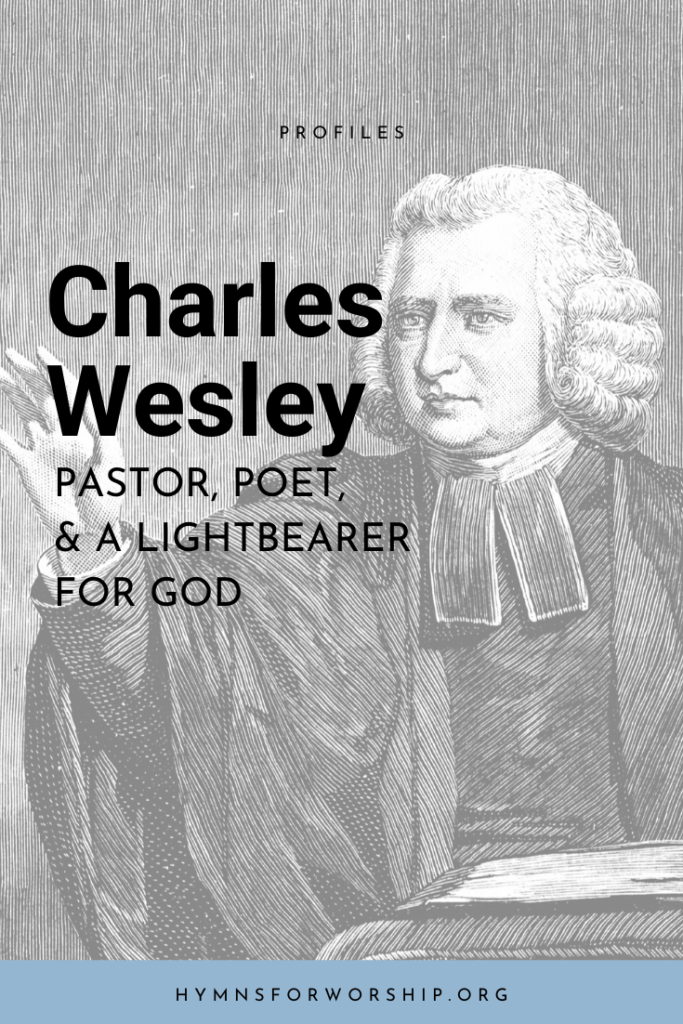
Charles was the other Wesley. Alongside his brother John who was considered the main guy behind the founding of Methodism, it was Charles’ hymns that pushed through the envelope of being “just another religion.” His lasting and well-known hymns have captivated Christians all around the world. Through his poetic lines, we are able to sing many hymns with such deep theology.
It was said that he wrote 8,989 hymns. That’s 10 lines of poetry every single day for 50 years. And we are privileged to have sung some of those hymns. Tell me, don’t these hymns ring a bell for you?
Explore more hymns: