SENTENCES & RESPONSES
SDAH 663
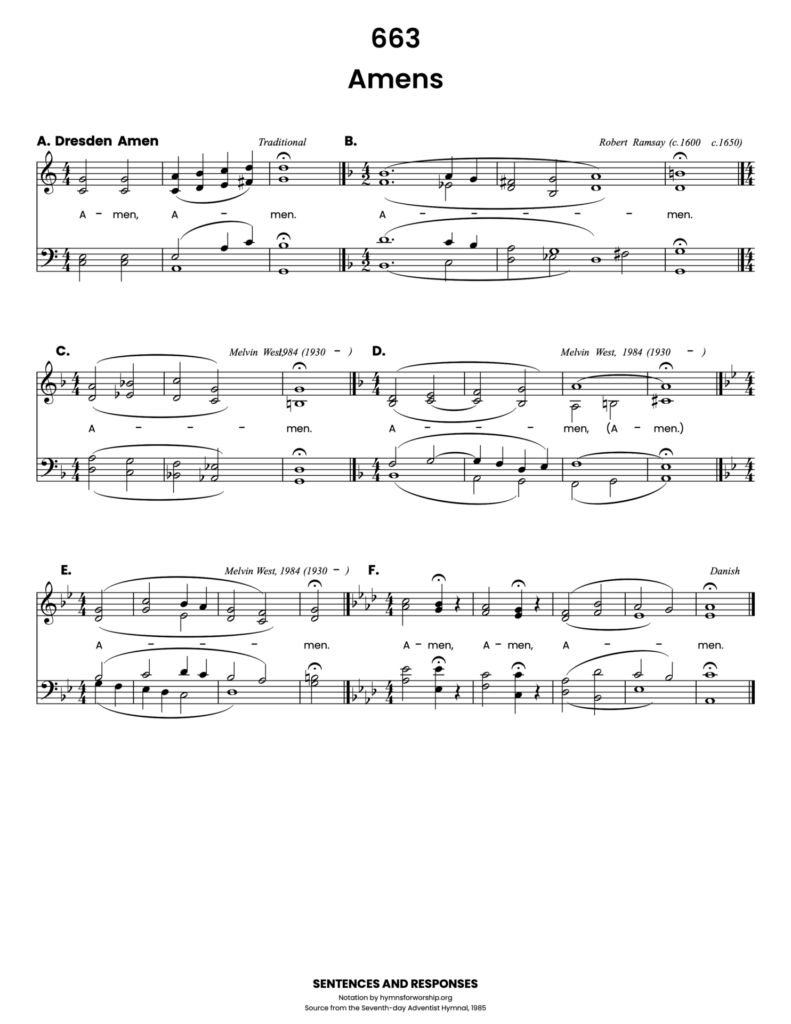
A—men.

For Worship Leaders
Make each hymn more meaningful with these helpful tools: Short, ready-to-use hymn introductions for church bulletins, multiple ways to introduce a hymn based on your worship theme and in-depth history and insights to enrich your song service.
📖 Reference: Feel free to share but please cite hymnsforworship.org when reproducing.
Introductions for Sabbath School Song Service (based on specific lesson quarterlies):
Let it be so,” “true,” “faithful,” “certain,” “surely,” “indeed,” are some of the shades of meaning of this word. In the Old Testament, “amen” appears as an affirmation assenting to a proclamation (as in Deuteronomy 27:15-26), and as a response to psalms chanted in the Temple service (as in Psalm 41:13). In the New Testament, “amen” commonly follows a doxology, or ascription of praise to God (as in Romans 11:36). It is also used as a closing word for several of the epistles. In Psalm 106:48, all the people are admonished to join in giving this affirmation: “Blessed be the Lord God of Israel from everlasting to everlasting: and let all the people say, Amen. Praise ye the Lord.”
In some hymnbooks, there is an amen at the end of each hymn. The committee chose not to follow this plan but to print a few that could be sung by choir or congregation wherever needed in the service to give affirmation or emphasis. James Moffatt once said that “the amen is like signing one’s name to a document, not a thing to be done casually.”
A. The Dresden Amen has been extracted from the Threefold Amen of the Royal Chapel of Dresden. It was written by J. G. Naumann (1741-1801), who spent all of his life in this part of Saxony, Germany. This same melody is in Mendelssohn’s Symphony No. 5 (Reformation); Richard Wagner used it also in his Parsifal.
B. Robert Ramsay (c. 1600-c. 1650) was organist at Trinity College, Cambridge, England, 1628-1644; and choral director, 1637-1644. He is known as a composer of Morning and Evening Services in F, two anthems, and other church music.
C, D, and E. Melvin West, (1930-; see Biographies) the chairman of the tunes subcommittee for SDAH, composed these three amens at the request of the committee for something a little more contemporary in sound.
F. Hymnbook editors seem to be unanimous in calling this amen “Danish,” but there is no information available that might give us a reason why.
📖 Reference: Companion to the Seventh-day Adventist Hymnal by Wayne Hooper and Edward E. White. Review and Herald Publishing Association, 1988.
Stanza:
1 – Psalm 106:48

Text
1
A-men, A—men.
2
A—–men.
3
A—men.
4
A—men, (A-men.)
5
A—–men.
6
A-men, A-men, A—men.

Hymn Info
Biblical Reference
(a) Ps 106:48
Copyright
(c) Copyright 1984 by Melvin West
(d) Copyright 1984 by Melvin West
(e) Copyright 1984 by Melvin West
Composer
(a) Traditional
(b) Robert Ramsay (c. 1600-c.1650)
(c) Melvin West, 1984 (1930-)
(d) Melvin West, 1984 (1930-)
(e) Melvin West, 1984 (1930-)
(f) Danish
Explore more hymns: