
CHRISTIAN LIFE >> JOY & PEACE
SDAH 464
When I can read my title clear
To mansions in the skies
I’ll bid farewell to every fear,
And wipe my weeping eyes;

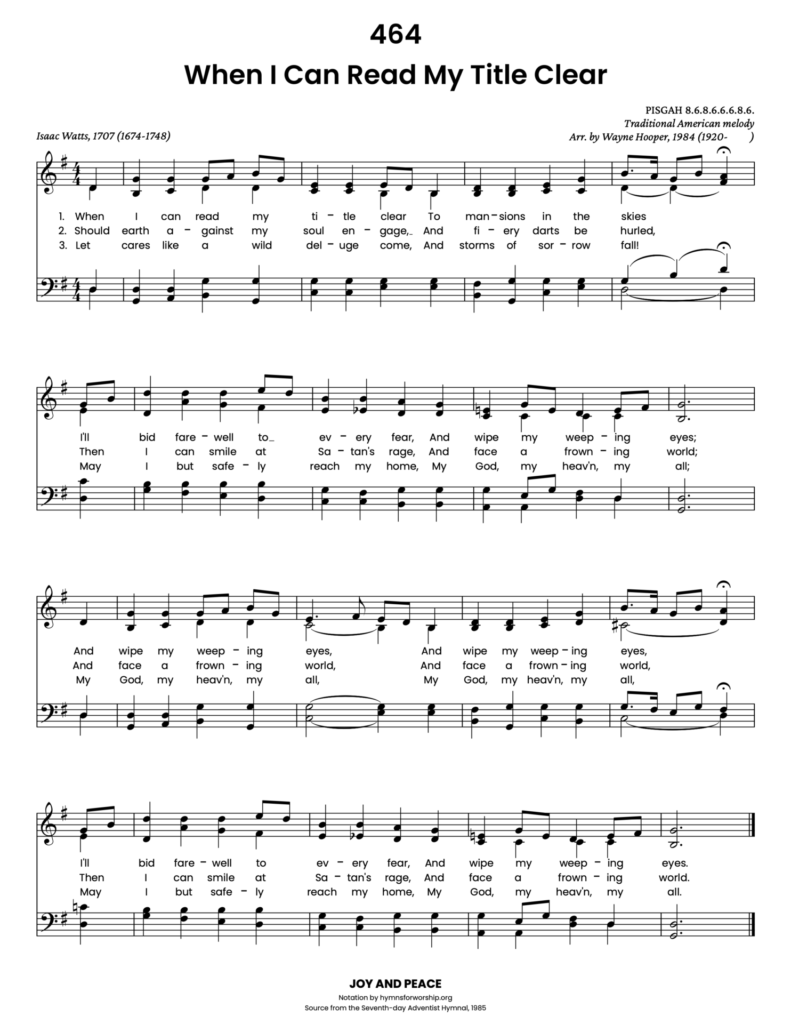
Get the hymn sheet in other keys here
For Worship Leaders
Make each hymn more meaningful with these helpful tools: Short, ready-to-use hymn introductions for church bulletins, multiple ways to introduce a hymn based on your worship theme and in-depth history and insights to enrich your song service.
Hymn Spotlight: When I Can Read My Title Clear
Isaac Watts first published this hymn in 1707 under the title “The Hopes of Heaven Our Support Under Trials on Earth,” inspired by Jesus’ promise in John 14:2 of “many mansions” in the Father’s house. In early American camp meetings, it was often sung to the lively folk-like tune PISGAH, with its pentatonic melody and repeated phrases forming a refrain-like effect. The tune’s origins are uncertain, though it appeared in several 19th-century Southern shape-note books and remains a favorite in The Sacred Harp tradition. Adventist history recalls James White, cofounder of the Seventh-day Adventist Church, singing this hymn with vigor as he entered the pulpit—its words reflecting the believer’s confident hope of heaven and freedom from fear.
📖 Reference: Feel free to share but please cite hymnsforworship.org when reproducing.
Introductions for Sabbath School Song Service (based on specific lesson quarterlies):
Under the title “The Hopes of Heaven Our Support Under Trials on Earth,” this hymn by Isaac Watts (1674-1748; see Biographies) was included in his Hymns and Spiritual Songs, 1707. In the second phrase of stanza two, Watts’s original was “And hellish darts be hurled.” It expands the promise of Jesus to His disciples when He said, “In my Father’s house are many mansions” (John 14:2).
In Watts’s day there were no repeats, but the hymn was sung to an ordinary common meter tune of four lines.
The tune name PISGAH comes from the name of a mountain near Dead Sea, where Moses was given a vision of the Promised Land. The tune was one of the most popular camp meeting melodies used in the early nineteenth century, and was sung with at least 10 different hymn texts. In this case, an extension by repetition of the text makes a sort of refrain. The melody is mostly pentatonic (five tones that can be played on the black notes of the piano). It “feels” like a folk song, and its spritely movement has led some to of the finest examples of the style.” Its composer is still a mystery. Kentucky conjecture that it came from a secular dance tune. Erik Routley calls it “one Harmony, 1816, and Allen D. Carden’s Missouri Harmony, 1820, attributed it to J. C. Lowry, about whom nothing is known. In 1819, Tennessee Harmony gave credit for it to an Alexander Johnson. It was picked up and used over and over in these oblong Southern tune books, includ- ing The Sacred Harp, 1844, where credit is given to J. C. Lowry, 1820. A note in that “an out- book says that he was standing musician of his day and wrote a great deal of sacred music.” The compiler of the Social Harp, 1855, says it was written by J. A. and J. F. Wade.
In England and Scotland the tune is known as COVENANTERS. The arrangement is by Wayne Hooper (1920-;).
William A. Spicer, president of the General Conference of Seventh-day Adventists from 1922 to 1930, tells this story in his book Pioneer Days of the Advent Message: “I remember well, as a boy, sitting in our church waiting for the preacher. Our backs were to the street door, through which the minister would enter. Then suddenly the silence would be broken by a sweetly musical and strong, sure voice, singing a familiar hymn. I can see the singer now, James White, silvery-haired, coming down the aisle, beating time on his Bible, and singing-
When I can read my title clear
To mansions in the skies,
I’ll bid farewell to every fear,
Wipe my weeping eyes.
📖 Reference: Companion to the Seventh-day Adventist Hymnal by Wayne Hooper and Edward E. White. Review and Herald Publishing Association, 1988.
Stanza:
1 – John 14:2
2 – Ephesians 6:16

Text
1
When I can read my title clear To mansions in the skies
I’ll bid farewell to every fear, And wipe my weeping eyes;
And wipe my weeping eyes, And wipe my weeping eyes,
I’ll bid farewell to every fear, And wipe my weeping eyes.
2
Should earth against my soul engage, And fiery darts be hurled,
Then I can smile at Satan’s rage, And face a frowning world;
And face a frowning world, And face a frowning world,
Then I can smile at Satan’s rage, And face a frowning world.
3
Let cares like a wild deluge come, And storms of sorrow fall!
May I but safely reach my home, My God, my heav’n, my all;
My God, my heav’n, my all; My God, my heav’n, my all;
May I but safely reach my home, My God, my heav’n, my all;

Hymn Info
Biblical Reference
(a) John 14:2 (b) Eph 6:16
Author
Isaac Watts (1674-1748)
Year Published
1707
Copyright
Arrangement copyright 1984 by Wayne Hooper
Hymn Tune
PISGAH
Metrical Number
8.6.8.6.6.6.8.6.
Arranged
Wayne Hooper (1920-)
Tune Source
Traditional American melody
Year Composed
1984
Explore more hymns: