CHRISTIAN LIFE >> MEDITATION AND PRAYER
SDAH 504
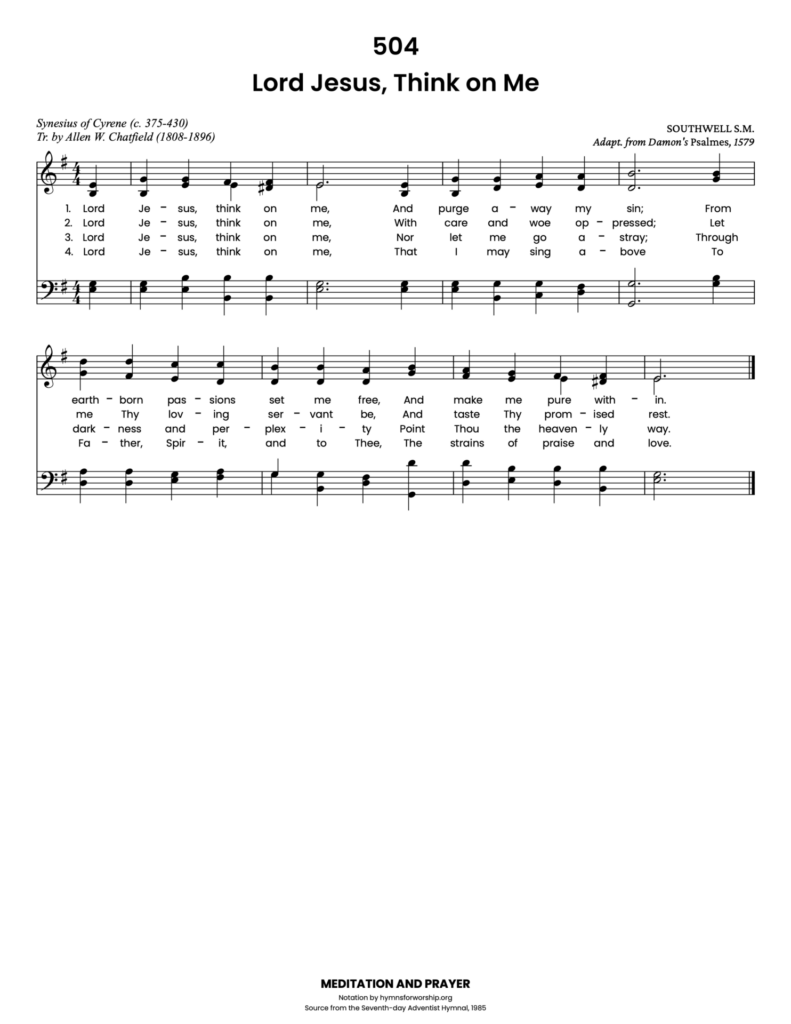
Lord Jesus, think on me,
And purge away my sin;
From earth-born passions set me free,
And make me pure within.
Get the hymn sheet in other keys here
For Worship Leaders
Make each hymn more meaningful with these helpful tools: Short, ready-to-use hymn introductions for church bulletins, multiple ways to introduce a hymn based on your worship theme and in-depth history and insights to enrich your song service.
Hymn Spotlight: Lord Jesus, Think on Me
This ancient prayer hymn traces back to Synesius of Cyrene, a fifth-century statesman, philosopher, and later bishop of Ptolemais, whose Greek ode “Mnoeo Christe” pleaded, “Remember, O Christ.” Elizabeth Barrett Browning admired the “rapture and ecstasy” of his writings, and Allen William Chatfield’s 1876 paraphrase—expanded with additional stanzas—brought this early Christian devotion into English hymnody. Each stanza echoes Nehemiah’s prayer, “Think upon me, my God” (Neh. 5:19), forming a humble, personal plea for Christ’s mercy, strength, and guidance. Set to the historic short-meter tune SOUTHWELL (also known as DAMON), first printed in William Damon’s 1579 Psalms, the melody’s distinctive repeated notes and modal roots give the hymn its timeless, contemplative character. Together, text and tune remind us that in every struggle and temptation, we may call on Jesus to remember us, sustain us, and lead us safely home.
📖 Reference: Feel free to share but please cite hymnsforworship.org when reproducing.
Introductions for Sabbath School Song Service (based on specific lesson quarterlies):
Charles Kingsley, rector of Eversley in Hampshire, England, and well-known novelist, describes in his book Hypatia, the conflict of Christianity with paganism at Alexandria at the beginning of the fifth century. Here we meet Synesius of Cyrene (c. 375-c. 430), who was converted in 401 and appointed bishop of Ptolemais by popular vote in 409. He was a deputy from Cyrene to the court of Arcadius in Thrace in the eastern empire at a time when the Goths were threatening North Africa. He was known as a statesman and philosopher, and for the eloquent way he could express his patriotism. He wrote 10 odes, which he considered as forming one book; this hymn is the last one, entitled “Mnoeo Xriste” (Remember, O Christ).
Elizabeth Barrett Browning translated two of these odes and said they had a “wonderful rapture and ecstasy.” Chatfield translated all 10 of them in his Songs and Hymns of the Earliest Greek Christian Poets, 1876. “Lord Jesus, Think on Me” is more of a paraphrase than a translation. The original had five stanzas; Chatfield added four new stanzas in a later edition. The last stanza in SDAH seems to be a modification of Chatfield’s stanza 8, incorporating a typical doxology. The first line of each stanza is Nehemiah’s prayer: “Think upon me, my God” (Neh. 5:19).
Allen William Chatfield was born October 2, 1808, in the vicarage (parsonage) of his father, an Anglican pastor of Chatteris, Cambridgeshire, England. Educated at Charterhouse School and Trinity College, Cambridge, he was ordained in 1832 and served until 1847 at Stotfold, Bedfordshire. From then until his death (49 years!) he was vicar of the small village of Much Marcle, Herefordshire. He is best known for his book of translations from the Greek poets mentioned above. He died on January 10, 1896.
SOUTHWELL, also known as DAMON and LONDON, is named after Southwell, a cathedral city in Nottinghamshire, England. The tune is one of the earliest in short meter, or 6.6.8.6., and first appeared in William Damon’s Psalms, 1579, the full title of which was “The Psalmes of David in English meter, with Notes of foure partes set vnto them, by Gulielmo Damon, for Iohn Bull, to the vse of the godly Christians for recreating themseluse, in stede of fond and vnseemley Ballades.” Damon (1540-1591) was organist of the Chapel Royal in the reign of Queen Elizabeth I.
We are told by James Lightwood in Hymn Tunes and Their Story, 1905, that Damon put together his collection of psalms for the private use of his good friend John Bull, a goldsmith who often had evening psalm-singing sessions at his home. Bull liked them so well that, without authorization, he had them published. Damon was not too happy that he did this, feeling they were not good enough; he destroyed all the copies he could find. Twelve years later Damon himself published a corrected version, which he felt was more in line with his skill as a musician. In this and some later printings, the tune was in the Dorian mode, which would make the third and fourth notes of the
different melody in our second staff C-sharp instead of C-natural, quite an effect than our modern minor scale. The melody is notable for the number of pairs of repeated notes, a total of 20 out of 26 in the complete melody, nine pairs being in succession.
📖 Reference: Companion to the Seventh-day Adventist Hymnal by Wayne Hooper and Edward E. White. Review and Herald Publishing Association, 1988.
Stanza:
1 – Nehemiah 5:19

Text
1
Lord Jesus, think on me,
And purge away my sin;
From earth-born passions set me free,
And make me pure within.
2
Lord Jesus, think on me,
With care and woe oppressed;
Let me Thy loving servant be,
And taste Thy promised rest.
3
Lord Jesus, think on me,
Nor let me go astray;
Through darkness and perplexity
Point Thou the heavenly way.
4
Lord Jesus, think on me,
That I may sing above
To Father, Spirit, and to Thee,
The strains of praise and love.

Hymn Info
Biblical Reference
(a) Neh 5:19
Author
Synesius of Cyrene (c. 375-430)
Translator
Allen W. Chatfield (1808-1896)
Hymn Tune
SOUTHWELL
Metrical Number
S.M.
Adapted
from Damon’s Psalmes, 1579
Explore more hymns: