CHRISTIAN LIFE >> MEDITATION AND PRAYER
SDAH 487
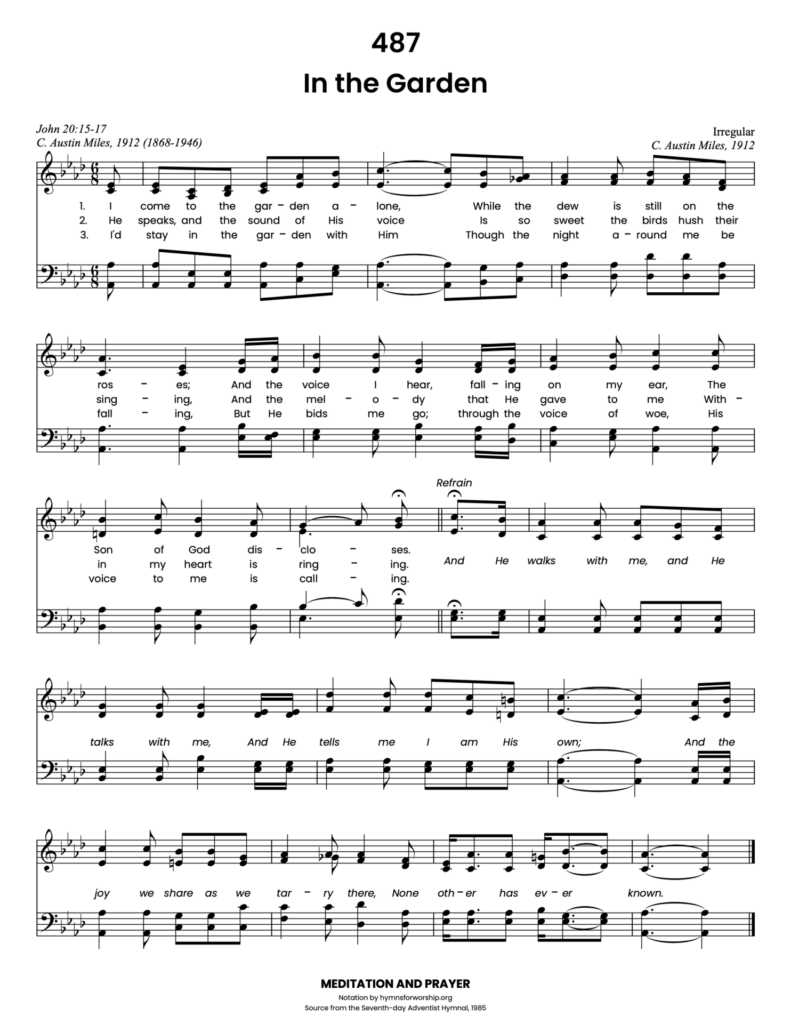
I come to the garden alone,
While the dew is still on the roses;
And the voice I hear, falling on my ear,
The Son of God discloses.
This hymn appears in:
Get the hymn sheet in other keys here
For Worship Leaders
Make each hymn more meaningful with these helpful tools: Short, ready-to-use hymn introductions for church bulletins, multiple ways to introduce a hymn based on your worship theme and in-depth history and insights to enrich your song service.
Hymn Spotlight: In the Garden
Written in 1912 by C. Austin Miles, this beloved hymn was inspired not by a stroll through nature, but by a vivid meditation on John 20—the moment Mary Magdalene recognized the risen Jesus in the garden. While in his darkroom, Miles pictured the scene so vividly that he immediately penned the words and later that same day composed the tune. Its gentle, personal tone reflects the intimacy of walking and talking with the living Christ, reminding us that the resurrection is not only a historic event but a present, personal reality for every believer who hears His voice today.
📖 Reference: Feel free to share but please cite hymnsforworship.org when reproducing.
Introductions for Sabbath School Song Service (based on specific lesson quarterlies):
Some people have objected that this hymn is nothing but a sentimental nature hymn with no religious theme. However, the circumstances of its writing show clearly that it was inspired by the incident of Mary Magdalene meeting Jesus, whom she suddenly recognized in the Garden of Gethsemane on the morning of the Resurrection. In March 1912, C. Austin Miles was sitting in the darkroom, where he kept his photographic equipment and, incidentally, his organ. As he took his Bible it fell open at his favorite chapter, John 20, which he reread. Then, gazing at the light-blue wall opposite him, he seemed to see the story enacted before his mind’s eye. There were Peter and John meeting Mary Magdalene at the tomb. Finding it empty, the two men left. Mary, alone, talked with “the gardener,” who then revealed Himself to her as the risen Lord. Austin Miles came to himself with his muscles tense. Gripping his Bible and under the inspiration of his vision, he wrote the poem as quickly as he could.
In the evening of the same day he composed the tune for the words, and published the hymn in The Gospel Message, No. 2, in 1912.
Miles was born at Lakehurst, New Jersey, on January 7, 1868; he was educated at the Philadelphia College of Pharmacy and the University of Pennsylvania. He practiced pharmacy for several years, but having written a gospel song that was favorably accepted, he was encouraged to write more. In 1898 he left pharmacy and worked full time for the Hall-Mack Publishing Company in Philadelphia, serving for 37 years as editor and manager. When the firm merged with Rodeheaver Company in 1935, he continued in an editorial capacity. He composed several anthems and cantatas, but he wished to be remembered as a composer of gospel songs, which he thought were of more value to the average person. He died at Pitman, New Jersey, on March 10, 1946.
📖 Reference: Companion to the Seventh-day Adventist Hymnal by Wayne Hooper and Edward E. White. Review and Herald Publishing Association, 1988.
Stanza:
1 – John 20:1
2 – John 20:16
3 – Matthew 28:10

Text
1
I come to the garden alone,
While the dew is still on the roses;
And the voice I hear, falling on my ear,
The Son of God discloses.
Refrain:
And He walks with me,
And He talks with me,
And He tells me I am His own;
And the joy we share as we tarry there,
None other has ever known.
2
He speaks, and the sound of His voice
Is so sweet the birds hush their singing,
And the melody that He gave to me
Within my heart is ringing.
3
I’d stay in the garden with Him
Though the night around me be falling,
But He bids me go; through the voice of woe,
His voice to me is calling.

Hymn Info
Biblical Reference
John 20:15-17 (a) John 20:1 (b) John 20:16 (c) Matt 28:10
Author
C. Austin Miles (1868-1946)
Year Published
1912
Composer
C. Austin Miles
Metrical Number
Irregular
Year Composed
1912
Copyright
Copyright 1912 by Hall-Mack Co. Renewed the Rodeheaver Co. (A Div. of Word, Inc.). All rights reserved. International copyright secured. Used by permission.
Watch
Explore more hymns: