CHRISTIAN LIFE >> MEDITATION AND PRAYER
SDAH 480
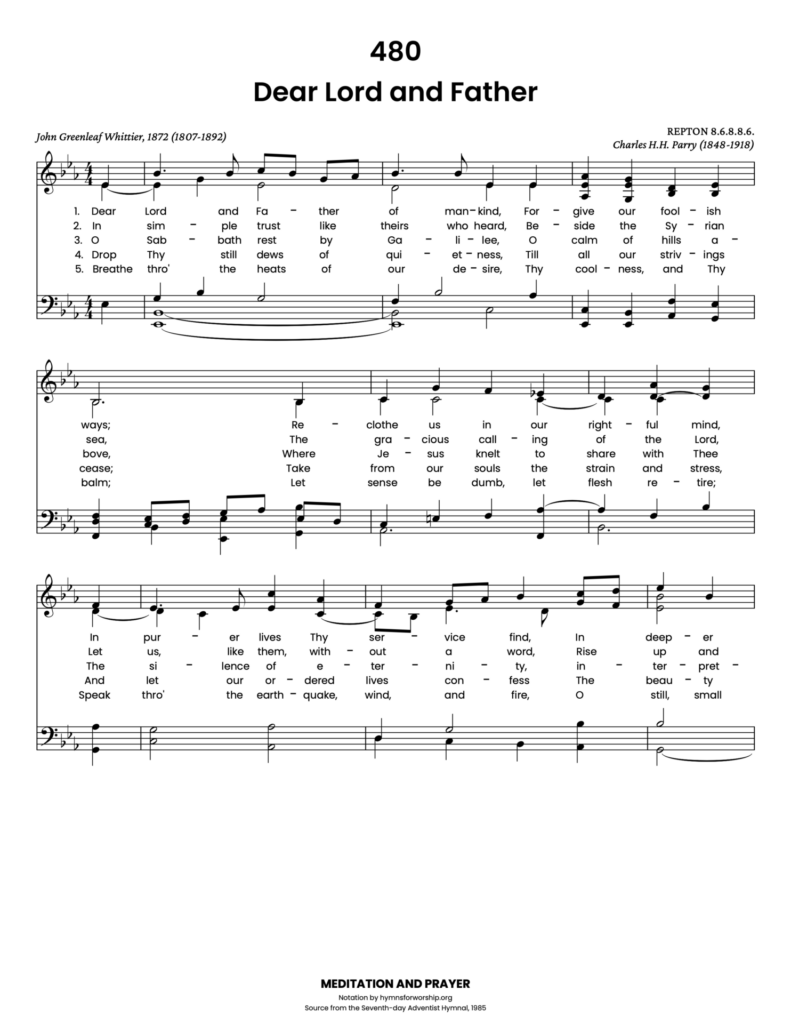
Dear Lord and Father of mankind,
forgive our foolish ways;
reclothe us in our rightful mind,
in purer lives thy service find,
in deeper reverence, praise.
Get the hymn sheet in other keys here
For Worship Leaders
Make each hymn more meaningful with these helpful tools: Short, ready-to-use hymn introductions for church bulletins, multiple ways to introduce a hymn based on your worship theme and in-depth history and insights to enrich your song service.
Hymn Spotlight: Dear Lord and Father of Mankind
Quaker poet John Greenleaf Whittier penned this hymn as part of his 1872 poem The Brewing of Soma, contrasting the frenzied, emotion-driven worship he saw in both pagan rituals and certain revival meetings with the quiet, inward communion that he believed truly connects the soul with God. Drawing on the image of Elijah hearing God’s “still small voice” (1 Kings 19:11–12), Whittier calls believers to calm, trust, and holy stillness. Set to Charles H. H. Parry’s serene tune REPTON, the hymn’s gentle flow mirrors its message—reminding worshipers that God’s presence is most often found, not in noise or spectacle, but in the deep peace of a surrendered heart.
📖 Reference: Feel free to share but please cite hymnsforworship.org when reproducing.
Introductions for Sabbath School Song Service (based on specific lesson quarterlies):
After reading the Sama-Veda, one of the sacred books of the Hindus, John Greenleaf Whittier (1807-1892; see SDAH 376), the Quaker poet, wrote a long religious poem in 1872 entitled “The Brewing of Soma.” Underneath the title he wrote, “These libations mixed with milk have been prepared for Indra: offer Soma to the drinker of Soma- Vashista, translated by Max Müller.” Soma was an intoxicating drink made from honey and milky sap, brewed by the ancient priests and alleged to be the drink of the gods. The pagan Indians drank to forget their cares and “From tent to tent / The Soma’s sacred madness went, / A storm of drunken joy.” These external forms of hectic excitement were quite foreign to Whittier’s Quaker temperament; he refers to the excitement and excessively fervent emotional scenes in some Christian revival services and camp meetings, of which he wrote a journalistic account. These, he says, are just as pagan as the Indians who aim for union with their gods:
In sensual transports wild as vain
We brew in many a Christian fane
The heathen Soma still!
After this stanza follow the words of the SDAH hymn, which consists of stanzas 12, 13, 14, 16, and 17. The long poem appeared first in the April 1872 issue of the Atlantic Monthly.
The poem as a whole pleads for the quiet, inward spiritual communion of the soul with God, an experience so well known to Quakers, in preference to an outward excitable, highly charged emotional relationship. The last words of the poem draw upon a biblical illustration to emphasize the point, although the still, small voice that Elijah heard came after, not through, the tempestuous manifestations, as recorded in 1 Kings 19:11, 12: “the Lord was not in the wind: and after the wind an earthquake; but the Lord was not in the earthquake: and after the earthquake a fire; but the Lord was not in the fire: and after the fire a still small voice.” Whittier also wrote SDAH 376, “All Things Are Thine,” and SDAH 455, “Immortal Love.”
Charles H. H. Parry (1848-1918; see SDAH 20) wrote the tune REPTON in scene ii of his oratorio Judith, where it is sung as a duet between Meshollemeth and a child, with the words “Long since in Egypt’s plenteous land.” It was first used as a hymn tune with Whittier’s poem in the Repton School Hymn Book (hence the tune name), 1924, and has since been included in many hymnals. H. A. Chambers composed an anthem in 1941, using REPTON and Whittier’s words, published by Novello, No. 29024708.
Parry also composed SDAH 20, LAUDATE DOMINUM; SDAH 80, JERUSALEM; and SDAH 636, RUSTINGTON.
📖 Reference: Companion to the Seventh-day Adventist Hymnal by Wayne Hooper and Edward E. White. Review and Herald Publishing Association, 1988.
Stanza:
1 – Luke 8:35
2 – Mark 1:16-18
5 – 1 Kings 19:11

Text
1
Dear Lord and Father of mankind,
Forgive our foolish ways;
Reclothe us in our rightful mind,
In purer lives thy service find,
In deeper reverence, praise,
In deeper reverence, praise.
2
In simple trust like theirs who heard,
Beside the Syrian sea,
The gracious calling of the Lord,
Let us, like them, without a word,
Rise up and follow thee,
Rise up and follow thee.
3
O sabbath rest by Galilee,
O calm of hills above,
Where Jesus knelt to share with thee
The silence of eternity,
Interpreted by love!
Interpreted by love.
4
Drop Thy still dews of quietness,
Till all our strivings cease;
Take from our souls the strain and stress,
And let our ordered lives confess
The beauty of thy peace.
The beauty of thy peace.
5
Breathe through the heats of our desire
Thy coolness and Thy balm;
Let sense be dumb, let flesh retire;
Speak through the earthquake, wind, and fire,
O still, small voice of calm.
O still, small voice of calm.

Hymn Info
Biblical Reference
(a) Luke 8:35 (b) Mark 1:16-18 (e) 1 Kings 19:11
Author
John Greenleaf Whittier (1807-1892)
Year Published
1872
Performance Suggestion
Unison
Hymn Tune
REPTON
Metrical Number
8.6.8.8.6.
Composer
Charles H.H. Parry (1848-1918)
Theme
MEDITATION AND PRAYER
Recommended Reading
The general idea when it comes to hymns is that there is a close bond between the author and the composer. That the author writes a hymn and the composer invents a tune to suit it, and then provides the harmony to accompany the tune. However, such wasn’t always the case.
Many hymns actually worked vice versa wherein authors would write verses according to existing tunes. Hundreds of hymns are sung from borrowed tunes, such as secular songs, chants, and even classical works. That being said, I went ahead and researched which hymns in the SDA Hymnal were originally classical works.
Explore more hymns: