CHRISTIAN LIFE >> FAITH AND TRUST
SDAH 506
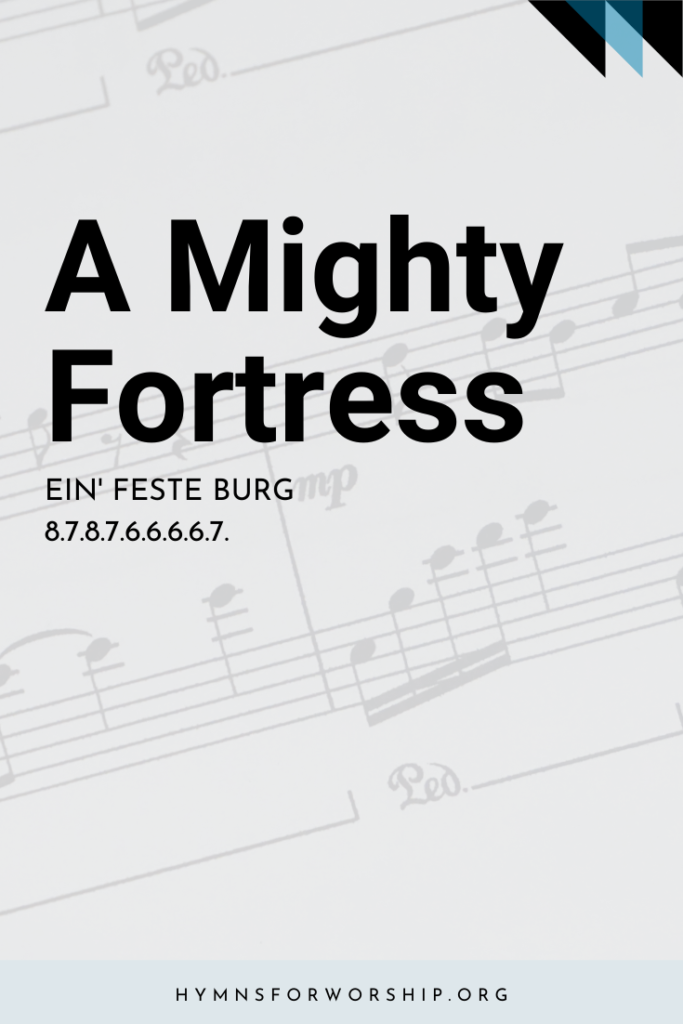
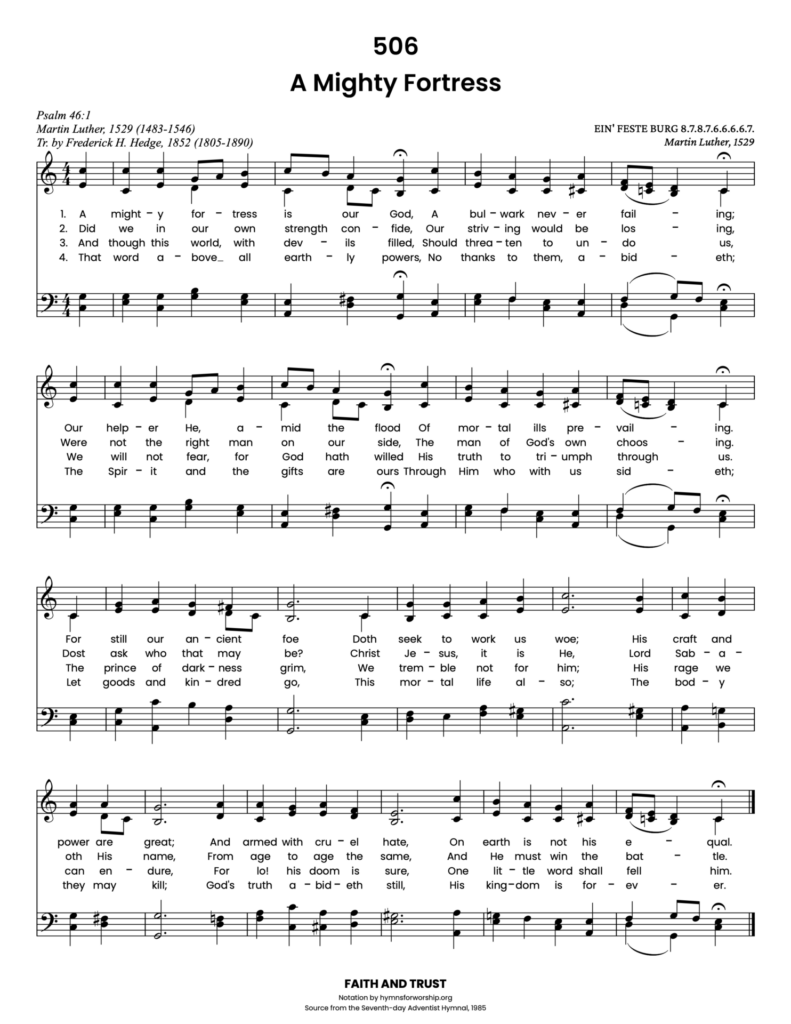
A mighty fortress is our God,
a bulwark never failing;
our helper He amid the flood
of mortal ills prevaling.
This hymn appears in:
Get the hymn sheet in other keys here
For Worship Leaders
Make each hymn more meaningful with these helpful tools: Short, ready-to-use hymn introductions for church bulletins, multiple ways to introduce a hymn based on your worship theme and in-depth history and insights to enrich your song service.
Hymn Spotlight: A Mighty Fortress
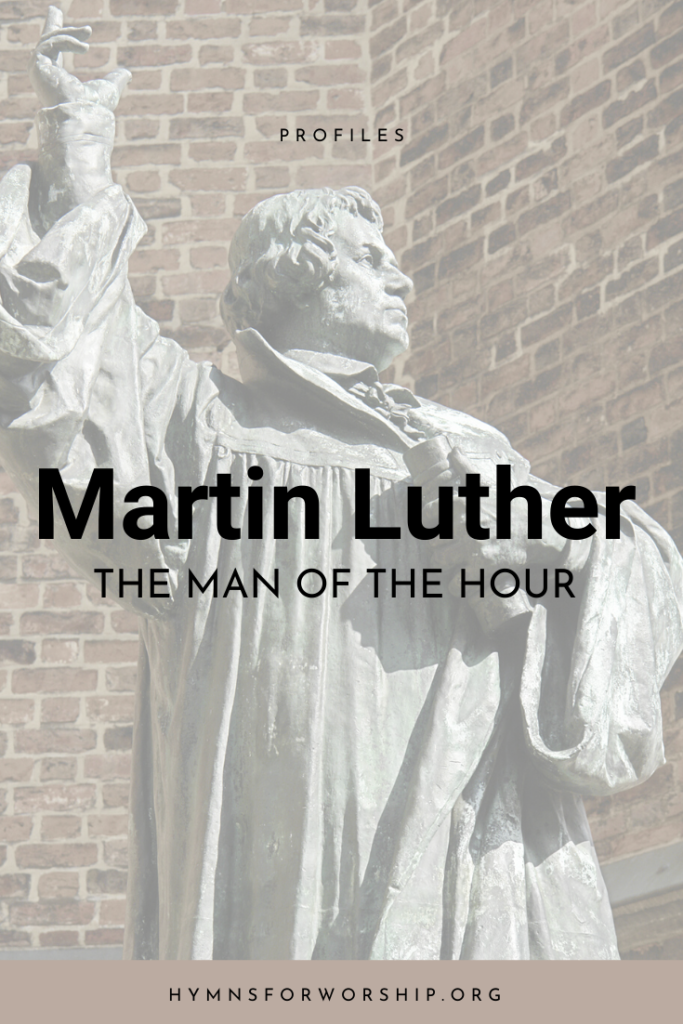
Known as the “battle hymn of the Reformation,” this powerful hymn was written by Martin Luther around 1529, likely just before the Diet of Speyer, where German princes boldly defended their right to uphold the gospel—an act that gave rise to the word Protestant. Luther’s own life story gives weight to the hymn: a scholar-monk turned reformer, he faced corruption in Rome, denounced indulgences through his 95 Theses, withstood excommunication, and held to Scripture alone at the Diet of Worms before translating the Bible into German during his refuge in Wartburg Castle. Frederick Henry Hedge’s 1852 English translation helped carry Luther’s defiant faith across generations, while the tune EIN’ FESTE BURG—traditionally attributed to Luther and later used by composers like Mendelssohn and Wagner—fortified its place as a musical emblem of trust in God. Sung at Luther’s funeral and carved on his tombstone, this hymn continues to proclaim that in every trial and spiritual conflict, God remains our strong fortress and unfailing defense.
📖 Reference: Feel free to share but please cite hymnsforworship.org when reproducing.
Introductions for Sabbath School Song Service (based on specific lesson quarterlies):
This “battle hymn of the Reformation” was written by Martin Luther, most probably just preceding the Diet of Speyer (or Spires) on April 20, 1529. It was on that occasion that the German princes opposed the papacy’s refusal to tolerate the new doctrine of Luther. They protested, that is, spoke on behalf of, their religious rights and so earned for posterity the name of Protestant. The name now connotes an opposition to, or denial of, Roman Catholicism, but originally it had the positive meaning of manifesting firm faith in God and truth.
Martin Luther was born at Eisleben, 20 miles west of Halle, now in East Germany, on November 10, 1483. He was educated in secondary schools at Eisenach and at Magdeburg. In 1501 he entered the University of Erfurt to study for the legal profession, graduating with a B.A. in 1502 and an M.A. in 1503. However, in 1505 he began another course-he entered the Augustinian monastery at Erfurt, and was ordained priest in 1507. He was appointed professor at the University of Wittenberg in 1508. A visit to Rome disturbed him as he observed the corruption in the church, and on his return he spoke out against the practice of granting indulgences. The matter came to a head when Tetzel came to Wittenberg to sell indulgences, prompting Luther to prepare his 95 theses denouncing certain corrupt practices in the church. He nailed a copy to the church door, and sent a copy to the archbishop as a basis for public debate. He was called to Rome to defend them, but the elector of Saxony and his university kept him in Germany. Luther’s treatise on The Babylonian Captivity of the Church produced a papal bull, which Luther publicly burned in 1520. For this he was excommunicated.
In 1521 he was summoned before the Diet of Worms but held fast to his convictions, accepting only evidence from the Scriptures. Returning to Wittenberg, he was “kidnapped” for his own safety by soldiers of the elector of Saxony, and was taken to the castle of Wartburg, near Eisenach, where he spent the next year. Here he began his translation of the Bible into German, and completed the New Testament in 1522. The Old Testament was published in 1534. The Reformation had begun, and Luther returned to Wittenberg in 1522. He strengthened the movement by publishing the first hymnbook in the language of his people. It had eight hymns in the first edition of 1524, and 40 in the second edition the next year. Luther married a former nun, Katherine von Bora, in 1525. In all, he wrote 37 original hymns and published nine hymnals, drawing from various sources, adapting and revising. In this way he furnished a foundation for the success of the Protestant Reformation. Luther died on February 18, 1546, while on a visit to his native Eisleben.
More than 50 translations of Luther’s hymn have been made into English, this one by Frederick Henry Hedge, which he made in 1852 for W. German Verse. Hedge was born at Cambridge, H. Furness’s Gems Massachusetts, on December 12, 1805, and was educated at Harvard and in Germany. He became a pastor of the Unitarian Church, serving first at West Cambridge from 1829 until 1835, and then transferring to Bangor, Maine. In 1850 he moved to Providence, Rhode Island, and then back to Brookline, Massachusetts, in 1856. The next year he was
appointed professor of ecclesiastical history at Harvard, and in 1872 professor of German literature there. He made two other translations from German and wrote four original hymns. He died at Cambridge, Massachusetts, on August 21, 1890.
The tune, aptly called EIN’ FESTE BURG (A Fortified Castle), (Hymnal) of 1529, but no copy is now in existence, although the tune is in composed by Martin Luther and is known to have been in Klug’s Gesangbuch the third edition of 1535. The tune was used by Mendelssohn in the fifth movement of his Reformation Symphony, by Meyerbeer in his prelude to the opera The Huguenots, and by Wagner in his Kaisermarsch, 1871. It is the national hymn of Germany and was sung at Luther’s funeral. On his tombstone at Eisleben is carved the first line of the hymn: “Ein’ feste burg ist unser Gott” (“Our God is a strong fortress”).
📖 Reference: Companion to the Seventh-day Adventist Hymnal by Wayne Hooper and Edward E. White. Review and Herald Publishing Association, 1988.
Stanza:
1 – Psalm 46:1
1 Peter 5:8
2 – James 5:4
3 – 2 Peter 2:4
4 – 1 Peter 1:23
Daniel 7:27
Recommended Reading
25 Hymn Tunes from the SDA Hymnal Inspired by Original Classical Works
The general idea when it comes to hymns is that there is a close bond between the author and the composer. That the author writes a hymn and the composer invents a tune to suit it, and then provides the harmony to…
PROTESTANT REFORMATION AND 500 YEARS OF CONGREGATIONAL SINGING
Music is often a reflection of what happens in the society. Many a man’s ideals, beliefs and philosophies are mirrored by music through its tune, rhythm, harmony, lyrics and form. When the Protestant Reformation era came about,

Text
1
A mighty fortress is our God,
A bulwark never failing;
Our helper He amid the flood
Of mortal ills prevailing.
For still our ancient foe
Doth seek to work us woe;
His craft and power are great,
And armed with cruel hate,
On earth is not his equal.
2
Did we in our own strength confide,
Our striving would be losing,
Were not the right man on our side,
The man of God’s own choosing.
Dost ask who that may be?
Christ Jesus, it is He;
Lord Sabbaoth, His name,
From age to age the same,
And He must win the battle.
3
And though this world, with devils filled,
Should threaten to undo us,
We will not fear, for God hath willed
His truth to triumph through us.
The Prince of Darkness grim,
We tremble not for him;
His rage we can endure,
For lo, his doom is sure;
One little word shall fell him.
4
That word above all earthly powers,
No thanks to them, abideth;
The Spirit and the gifts are ours,
Thru Him who with us sideth.
Let goods and kindred go,
This mortal life also;
The body they may kill;
God’s truth abideth still;
His kingdom is forever.

Hymn Info
Biblical Reference
(a) Ps 46:1; 1 Pet 5:8 (b) Jas 5:4 (c) 2 Pet 2:4 (d) 1 Pet 1:23; Dan 7:27
Author
Martin Luther (1483-1546)
Translator / Paraphrase
Frederick H. Hedge, 1852 (1805-1890)
Year Published
1529
Hymn Tune
EIN’ FESTE BURG
Metrical Number
8.7.8.7.6.6.6.6.7.
Composer
Martin Luther
Year Composed
1529
Theme
FAITH & TRUST
Explore more hymns: