CHRISTIAN LIFE >> Thankfulness
SDAH 559
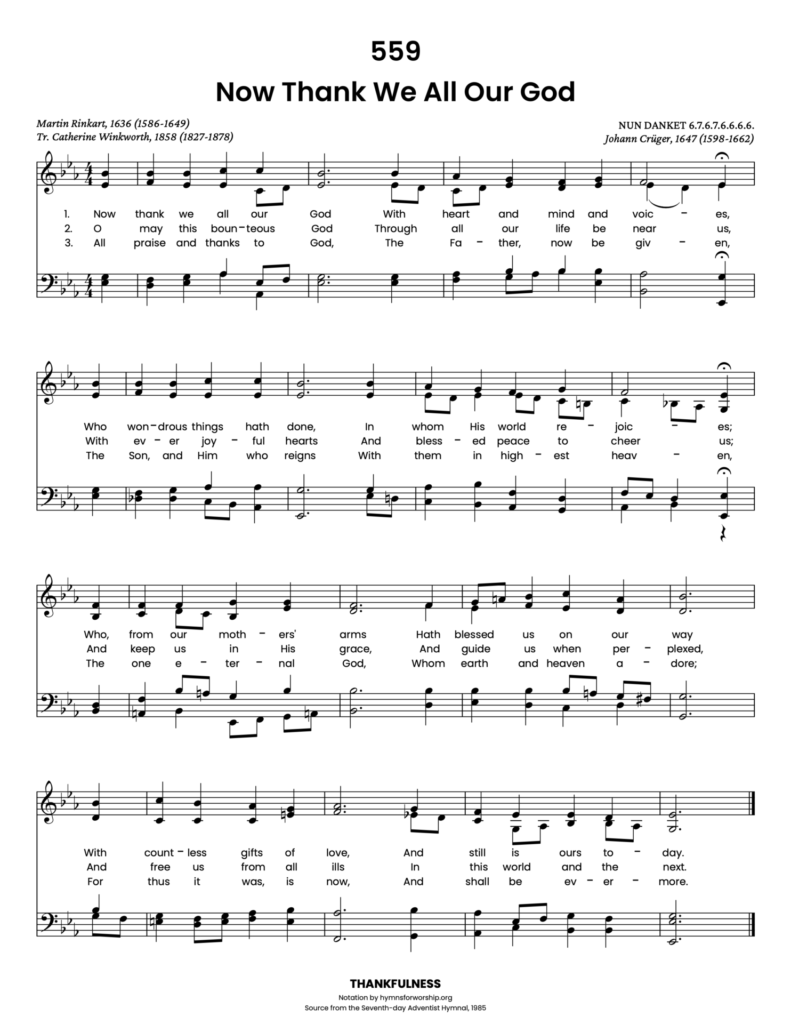
Now thank we all our God
with heart and hands and voices,
who wondrous things hath done,
in whom His world rejoices;
Get the hymn sheet in other keys here
For Worship Leaders
Make each hymn more meaningful with these helpful tools: Short, ready-to-use hymn introductions for church bulletins, multiple ways to introduce a hymn based on your worship theme and in-depth history and insights to enrich your song service.
📖 Reference: Feel free to share but please cite hymnsforworship.org when reproducing.
Introductions for Sabbath School Song Service (based on specific lesson quarterlies):
This hymn is a translation by Catherine Winkworth (1827-1878; see Biographies) of a German hymn written by Martin Rinkart. It appears in his Jesu Herz-Büchlein (Booklet of the Heart of Jesus) 1663 edition. Seeing that the words and tune are in Johann Crüger’s Praxis, 1647, it is reasonable to assume that the text was also in Rinkart’s first edition, 1636, and that it was written in or before that year. It is entitled “Tisch-Gebetlein” (A Short Grace at Table). The first two stanzas were the grace or thanksgiving to be sung by his family after meals; the doxology of the third stanza was added about 1636. The hymn is based on some verses in the Apocrypha, Ecclesiasticus 50:22-24. “Now bless ye the God of all, which everywhere doeth great things. May He grant us joyfulness of heart, and that peace may be in our days for the days of eternity” (RV). A similar thought is found in Psalm 126:2, 3.
Rinkart was born April 23, 1586, at Eilenburg, near Leipzig. He studied at the University of Leipzig to prepare for the ministry. He taught in the secondary school at Eisleben in 1610; then was choir director in the Church of St. Anne; then for about four years was pastor of two small village churches nearby. In 1617 he was invited to his hometown and was pastor of the Lutheran church there for 32 years until his death. His pastorate covered a walled town, attracted many refugees, which caused abnormal overcrowding the town, and Rinkart had the unhappy experience of conducting the funeral service of two resident and two refugee clergymen. This left him the added burden of being the only minister to conduct the increasing number of burials, up to 40 a day at times. His wife also succumbed to the plague, and he himself fell ill, but survived. In view of all these problems his hymn of praise is a remarkable statement of faith. He died December 8, 1649.
The translation is in Catherine Winkworth’s (1827-1878; see Biogra- phies) Lyra Germanica, Second Series, 1858. It is titled “The Chorus of God’s Thankful Children” and has the footnote “Martin Rinkart, 1656.” The hymn has been made even more popular by its inclusion by Mendelssohn in his oratorio Hymn of Praise, 1840. The hymn was sung in all the churches as a hymn of thanksgiving for the end of the Thirty Years’ War, a Catholic- Protestant conflict, but it appears to be a coincidence that the elector of Saxony should have selected the verses in the Apocrypha to be used by preachers in their service of thanksgiving, thus giving rise to the false idea that Rinkart wrote the hymn specially for the celebration of the peace.
NUN DANKET, named for the first two words of the German text, was written in 1647 by Johann Crüger (1598-1662; see SDAH 239) and in his collection Praxis Pietatis Melica.
📖 Reference: Companion to the Seventh-day Adventist Hymnal by Wayne Hooper and Edward E. White. Review and Herald Publishing Association, 1988.
Stanza:
1 – Psalm 126:2, 3
Notes

Text
1
Now thank we all our God
With heart and hands and voices,
Who wondrous things hath done,
In whom His world rejoices;
Who, from our mothers’ arms
Hath blessed us on our way
With countless gifts of love,
And still is ours today.
2
O may this bounteous God
Through all our life be near us,
With ever joyful hearts
And blessed peace to cheer us;
And keep us in His grace,
And guide us when perplexed;
And free us from all ills,
In this world and the next.
3
All praise and thanks to God
the Father now be given;
the Son, and Him who reigns
with them in highest heaven;
the one eternal God,
whom earth and heaven adore;
for thus it was, is now,
and shall be evermore.

Hymn Info
Biblical Reference
(a) Ps 126:2, 3
Author
Martin Rinkart (1586-1649)
Translator
Catherine Winkworth, 1858 (1827-1878)
Hymn Tune
NUN DANKET
Metrical Number
6.7.6.7.6.6.6.6.
Composer
Johann Cruger (1598-1662)
Year Composed
1647
Explore more hymns: