CHRISTIAN LIFE >> Watchfulness
SDAH 599
Rejoice, rejoice, believers, and let your lights appear:
The evening is advancing, and darker night is near.
The Bridegroom is arising, and soon He draweth nigh.
Up, pray, and watch, and wrestle, at midnight comes the cry.
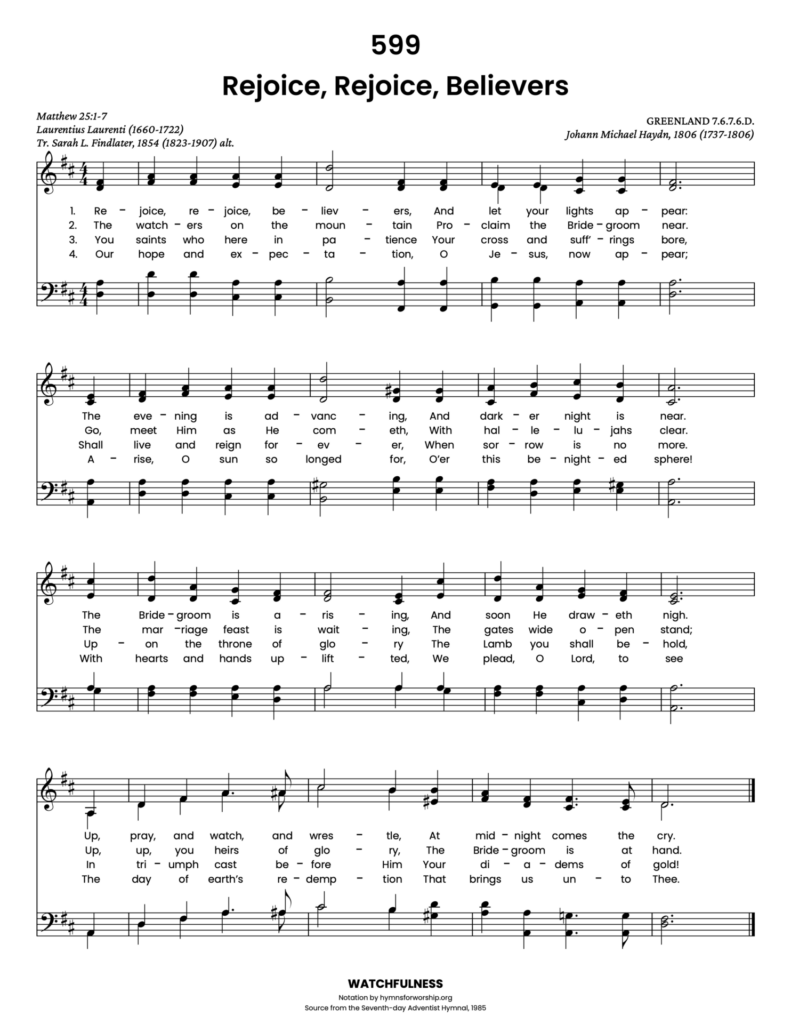

Get the hymn sheet in other keys here
For Worship Leaders
Make each hymn more meaningful with these helpful tools: Short, ready-to-use hymn introductions for church bulletins, multiple ways to introduce a hymn based on your worship theme and in-depth history and insights to enrich your song service.
📖 Reference: Feel free to share but please cite hymnsforworship.org when reproducing.
Introductions for Sabbath School Song Service (based on specific lesson quarterlies):
Watching for the Lord to come is the subject of this hymn, based on Jesus’ parable of the 10 virgins, recorded in Matthew 25:1-7. It was first published by Laurentius Laurenti in his Evangelica Melodica, 1700, a collection of words and music for the entire Christian church year.
Lorenz Lorenzen was born June 8, 1660, in Schleswig (at that time a duchy ruled by Denmark). His father was a town burgess and loved music, so he saw to it that his son was musically educated. Lorenzen studied at the University of Rostock and in the city of Kiel, where he changed his name to the Latin version, Laurentius Laurenti. In 1684 he became cantor and director of music at the Cathedral Church of Bremen, Germany, and held this position for 38 years until his death on May 29, 1722.
Sarah Laurie (Borthwick) Findlater’s translation appeared in Hymns From the Land of Luther, 1854, to which she contributed 53 hymns. Her sister Jane Bothwick (see SDAH 357) contributed the other 69 items. Sarah was born in Edinburgh, Scotland, on November 26, 1823. Her father was an insurance executive. A naturally gifted poet, she became the wife of Erick Findlater, pastor of the Free Church of Scotland at Lochearnhead, Perthshire. She died at Torquay, Devonshire, on December 25, 1907. The translations made by these Borthwick sisters are universally considered to be of high quality.
GREENLAND is from the Lausanne Psalter, 1790, and received the name from later use with Heber’s “From Greenland’s Icy Mountains.” The music is thought to be one of the verses from Michael Haydn’s “Services for Country Churches.” On Johann Michael Haydn, see SDAH 83.
📖 Reference: Companion to the Seventh-day Adventist Hymnal by Wayne Hooper and Edward E. White. Review and Herald Publishing Association, 1988.
Stanza:
1 – Matthew 25:1-6
2 – Revelation 19:9
3 – Revelation 4:10

Text
1
Rejoice, rejoice, believers, and let your lights appear:
The evening is advancing, and darker night is near.
The Bridegroom is arising, and soon He draweth nigh.
Up, pray, and watch, and wrestle, at midnight comes the cry.
2
The watchers on the mountain proclaim the Bride-groom near.
Go, meet Him as He cometh, with hallelujahs clear.
The marriage feast is waiting, the gates wide open stand;
Up, up, you heirs of glory, the Bride-groom is at hand.
3
You saints who here in patience your cross and suff’rings bore,
Shall live and reign forever, when sorrow is no more.
Upon the throne of glory the Lamb you shall behold,
In triumph cast before Him your diadems of gold!
4
Our hope and expectation, O Jesus, now appear;
Arise, O sun so longed for, o’er this benighted sphere!
With hearts and hands uplifted, we plead, O Lord, to see
The day of earth’s redemption that brings us unto Thee.

Hymn Info
Biblical Reference
(a) Matt 25:1-6 (b) Rev 19:9 (c) Rev 4:10
Author
Laurentius Laurenti (1660-1722)
Translator
Sarah L. Findlater (1823-1907)
Year Published
1854
Hymn Tune
GREENLAND
Metrical Number
7.6.7.6.D.
Composer
Johann Michael Haydn (1737-1806)
Year Composed
1806
Explore more hymns: