CHRISTIAN LIFE >> PILGRIMAGE
SDAH 630
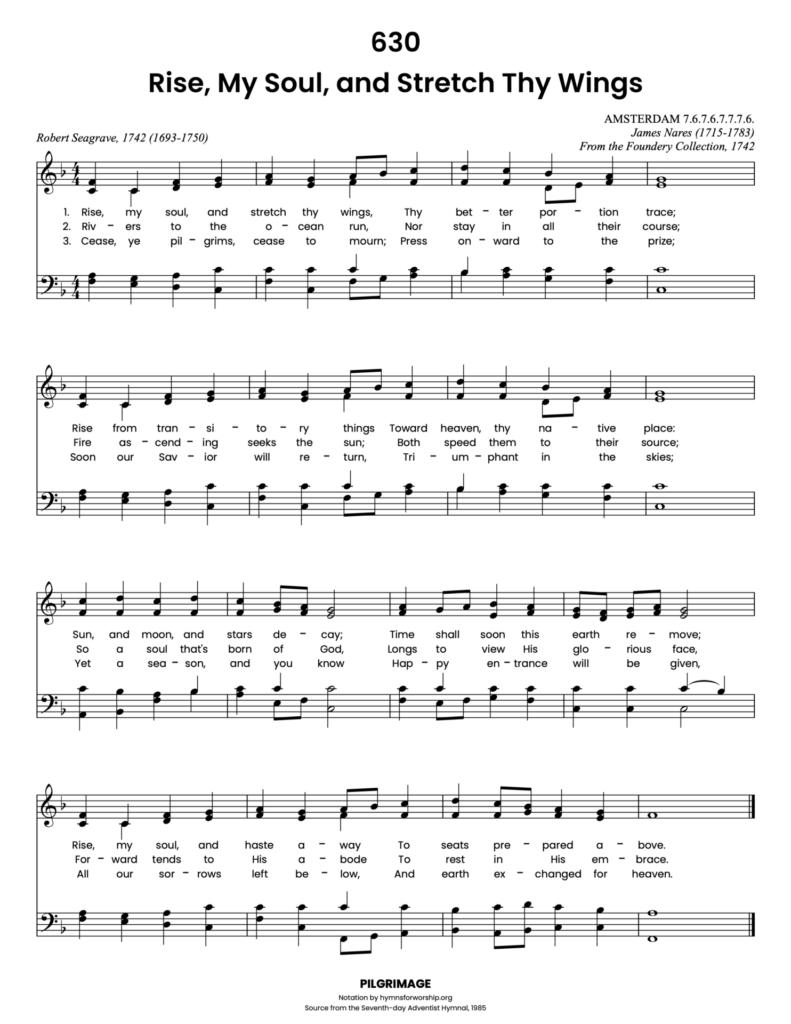
Rise, my soul, and stretch thy wings,
thy better portion trace;
Rise from transitory things toward heaven,
thy native place;
Get the hymn sheet in other keys here
For Worship Leaders
Make each hymn more meaningful with these helpful tools: Short, ready-to-use hymn introductions for church bulletins, multiple ways to introduce a hymn based on your worship theme and in-depth history and insights to enrich your song service.
📖 Reference: Feel free to share but please cite hymnsforworship.org when reproducing.
Introductions for Sabbath School Song Service (based on specific lesson quarterlies):
Robert Seagrave wrote this hymn in 1742 for his own congregation whom he address every Sunday evening in the Lorimers, Hall in London. This was the headquarters of the guild of lorimers, makers of spurs for riders and leather straps and bits for horses. He had left the Anglican Church the previous year, dissatisfied with the lackadaisical attitude of the clergy generally and their lack of response to the reforming zeal of Wesley and Whitefield. He published the hymn in his Hymns for Christian Worship, 1742, and entitled it “The Pilgrim’s Song.” The words give some idea of the troubles experienced by the new Methodists and raise their thoughts from earth to heaven.
Seagrave was born on November 22, 1693, in the small village of Twyford, nine miles from Leicester, England. He graduated from Cambridge University in 1714, was ordained to the Anglican ministry, and joined John Wesley and George Whitefield in their revival campaign to preach the gospel to the masses. He wrote numerous letters and pamphlets between 1731 and 1746 in an endeavor to stir the clergy. Ultimately he joined Whitefield, became his intimate friend, and often preached in his tabernacle. He died in London in the year 1750.
The tune AMSTERDAM is one of six tunes adapted by John Wesley from J. A. Freylinghausen’s Geistreiches Gesangbuch (Spiritual Hymnbook), 1704, and published in his Collection of Tunes as They Are Sung in the Foundery, 1742. It has been attributed to James Nares (1715-1783) who was an organist at York Minster and later at the Chapel Royal, Windsor, and a trainer of boys’ choirs. He was christened at Stanwell, Middlesex, on April 19, 1715, and died at Westminster, also in Middlesex, on February 10, 1783. He received the D.Mus. from the University of Cambridge in 1756, and published treatises on singing and on playing the organ and the harpsichord. It will be noticed that the form is AABA, scores 1, 2, and 4 being almost identical.
📖 Reference: Companion to the Seventh-day Adventist Hymnal by Wayne Hooper and Edward E. White. Review and Herald Publishing Association, 1988.
Stanza:
1 – Ephesians 2:6
2 – Ecclesiastes 1:7
3 – Philippians 3:14

Text
1
Rise, my soul, and stretch thy wings,
Thy better portion trace;
Rise from transitory things toward heaven,
Thy native place;
Sun, and moon, and stars decay;
Time shall soon this earth remove;
Rise, my soul, and haste away
To seats prepared above.
2
Rivers to the ocean run,
Nor stay in all their course;
Fire ascending seeks the sun;
Both speed them to their source;
So a soul that’s born of God,
Longs to view His glorious face,
Forward tends to His abode
To rest in His embrace.
3
Cease, ye pilgrims, cease to mourn;
Press onward to the prize;
Soon our Savior will return,
Triumphant in the skies;
Yet a season, and you know
Happy entrance will be given,
All our sorrows left below,
And earth exchanged for heaven.

Hymn Info
Biblical Reference
(a) Eph 2:6 (b) Eccl 1:7 (c) Phil 3:14
Author
Robert Seagrave (1693-1750)
Year Published
1742
Hymn Tune
AMSTERDAM
Metrical Number
7.6.7.6.7.7.7.6.
Composer
James Nares (1715-1783)
Tune Source
from the Foundery Collection, 1742
Explore more hymns: