CHRISTIAN LIFE >> PILGRIMAGE
SDAH 620
On Jordan’s stormy banks I stand,
And cast a wishful eye
To Canaan’s fair and happy land,
Where my possessions lie.
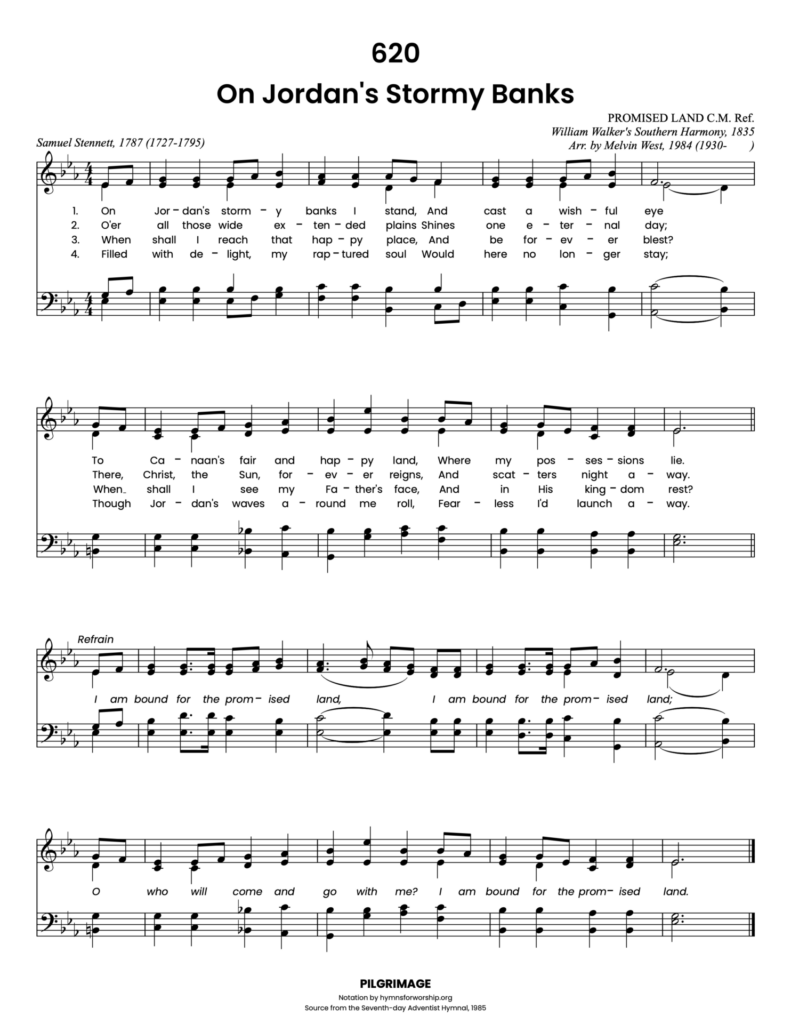
Get the hymn sheet in other keys here
For Worship Leaders
Make each hymn more meaningful with these helpful tools: Short, ready-to-use hymn introductions for church bulletins, multiple ways to introduce a hymn based on your worship theme and in-depth history and insights to enrich your song service.
📖 Reference: Feel free to share but please cite hymnsforworship.org when reproducing.
Introductions for Sabbath School Song Service (based on specific lesson quarterlies):
The first printing of this hymn was in John Rippon’s Selection of Hymns, London, 1787, under the heading “Heaven Anticipated.” The original had eight four-line stanzas. The refrain was added much later.
This figure of crossing the swelling, stormy river of Jordan before death and entering the heavenly Canaan to enjoy eternal life is not strictly biblical. It is a parallel to the time when the Israelites in Joshua’s time came to cross the Jordan River and found the banks flooded (see Joshua 3). The Lord caused the waters to cease so that the Israelites could pass over into Canaan’s land. Another incident associated with the Jordan and with death and eternal life concerns the translation of the prophet Elijah. He was crossing in the other direction, from Jericho eastward. Again a miracle was performed, for Elijah smote the waters with his mantle and he and Elisha went over on dry ground (2 Kings 2:8). In neither case was there a struggle against Jordan’s waves; we owe this figure to John Bunyan’s usage in Pilgrim’s Progress, when all the trumpets sounded for Christian from the other side as he made a triumphal crossing of the watery barrier between him and the Delectable Country.
John Rippon (1751-1836) was born at Tiverton, Devon, England, and prepared for the ministry at Baptist College, Bristol. He was the pastor of Carter Lane Baptist Church in London for 63 years! His most significant contribution to hymnody was a collection of hymns he put together in 1787, A Selection of Hymns From the Best Authors, Intended as an Appendix to Dr. Watts’s Psalms and Hymns. Several editions of this work were published until it eventually contained some 1,170 hymns in 100 different meters.
Samuel Stennett, born at Exeter, England, in 1727, was also a Baptist minister. He succeeded his father as pastor of the Seventh Day Baptist Church in Little Wild Street, London, in 1758, and served there until his death. Holding a prominent position among the “dissenting” ministers of London, he was respected by the statesmen of his time for his stand on religious liberty, a tenet strongly held by Baptists, who were considered heretics by the established Church of England. He was a personal friend of King George III, and not only preached regularly on seventh-day Sabbaths, but also for the other Baptists on Sundays. His published works include sermons, pamphlets, and 38 hymns in Rippon’s book. In 1763 he was granted an honorary D.D. degree by the University of Aberdeen, Scotland. He died in London August 25, 1795.
It is undoubtedly the delightful music of PROMISED LAND that has made this hymn so popular since it first appeared in William Walker’s Southern Harmony, 1835, where credit is given to Miss M. Durham. Nothing about her is known. William “Singing Billy” Walker (1809-1875) was a Baptist layman and singing-school teacher of South Carolina, who wrote some 25 tunes for his successful book, of which 600,000 copies were sold in 30 years. An all-day “sing” that started in 1884, using this book, is still carried on in Benton, Kentucky, every fourth Sunday in May.
Originally PROMISED LAND was in F sharp minor. Rigdon M. McIntosh, onetime head of the Music Department of Vanderbilt University and music editor of the Methodist Episcopal Church, South, publishing house, changed it to F major. The SDAH arrangement is by Melvin West (1930-; see Biographies).
📖 Reference: Companion to the Seventh-day Adventist Hymnal by Wayne Hooper and Edward E. White. Review and Herald Publishing Association, 1988.
Stanza:
1 – Joshua 3:15
2 – Revelation 21:22
3 – Revelation 22:4
R – Revelation 15:3

Text
1
On Jordan’s stormy banks I stand,
And cast a wishful eye
To Canaan’s fair and happy land,
Where my possessions lie.
I am bound for the promised land,
I am bound for the promised land;
O who will come and go with me?
I am bound for the promised land.
2
O’er all those wide extended plains
Shines one eternal day;
There, Christ, the Sun, for ever reigns,
And scatters night away.
I am bound for the promised land,
I am bound for the promised land;
O who will come and go with me?
I am bound for the promised land.
3
When shall I reach that happy place,
And be forever blest?
When shall I see my Father’s face,
And in His kingdom rest?
I am bound for the promised land,
I am bound for the promised land;
O who will come and go with me?
I am bound for the promised land.
4
Filled with delight, my raptured soul
Would here no longer stay;
Though Jordan’s waves around me roll,
Fearless I’d launch away.
I am bound for the promised land,
I am bound for the promised land;
O who will come and go with me?
I am bound for the promised land.

Hymn Info
Biblical Reference
(a) Jos 3:15 (b) Rev 21:22 (c) Rev 22:4 (r) Rev 15:3
Author
Samuel Stennett (1727-1795)
Year Published
1787
Copyright
Arrangement copyright 1984 by Melvin West
Hymn Tune
PROMISED LAND
Metrical Number
C.M.Ref.
Tune Source
William Walker’s Southern Harmony, 1835
Arranged
Melvin West, 1984 (1930-)
Theme
PILGRIMAGE
Watch
Explore more hymns: