
JESUS CHRIST >> RESURRECTION & ASCENSION
SDAH 171
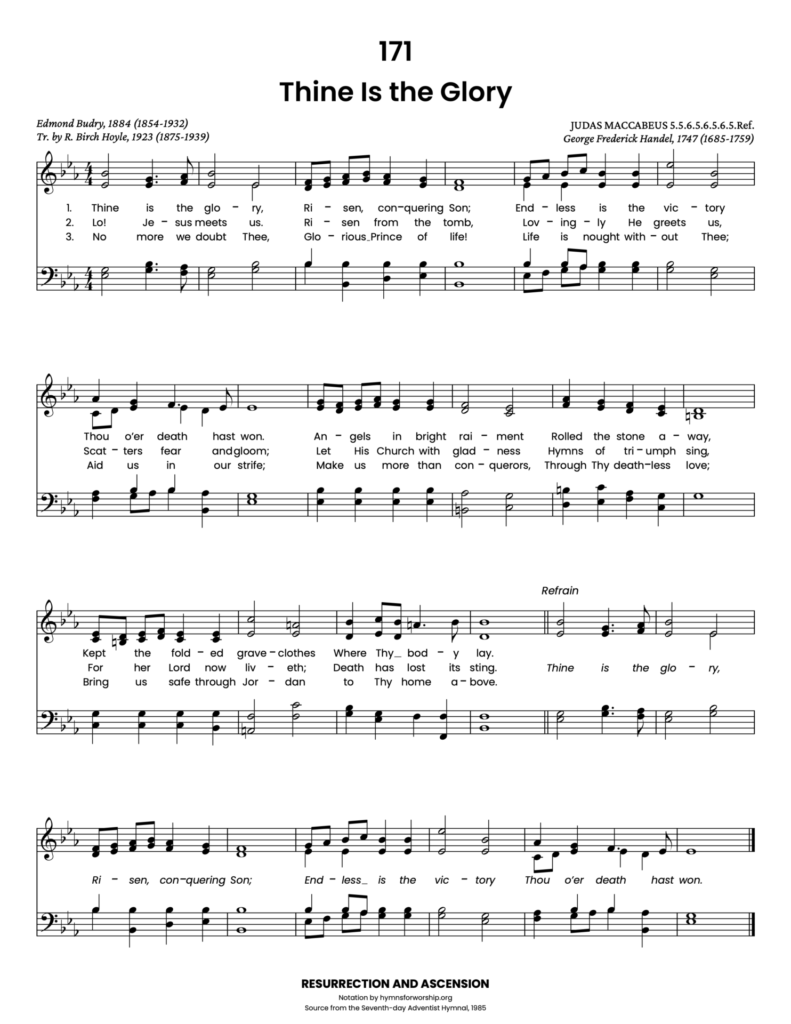
Thine is the glory, Risen, conquering Son;
Endless is the victory thou o’er death hast won.
Angels in bright raiment rolled the stone away,
Kept the folded grave-clothes where Thy body lay.
Get the hymn sheet in other keys here
For Worship Leaders
Make each hymn more meaningful with these helpful tools: Short, ready-to-use hymn introductions for church bulletins, multiple ways to introduce a hymn based on your worship theme and in-depth history and insights to enrich your song service.
Hymn Spotlight: Thine Is the Glory
First written in French by Edmond Budry in 1884, this hymn celebrates Christ’s resurrection with triumphant praise. The English version, translated by Richard Hoyle, quickly gained popularity and was sung at the first World Council of Churches in 1948. Set to Handel’s stirring “See, the Conquering Hero Comes,” it resonates with confidence in Christ’s victory over death. The hymn draws on the post-resurrection appearances of Jesus and the joy of His living presence. It’s a powerful reminder that our risen Lord walks with us still. Let us sing it boldly as we rejoice in the assurance that “death hath lost its sting.”
📖 Reference: Feel free to share but please cite hymnsforworship.org when reproducing.
Introductions for Sabbath School Song Service (based on specific lesson quarterlies):
The original of this hymn, in French, “A toi la gloire” (To Thee the Glory), dated 1884, was first published in the YMCA Hymn Book, Lausanne, Switzerland, 1904. Hoyle’s 1923 translation into English was included in Cantate Domino (the hymnal of the World’s Student Christian Federation), 1925, and was the favorite hymn at the 1948 assembly of the World Council of Churches in Amsterdam.
Edmond Louis Budry was born August 30, 1854, at Vevey, Switzerland, and educated at Lausanne to be a minister of the National Reformed Church. For eight years he was pastor at Cully before going to the Free Church at Vevey, where he ministered for 35 years. During this time he wrote many original hymns and translated others from Latin, German, and English into French. More than 60 of his hymns were used in various French hymnals. He died November 12, 1932.
The translator, Richard Birch Hoyle, was born March 8, 1875, in Cloughfold, Lancashire, England, into a Methodist home. He was educated at Regent’s Park College, London, and ordained a Baptist minister. For 20 years he served various churches, then edited the YMCA paper Red Triangle for five years. A sojourn of two years, 1934 to 1936, found him teaching systematic theology at Western Theological Seminary, Pittsburgh, Pennsylvania, after which he returned to a pastorate in Kingston-on-Thames, Surrey. He contributed “The Holy Spirit” to The Encyclopaedia of Religion and Ethics. He died at Wimbledon, Surrey, on December 14, 1939.
JUDAS MACCABEUS was first composed by Handel (1685–1759; see SDAH 125) for his oratorio Joshua, 1747, but was taken for his Judas Maccabeus in 1751. He wrote this oratorio, based on the life of the great Jewish hero of that name, at the request of Frederick, prince of Wales, who wanted something grand to celebrate the victory of his brother, the duke of Cumberland, at Culloden, Invernessshire, in 1746. The tune was made for “See the Conquering Hero Comes,” and has been adapted for “Thine Is the Glory.” The original French and the English translation were written with this tune in mind.
Stanza:
1 – Matthew 28:2
John 20:7
2 – Matthew 28:9
1 Corinthians 15:55
3 – Romans 8:37

Text
1
Thine is the glory, Risen, conquering Son;
Endless is the victory Thou o’er death hast won.
Angels in bright raiment rolled the stone away,
Kept the folded grave-clothes where Thy body lay.
Refrain :
Thine is the glory,
Risen, conquering Son;
Endless is the victory
Thou o’er death hast won.
2
Lo! Jesus meets us, risen from the tomb,
Lovingly He greets us, scatters fear and gloom;
Let His Church with gladness hymns of triumph sing,
For her Lord now liveth; death has lost its sting.
3
No more we doubt Thee, glorious Prince of life!
Life is nought without Thee; aid us in our strife;
Make us more than conquerors through Thy deathless love
Bring us safe through Jordan to Thy home above.

Hymn Info
Biblical Reference
(a) Matt 28:2; John 20:7 (b) Matt 28:9; 1 Cor 15:55 (c) Rom 8:37
Author
Edmond Budry (1854-1932)
Translator
R. Birch Hoyle, 1923 (1875-1939)
Copyright
Words from Cantate Domino. Copyright by World Student Christian Federation. Used by permission.
Hymn Tune
JUDAS MACCABEUS
Metrical Number
5.5.6.5.6.5.6.5.Ref.
Composer
George Friderick Handel (1685-1759)
Arranged
Leisentritt’s Gesangbuch, 1584
Year Composed
1747
Theme
RESURRECTION AND ASCENSION
Recommended Reading
The general idea when it comes to hymns is that there is a close bond between the author and the composer. That the author writes a hymn and the composer invents a tune to suit it, and then provides the harmony to accompany the tune. However, such wasn’t always the case.
Many hymns actually worked vice versa wherein authors would write verses according to existing tunes. Hundreds of hymns are sung from borrowed tunes, such as secular songs, chants, and even classical works. That being said, I went ahead and researched which hymns in the SDA Hymnal were originally classical works.
Explore more hymns: