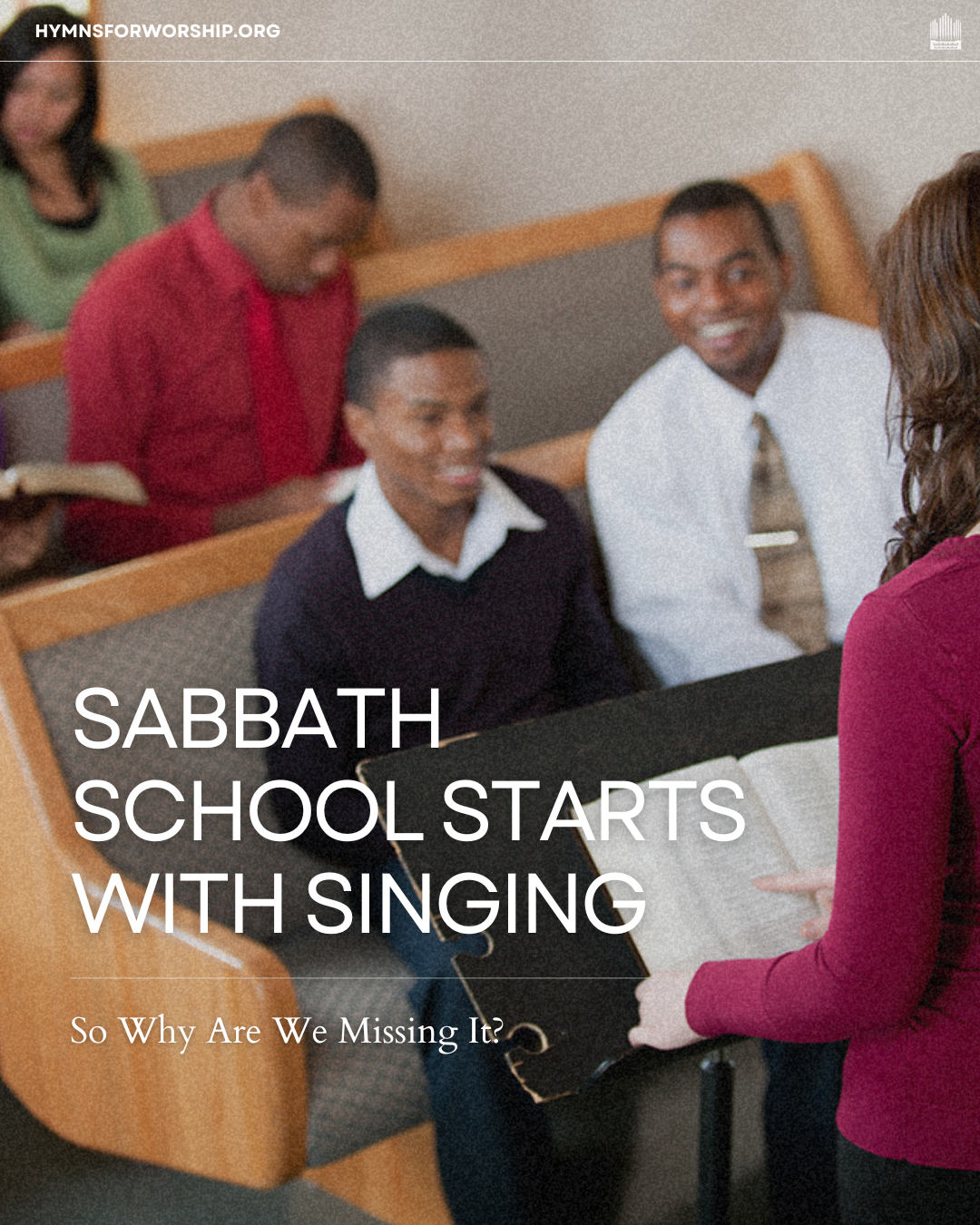
Sabbath School is often packed: mission stories, features, offerings, and of course the lesson study (which usually takes the biggest slice of time). But tucked right at the beginning is a small piece that’s easy to overlook—and even easier to miss if we walk in late:
the song service.
And that’s unfortunate, because Sabbath School doesn’t just begin with singing… it’s meant to begin with singing.
How music is usually incorporated in Sabbath School
In most churches, music shows up in two main ways:
- Song service – the congregation singing hymns together to open Sabbath School
- Special music items – a soloist, small group, or instrumentalist placed between spoken parts (welcome, prayer, remarks) to add variety and give members a chance to offer their gifts to God
Both can be meaningful. But they are not equal in what they ask of the church.
Which one requires the church to actively participate?
The song service.
Special music is offered to the congregation. But congregational singing is offered by the congregation—together, as one body.
When we consistently arrive after the opening songs, we aren’t just missing “the warm-up.” We’re missing the one part of Sabbath School where everyone—young and old, trained and untrained—can participate at the same time in a shared act of worship.
The Scriptural foundation for congregational singing
The Bible doesn’t treat singing as a side feature. It consistently places praise in the congregation:
- Psalm 111:1 — “Praise ye the LORD. I will praise the LORD with my whole heart, in the assembly of the upright, and in the congregation.”
- Psalm 149:1 — “Praise ye the LORD. Sing unto the LORD a new song, and his praise in the congregation of saints.”
- Hebrews 2:12 — “…in the midst of the church will I sing praise unto thee.”
The early church also gathered to worship—to pray, learn, and praise God (see Acts 2:42–47; Acts 13:1–2). Praise wasn’t peripheral; it was part of how believers met with God together.
Yes, the most powerful praise is the life we live—obedience, humility, faithfulness. But when the church assembles, the most tangible expressions of collective worship are:
- the testimonies we share
- the prayers we offer
- and the songs we sing
And in Sabbath School, song service is often the clearest moment where the whole room can worship as one.
Ellen White says it plainly:
“The singing should not be done by a few only. All present should be encouraged to join in the song service.”—Letter 157, 1902 (Evangelism, p. 507)
So if congregational singing is meant for all present… what happens when half the congregation isn’t present yet?
Why we arrive late—and what it costs us
I understand why people drift in late. Some are coming from long commutes. Some are wrangling kids. Some are simply used to thinking, “The lesson study is what matters, so as long as I make it by then, I’m fine.”
But the cost is real:
- We start the day in rushed mode, not worship mode.
- We miss the moment where hearts can be gathered and softened.
- We lose the shared experience of one voice, one message, one body.
- We unintentionally teach our children and new believers that singing is optional—when Scripture treats it as essential.
If Sabbath School starts with singing, lateness quietly turns the opening worship into background noise.
A gentle word about special music items
Special music can bless the church. But it should be included thoughtfully and chosen judiciously, not used to fill gaps. Here are a few cautions worth remembering—especially if special items begin to replace congregational participation.
1) Special music can easily drift into performance
As one writer put it:
“A solo is sometimes very effective; so also is a quartet. But no one wants either as a regular diet… there is a temptation to sing for show…” — R. L. Whiteside, Reflections, p. 372
When singing becomes “for show,” worship becomes harder for the congregation to enter. Even unintentionally, the atmosphere shifts from participation to observation.
Ellen White also warned against “theatrical display,” noting how outward show can water down the spiritual message and reduce its impact.
2) Too much solo/small-group singing can make worship feel like a concert
When the congregation has little to do but watch, they slowly become spectators instead of worshippers.
A helpful principle is this:
The congregation is the primary choir.
Musicians are meant to aid the worship of the people—not replace it.
As McClintock and Strong observed:
“…the most ancient and general practice of the Church was for the whole assembly to unite with one heart and voice in celebrating the praises of God…” — Cyclopedia of Biblical, Theological and Ecclesiastical Literature, Vol. 8, p. 738
3) Character matters as much as skill
It’s unavoidable: when one person stands in front, attention centers on them. If the life doesn’t match the message, the result can become a distraction—or even a stumbling block.
Ellen White speaks to this clearly:
“Many are singing beautiful songs… but some do not do these things… they do not sing with the spirit and the understanding also…” — Evangelism, p. 508
This isn’t to discourage gifted singers—it’s to remind us that music ministry is spiritual work, not just musical work.
Achieving the balance
This is not a call to remove all special music. Some have been given a genuine gift to touch hearts through song and live faithfully before God. They should absolutely have a place in worship.
But the order matters:
- Congregational singing should remain primary.
- Special music should remain supportive, intentional, and spiritually appropriate.
- And the church should protect the opening song service as a real act of worship—not a prelude people can casually miss.
So… how do we stop missing it?
Here are simple, practical shifts that can restore what we’ve lost:
- Treat song service as the “true start.” Aim to be seated before the first hymn begins.
- Make it easier for families. If you’re a leader, consider starting with a familiar hymn, a clear number announcement, and a steady tempo—help people join quickly.
- Keep it congregational. Choose singable keys, familiar hymns, and avoid turning the opening into a mini concert.
- Build a culture of early worship. Leaders set the tone: if the platform treats song service as important, the church eventually will too.
Because Sabbath School doesn’t start when the discussion begins.
It starts when the church begins to sing.
Like this article? Share it!
Explore more hymns: