DOCTRINES >> SPIRITUAL GIFTS
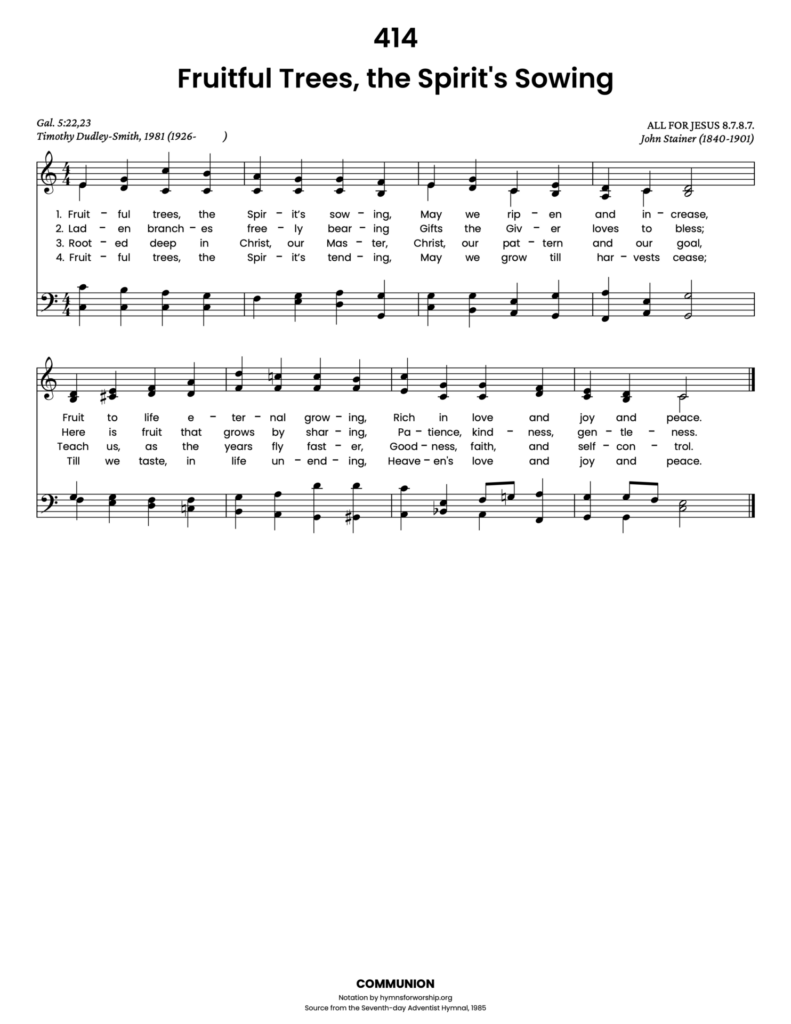
SDAH 414
Fruitful trees, the Spirit’s sowing,
May we ripen and increase,
Fruit to life eternal growing,
Rich in love and joy and peace.
Get the hymn sheet in other keys here
For Worship Leaders
Make each hymn more meaningful with these helpful tools: Short, ready-to-use hymn introductions for church bulletins, multiple ways to introduce a hymn based on your worship theme and in-depth history and insights to enrich your song service.
Hymn Spotlight: Fruitful Trees, The Spirit’s Sowing
Inspired by Galatians 5:22–23, Timothy Dudley-Smith uses the image of a tree to portray the Christian life rooted in Christ and nurtured by the Holy Spirit. Only when planted in the Saviour’s love can we bear the fruit of the Spirit—love, joy, peace, patience, kindness, goodness, faithfulness, gentleness, and self-control. Set to John Stainer’s warm and devotional tune ALL FOR JESUS, this hymn calls us to let our lives be living gardens where Christ’s character is seen and His Spirit’s work is made evident to the world.
📖 Reference: Feel free to share but please cite hymnsforworship.org when reproducing.
Introductions for Sabbath School Song Service (based on specific lesson quarterlies):
The text is based on Galatians 5:22, 23: “But the fruit of the Spirit is love, joy, peace, longsuffering, gentleness, goodness, faith, meekness, temperance: against such there is no law.” Timothy Dudley-Smith (1926- 😉 uses most skillfully the “fruit of the tree” imagery to show how all these good results in our lives can come only if the “tree” is rooted in Christ our Saviour and is tended by the Holy Spirit. He wrote it in August 1981 while on a holiday at the village of Ruan Minor in the Cornwall section of England. After reading the above Bible text, he copied into his manuscript book an analysis of these fruits, from a variety of English translations of the New Testament. Nearly all the versions agreed on “love,” “joy,” and “peace,” but there was divergence on the words for “longsuffering” and “meekness.” He decided to follow the Revised Standard Version and use the modern words for these fruits of the Spirit. His suggestion was to use Stainer’s tune.
ALL FOR JESUS is the final chorale from John Stainer’s Crucifixion, composed for the choir of Marylebone Parish Church (London) and first performed there in 1887. The tune name comes from the first words of the chorale.
Stainer was born in Southwark, London, June 1840. At the age of 7, already accomplished at the organ, he became a chorister at St. Paul’s Cathedral. During the nine years he was there, some of his compositions wers used in the service, and he often played the organ. At 14, he was appointed organist at St. Benedict and St. Peter’s, Paul’s Wharf, and at 16 was promoted to organist at St. Michael’s College, near Tenbury, Worcestershire. Entering Oxford in 1859 at age 19, he earned the M.A. and B.Mus. degrees while serving as organist for Magdalen College Chapel, and later for University College. In 1872 he succeeded Sir John Goss (see SDAH 4) as organist- choirmaster at St. Paul’s, and was recognized for his ability as a choral director and for setting a standard of excellence at St. Paul’s that was the finest in all England. Other posts held with distinction were: professor of organ, and then principal of the National Training School for Music (now the Royal College of Music); organist for the Royal Choral Society; government inspector of music in training schools; professor of music at the University of Oxford. Retiring in 1899, he was made master of the Musician’s Company. At age 48 he gave up his post at St. Paul’s because of failing eyesight, and in the same year was knighted by Queen Victoria. He died March 31, 1901, while on a visit to Italy.
He wrote more than 150 hymn tunes; many anthems; several cantatas; the books The Music of the Bible and A Treatise on Harmony; and textbooks on the organ, composition, and musical terms. Hymnbooks that were the beneficiary of his editorial knowledge were Church Chant Book, 1891; Church Hymnary, 1898; and several editions of Hymns Ancient and Modern.
Erik Routley (see SDAH 13) has characterized Stainer as a “matchless part-writer, contrapuntist and handler of the musical language; essentially a church musician, modest about his own work, admiring others more than himself.” One musical oddity he left us is the hymn tune PER RECTE ET RETRO, which can be sung and played backward without changing any notes; the melody is the same either way! It has been judged almost useless as a hymn tune, but a real feat of musical engineering. It can be found in Erik Routley’s The Music of Christian Hymns, 1981, and in the Episcopal Hymnal 1940 Companion.
📖 Reference: Companion to the Seventh-day Adventist Hymnal by Wayne Hooper and Edward E. White. Review and Herald Publishing Association, 1988.
Stanza:
Galatians 5:22, 23

Text
1
Fruitful trees, the Spirit’s sowing,
May we ripen and increase,
Fruit to life eternal growing,
Rich in love and joy and peace.
2
Laden branches freely bearing
Gifts the Giver loves to bless;
Here is fruit that grows by sharing,
Patience, kindness, gentleness.
3
Rooted deep in Christ, our Master,
Christ, our pattern and our goal,
Teach us, as the years fly faster,
Goodness, faith, and self control.
4
Fruitful trees, the Spirit’s tending,
May we grow till harvests cease;
Till we taste, in life unending,
Heaven’s love and joy and peace.

Hymn Info
Biblical Reference
Gal 5:22, 23
Author
Timothy Dudley-Smith (1926-)
Copyright
Words copyright 1984 by Hope Publishing Co., Carol Stream, IL 60188. All rights reserved. Used by permission.
Hymn Tune
ALL FOR JESUS
Metrical Number
8.7.8.7.
Composer
John Stainer (1840-1901)
Theme
SPIRITUAL GIFTS
Recommended Reading
The general idea when it comes to hymns is that there is a close bond between the author and the composer. That the author writes a hymn and the composer invents a tune to suit it, and then provides the harmony to accompany the tune. However, such wasn’t always the case.
Many hymns actually worked vice versa wherein authors would write verses according to existing tunes. Hundreds of hymns are sung from borrowed tunes, such as secular songs, chants, and even classical works. That being said, I went ahead and researched which hymns in the SDA Hymnal were originally classical works. Continue reading.
Explore more hymns: