JESUS CHRIST >> LOVE OF CHRIST FOR US
SDAH 188
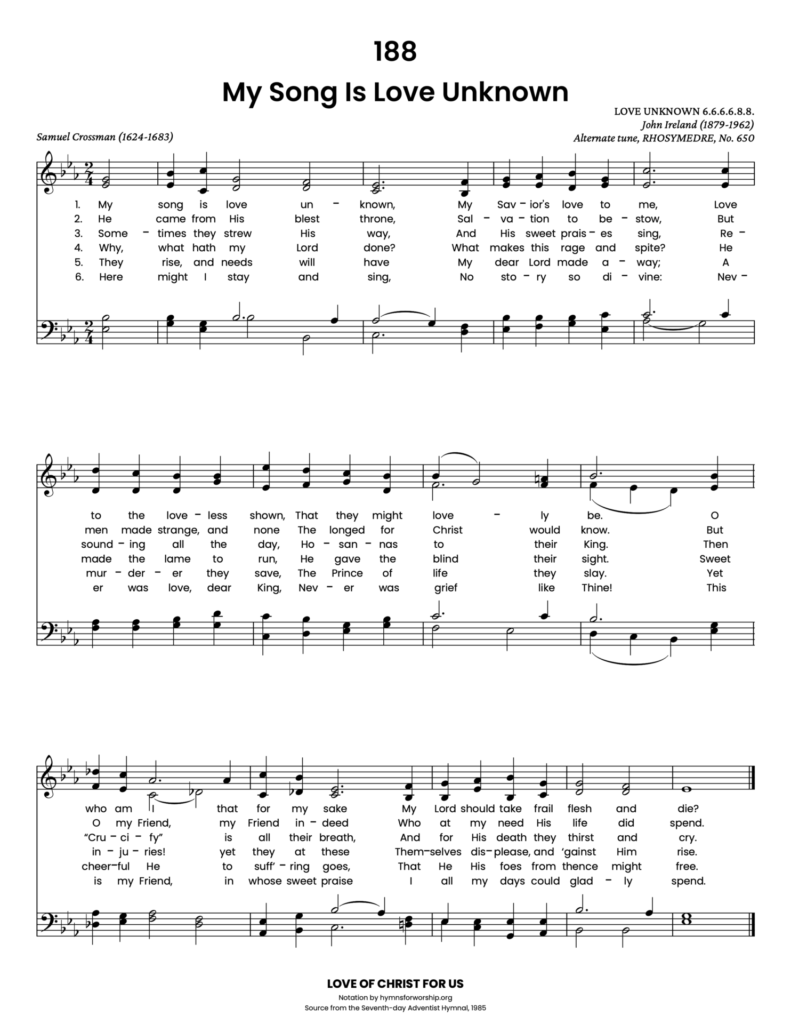
My song is love unknown,
My Savior’s love to me,
Love to the loveless shown,
That they might lovely be.
Get the hymn sheet in other keys here
For Worship Leaders
Make each hymn more meaningful with these helpful tools: Short, ready-to-use hymn introductions for church bulletins, multiple ways to introduce a hymn based on your worship theme and in-depth history and insights to enrich your song service.
Hymn Spotlight: My Song Is Love Unknown
Written in 1664 by Samuel Crossman, this reflective hymn meditates on Christ’s sacrificial love. It has been called one of the finest English hymns on the passion of Christ. Set to the hauntingly beautiful tune LOVE UNKNOWN by John Ireland, the hymn invites quiet contemplation. As we sing, may we marvel anew at the mystery of divine love poured out for us.
📖 Reference: Feel free to share but please cite hymnsforworship.org when reproducing.
Introductions for Sabbath School Song Service (based on specific lesson quarterlies):
Although Isaac Watts is known as the “Father of English Hymnody,” there were several seventeenth-century poets before him who wrote “hymns of human composure,” as opposed to the officially sanctioned metrical versions of the psalms. Crossman shares this distinction with George Herbert (SDAH 9) and Thomas Ken (SDAH 1), among others. This hymn, characterized by some as one of the finest in the English language on the subject of our Lord’s loving sacrifice for us, appeared as one of nine in Crossman’s The Young Man’s Meditation, or Some Few Sacred Poems Upon Selected Subjects, and Scriptures, 1664. Although they were in the psalm meters, they were probably meant to be read rather than sung, as evidenced by this motto printed with them: “A Verse may find him whom a Sermon flies.”
Born about 1624 at Bradfield Monachorum, Suffolk, England, Samuel Crossman was educated at Pembroke College, Cambridge. At his first church assignment, All Saints, Sudbury, he also was sympathetic with and ministered to a Puritan congregation. Puritans were known as “dissenters” from the established Anglican Church. As an attempt to bring peace in this controversy, the Savoy Conference of 1661 was called to revise the Book of Common Prayer to make it acceptable to both groups. When they were not able to come up with a compromise, the 1662 Act of Uniformity resulted in some 2,000 ministers losing their churches. Crossman was among them, but he later conformed and became a chaplain to the king in 1665. Two years later he was appointed to Bristol Cathedral, and just a few months before his death on February 4, 1684, was made its dean.
LOVE UNKNOWN gets its name from the text, and was composed for these words at the request of Geoffrey Shaw while Shaw was working on Songs of Praise, 1926. As an experiment, the editors of that book invited composers who were not primarily church musicians to submit original hymn tunes. In a letter to the London Daily Telegraph, April 5, 1950, a Donald Ford stated that Ireland composed the music in a quarter of an hour on a scrap of paper immediately after receiving Shaw’s request. Shaw and Ireland were having lunch. About halfway through their meal, Shaw handed his guest a slip of paper with verses on it and said, “I want a tune for this lovely poem by Samuel Crossman.” The composer took the paper, read the verses through several times, took out a pencil, and picked up the menu. After writing on the back of the menu for a few minutes, he handed it to Shaw with the casual remark, “Here is your tune.”
LOVE UNKNOWN was not quite what churchgoers and organists of 1926 expected of a new hymn tune, with its alternating six- and four-beat bars, and the unexpected chromatic note halfway through, which brands it as Ireland’s handiwork.
John Nicholson Ireland was born August 13, 1879, at Bowdon, Cheshire, England. He was educated at Leeds Grammar School and the Royal School of Music, studying under Stanford (see SDAH 32). For a time he was organist at St. Luke’s Chelsea, but for the most part his creative effort was channeled into composition. His works include “Piano Concerto in E-flat”; “These Things Shall Be,” for chorus and orchestra; “A London Overture”; and many solo songs. In 1932 Durham Cathedral bestowed on him an honorary D.Mus. He died at Washington, Sussex, on June 12, 1962.
Stanza:
1 – Romans 5:8
John 1:14
2 – John 1:11
3 – Mark 11:8, 9
Mark 15:13
4 – John 9
5 – Matthew 27:21
6 –Isaiah 53:3

Text
1
My song is love unknown,
My Savior’s love to me,
Love to the loveless shown,
That they might lovely be.
O who am I that for my sake
My Lord should take frail flesh and die?
2
He came from His blest throne,
Salvation to bestow,
But men made strange, and none
The longed for Christ would know.
But O my Friend, my Friend indeed
Who at my need His life did spend.
3
Sometimes they strew His way,
And His sweet praises sing,
Resounding all the day,
Hosannas to their King.
Then “Crucify” is all their breath,
And for His death they thirst and cry.
4
Why, what hath my Lord done?
What makes this rage and spite?
He made the lame to run,
He gave the blind their sight.
Sweet injuries! yet they at these
Themselves displease, and ‘gainst Him rise.
5
They rise, and needs will have
My dear Lord made away;
A murderer they save,
The Prince of life they slay.
Yet cheerful He to suff’ring goes,
That He His foes from thence might free.
6
Here might I stay and sing,
No story so divine:
Never was love, dear King,
Never was grief like Thine!
This is my Friend, in whose sweet praise
I all my days could gladly spend.

Hymn Info
Biblical Reference
(a) Rom 5:8; John 1:14 (b) John 1:11 (c) Mark 11:8,9;15:13 (d) John 9 (e) Matt 27:21 (f) Isa 53:3
Author
Samuel Crossman (1624-1683)
Copyright
Music by permission of executors of Mrs. N.K. Kirby
Hymn Tune
LOVE UNKNOWN
Metrical Number
6.6.6.6.8.8.
Composer
John Ireland (1879-1962)
Alternate Tune
RHOSYMEDRE, SDAH 650
Explore more hymns: