JESUS CHRIST >> LOVE OF CHRIST FOR US
SDAH 198
And can it be that I should gain
an interest in the Savior’s blood!
Died he for me? who caused his pain!
For me? who him to death pursued?
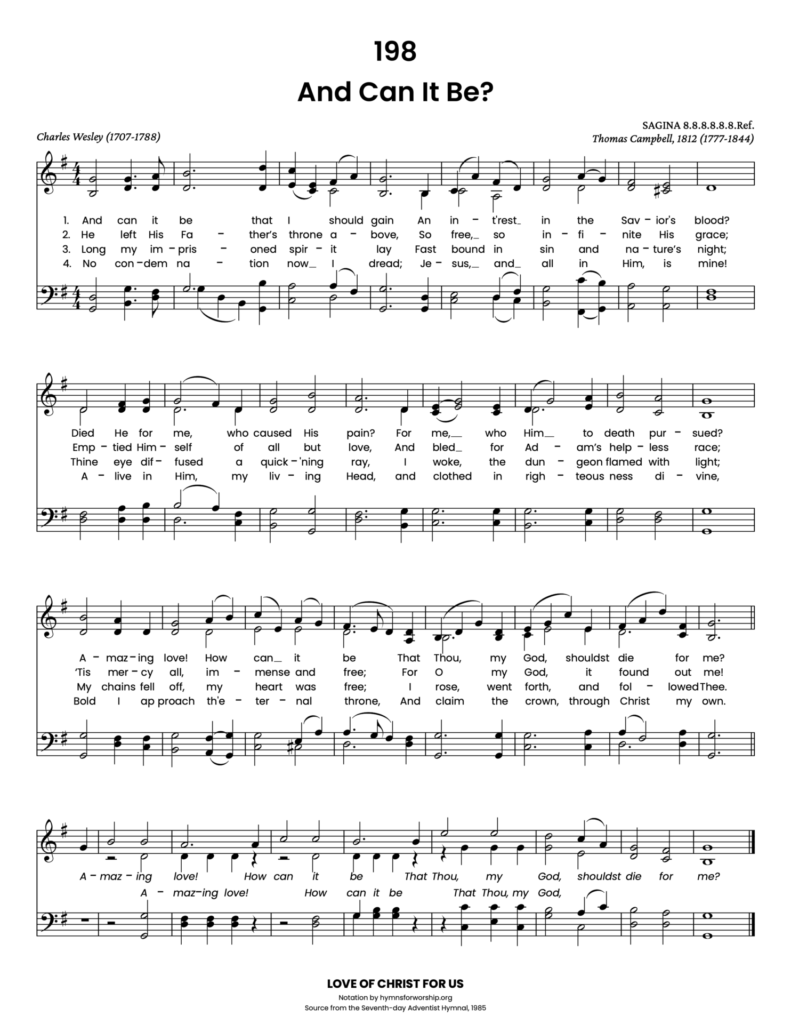
Get the hymn sheet in other keys here
For Worship Leaders
Make each hymn more meaningful with these helpful tools: Short, ready-to-use hymn introductions for church bulletins, multiple ways to introduce a hymn based on your worship theme and in-depth history and insights to enrich your song service.
Hymn Spotlight: And Can It Be?
Written shortly after Charles Wesley’s conversion, this powerful hymn celebrates the wonder of God’s grace and the believer’s release from sin. It invites us to stand in awe of a love “so free, so infinite.” The triumphant tune SAGINA carries the text with stirring strength. Let our hearts rise with the final line: “And claim the crown, through Christ my own.”
📖 Reference: Feel free to share but please cite hymnsforworship.org when reproducing.
Introductions for Sabbath School Song Service (based on specific lesson quarterlies):
Charles Wesley (1707–1788; see Biographies) wrote this soon after his conversion (May 1738), for it appeared under the title “Free Grace” in Psalms and Hymns, 1738, and also in Hymns and Sacred Poems, 1739. It is a profound study of the atonement by one who was deeply touched by the mystery and significance of the death of Christ. In his journal, May 21, 1738, he records: “At 9 I began a hymn on my conversion but was persuaded to break off for fear of pride. I prayed Christ to stand by me and finished the hymn.”
Both John and Charles Wesley often told in their journals how they made use of hymns in their evangelistic ministry. The August 22, 1739, entry in Charles’s journal tells how this hymn was used by the Holy Spirit in the conviction and conversion of a drunken servant of a Mr. Seward: “This morning the work upon poor Robin appeared to be God’s work. The words that made the first impression were [from stanza 2]:
’Tis mercy all, immense and free;
For, O my God, it found out me!
He now seems full of sorrow and joy and astonishment and love.”
Notice how the third stanza uses the poetic analogy of being freed by the grace of God from a prisonhouse of sin. Peter’s miraculous release from prison (Acts 12:7–9) is remembered by the phrases “dungeon flamed with light,” “my chains fell off,” and “I rose, went forth, and followed Thee.”
The tune SAGINA is the only survivor from The Bouquet, 1825, which was published by Thomas Campbell. The book had 23 of his original tunes, to all of which he gave botanical names. Sagina is a plant of the pink family that grows in low-lying marshy areas and provides fodder in springtime for grazing sheep. Thomas Campbell, of whom little is known, was born in Sheffield and is not the poet of the same name mentioned in Grove’s Dictionary of Music and Musicians.
Stanza:
1 – Galatians 2:20
2 – Philippians 2:7
3 – Acts 12:7, 9
4 – Romans 8:1
Romans 6:11
Hebrews 4:16

Text
1
And can it be that I should gain
An interest in the Savior’s blood!
Died He for me? who caused His pain!
For me? who Him to death pursued?
Amazing love! How can it be
That Thou, my God, shouldst die for me?
Refrain
Amazing love! How can it be
That Thou, my God, shouldst die for me?
2
He left His Father’s throne above
So free, so infinite His grace!;
Emptied Himself of all but love,
And bled for Adam’s helpless race.
‘Tis mercy all, immense and free,
For O my God, it found out me!
3
Long my imprisoned sprit lay,
Fast bound in sin and nature’s night;
Thine eye diffused a quickening ray;
I woke, the dungeon flamed with light;
My chains fell off, my heart was free,
I rose, went forth, and followed Thee.
4
No condemnation now I dread;
Jesus, and all in him, is mine;
Alive in Him, my living Head,
And clothed in righteousness divine,
Bold I approach th’ eternal throne,
And claim the crown, through Christ my own.

Hymn Info
Biblical Reference
(a) Gal 2:20 (b) Phil 2:7 (c) Acts 12:7, 9 (d) Rom 8:1; 6:11; Heb 4:16
Author
Charles Wesley (1707-1788)
Hymn Tune
SAGINA
Metrical Number
8.8.8.8.8.8.Ref.
Composer
Thomas Campbell (1777-1844)
Tune Source
1812
Theme
LOVE OF CHRIST FOR US
Watch
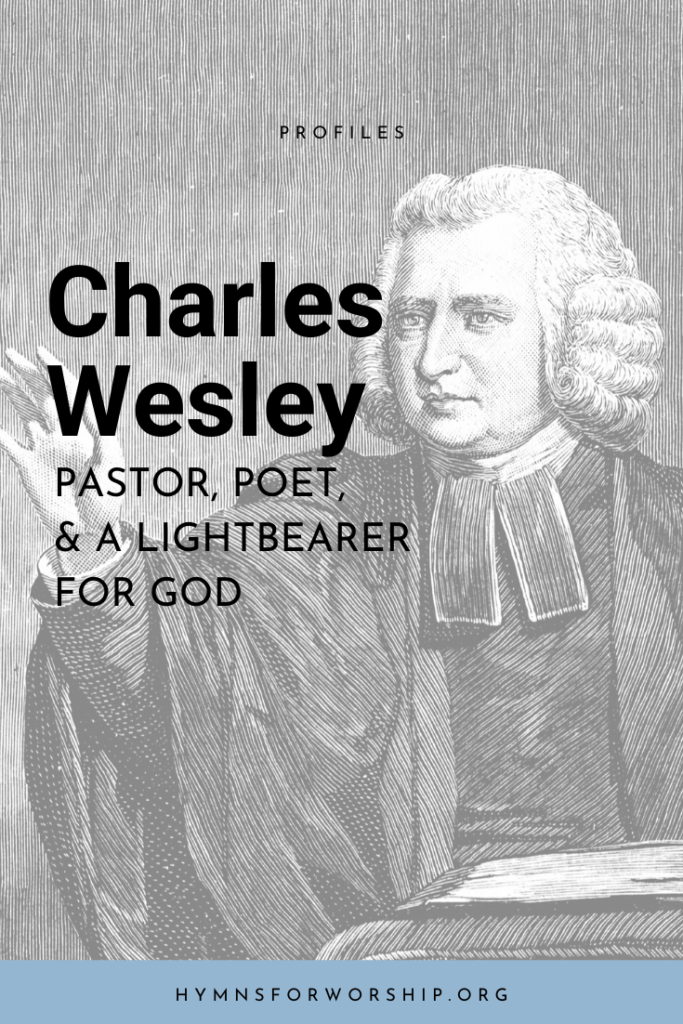
Charles was the other Wesley. Alongside his brother John who was considered the main guy behind the founding of Methodism, it was Charles’ hymns that pushed through the envelope of being “just another religion.” His lasting and well-known hymns have captivated Christians all around the world. Through his poetic lines, we are able to sing many hymns with such deep theology.
It was said that he wrote 8,989 hymns. That’s 10 lines of poetry every single day for 50 years. And we are privileged to have sung some of those hymns. Tell me, don’t these hymns ring a bell for you?
Explore more hymns: